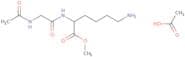
CAS 14752-92-2
:L-Lysin, N-acetylglycyl-, Methylester, Acetat (1:1)
Beschreibung:
L-Lysin, N-acetylglycyl-, Methylester, Acetat (1:1) ist eine chemische Verbindung, die eine Kombination aus Aminosäuren und funktionellen Gruppen aufweist. Sie wird aus Lysin, einer essentiellen Aminosäure, abgeleitet, die eine entscheidende Rolle bei der Proteinsynthese und verschiedenen Stoffwechselprozessen spielt. Das Vorhandensein der N-Acetylglycylgruppe zeigt an, dass das Lysin modifiziert wurde, was möglicherweise seine Löslichkeit und Bioverfügbarkeit verbessert. Die Methylesterfunktionalität deutet darauf hin, dass die Verbindung im Vergleich zu ihrer freien Säureform unterschiedliche Eigenschaften aufweisen kann, wie veränderte Reaktivität und Stabilität. Die Acetatkomponente impliziert, dass die Verbindung in Form eines Salzes vorliegt, was ihre Löslichkeit in wässrigen Lösungen beeinflussen kann. Diese Verbindung könnte von Interesse in der biochemischen Forschung, der Pharmazie und in ernährungsphysiologischen Anwendungen sein, aufgrund ihrer potenziellen Rollen in zellulären Funktionen und als Baustein für Peptide. Spezifische Anwendungen und biologische Aktivitäten würden jedoch von weiteren Studien und dem Kontext ihrer Verwendung abhängen.
Formel:C11H21N3O4·C2H4O2
InChl:InChI=1S/C11H21N3O4.C2H4O2/c1-8(15)13-7-10(16)14-9(11(17)18-2)5-3-4-6-12;1-2(3)4/h9H,3-7,12H2,1-2H3,(H,13,15)(H,14,16);1H3,(H,3,4)/t9-;/m0./s1
InChI Key:InChIKey=UNWQLIOZIACTGA-FVGYRXGTSA-N
SMILES:[C@H](NC(CNC(C)=O)=O)(CCCCN)C(OC)=O.C(C)(O)=O
Synonyme:- <span class="text-smallcaps">L</span>-Lysine, N-acetylglycyl-, methyl ester, acetate (1:1)
- <span class="text-smallcaps">L</span>-Lysine, N-acetylglycyl-, methyl ester, monoacetate
- <span class="text-smallcaps">L</span>-Lysine, N<sup>2</sup>-(N-acetylglycyl)-, methyl ester, monoacetate
- Ac-Gly-Lys-OMe
- Lysine, N<sup>2</sup>-(N-acetylglycyl)-, methyl ester, monoacetate, <span class="text-smallcaps">L</span>-
- Methyl 6-[(2-Acetamidoacetyl)Amino]-2-Amino-Hexanoate
- N-?-Acetylglycyl-L-lysine methyl ester acetate
- N-Acetyl-Gly-Lys Methyl Ester Acetate Salt
- N-Acetylglycyl-<span class="text-smallcaps">L</span>-lysine methyl ester acetate
- L-Lysine, N2-(N-acetylglycyl)-, methyl ester, monoacetate
- Lysine, N2-(N-acetylglycyl)-, methyl ester, monoacetate, L-
- L-Lysine, N-acetylglycyl-, methyl ester, acetate (1:1)
- Weitere Synonyme anzeigen
Sortieren nach
Reinheit (%)
0
100
|
0
|
50
|
90
|
95
|
100
3 Produkte.
Ac-Gly-Lys-OMe acetate
CAS:Kontrolliertes ProduktAc-Gly-Lys-OMe acetate salt is a reactive chemical compound that is used in the synthesis of peptides. This salt is synthesized by reacting glycine with lysine and formaldehyde. Ac-Gly-Lys-OMe acetate salt has been shown to have hemolytic activity and can be used as a synthetic substrate for kinetic studies. It has also been found to activate complement, which may be due to its disulfide bond formation. Ac-Gly-Lys-OMe acetate salt has been shown to inhibit fibrinogen and nitrosylation, which may result in thrombotic disorders.Formel:C11H21N3O4•C2H4O2Reinheit:Min. 95%Farbe und Form:PowderMolekulargewicht:319.35 g/molAc-Gly-Lys-OMe • AcOH [AGLME]
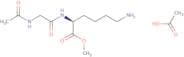
CAS:Ac-Gly-Lys-OMe • AcOH is a synthetic substrate that is used in enzymatic reactions. This product is a peptide that contains an amide bond and a disulfide bond. It has been shown to be inactive when exposed to human serum for up to 30 minutes. Ac-Gly-Lys-OMe • AcOH has been shown to have inhibitory effects on the activity of monoclonal antibodies as well as dodecyl, which belongs to the group of lipids found in blood plasma. The rate of this reaction increases with increasing temperature and pH, but decreases with increasing concentrations of AGLME or dodecanol.Formel:C11H21N3O4•CH3COOHReinheit:Min. 95%Molekulargewicht:319.35 g/molAc-Val-Asp-Val-Ala-Asp-AMC
CAS:Kontrolliertes ProduktAc-Val-Asp-Val-Ala-Asp-AMC is a research tool used to study the function of ion channels. It is an activator that binds to the receptor site on ATP sensitive potassium channels. Ac-Val-Asp-Val-Ala-Asp-AMC has been shown to inhibit calcium and sodium ion flux through ion channels, as well as high purity and good solubility. This peptide is useful for studying protein interactions, pharmacology, and life science research.
Formel:C33H44N6O12Reinheit:Min. 95%Molekulargewicht:716.74 g/mol

![Ac-Gly-Lys-OMe • AcOH [AGLME]](/_next/image/?url=https%3A%2Fstatic.cymitquimica.com%2Fproducts%2F3D%2Fthumb%2FSGK-3058.jpg&w=3840&q=75)