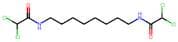
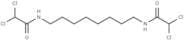
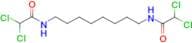
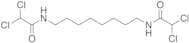
![N,N′-1,8-Octanediylbis[2,2-dichloroacetamide]](/_next/image/?url=https%3A%2Fstatic.cymitquimica.com%2Fcas-image%2Fthumb-webp%2F364962-n-n-octamethylenebis-dichloroacetamide.webp&w=3840&q=75)
CAS 1477-57-2
:N,N′-1,8-Octandiylbis[2,2-dichloracetamid]
Beschreibung:
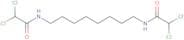
N,N′-1,8-Octandiylbis[2,2-dichloracetamid], mit der CAS-Nummer 1477-57-2, ist eine chemische Verbindung, die durch ihre Amid-Funktionalgruppen und eine lange Kohlenwasserstoffkette gekennzeichnet ist. Diese Substanz weist zwei 2,2-Dichloroacetamid-Einheiten auf, die durch einen Octandiyl (C8) Spacer verbunden sind, was zu ihren einzigartigen Eigenschaften beiträgt. Sie ist typischerweise ein Feststoff bei Raumtemperatur und ist bekannt für ihre Anwendungen in verschiedenen Bereichen, einschließlich der Landwirtschaft als Pestizid oder Herbizid, aufgrund ihrer Fähigkeit, biologische Prozesse in Zielorganismen zu stören. Die Anwesenheit von Chloratomen erhöht ihre Reaktivität und ihr Potenzial für biologische Aktivität. Darüber hinaus kann die lange Kohlenwasserstoffkette hydrophobe Eigenschaften verleihen, die ihre Löslichkeit und Wechselwirkung mit biologischen Membranen beeinflussen. Sicherheitsüberlegungen sind wichtig, wenn man mit dieser Verbindung umgeht, da sie Umwelt- und Gesundheitsrisiken darstellen kann, was angemessene Schutzmaßnahmen und Entsorgungsprotokolle erforderlich macht. Insgesamt exemplifiziert N,N′-1,8-Octandiylbis[2,2-dichloracetamid] eine Klasse von Chemikalien, die strukturelle Komplexität mit funktionaler Nützlichkeit kombiniert.
Formel:C12H20Cl4N2O2
InChl:InChI=1/C12H20Cl4N2O2/c13-9(14)11(19)17-7-5-3-1-2-4-6-8-18-12(20)10(15)16/h9-10H,1-8H2,(H,17,19)(H,18,20)
InChI Key:InChIKey=FAOMZVDZARKPFJ-UHFFFAOYSA-N
SMILES:N(C(C(Cl)Cl)=O)CCCCCCCCNC(C(Cl)Cl)=O
Synonyme:- 2,2-Dichloro-N-[8-[(2,2-dichloroacetyl)amino]octyl]acetamide
- Acetamide, N,N′-1,8-octanediylbis[2,2-dichloro-
- Acetamide, N,N′-octamethylenebis[2,2-dichloro-
- Bis-Diamine
- Fertilysin
- Fertilysine
- N,N'-octane-1,8-diylbis(2,2-dichloroacetamide)
- N,N-Bis(dichloroacetyl)-1,8-octamethylenediamine
- N,N′-1,8-Octanediylbis[2,2-dichloroacetamide]
- N,N′-Bis(dichloroacetyl)-1,8-diaminooctane
- N,N′-Octamethylenebis(2,2-dichloroacetamide)
- NSC 59354
- Win 18441
- Win 18446
- N,N-Octamethylenebis(dichloroacetamide)
- win18,446
- n,n-bis(dichloroacetyl)-1,8-octanediamine
- n,n’,1,8-octanediylbis(2,2-dichloro-acetamid
- win18441
- win18446
- N,N'-(Octane-1,8-diyl)bis(2,2-dichloroacetaMide)
- r-010-tk
- N,N''-OCTMETHYLENEBIS (DICHLOROACETAMIDE)
- n,n’-octamethylenebis(2,2-dichloroactamide)
- N,N'-(1,8-Octanediyl)bis(2,2-dichloroacetamide)
- N,N'-OCTA-METHYLENE-BIS[2,2-DICHLOROACETAMIDE]
- N,N'-Octamethylenebis(dichloroacetamide),97%
- n,n’-octamethylenebis(2,2-dichloro-acetamid
- bisdiamine
- Weitere Synonyme anzeigen
Sortieren nach
Reinheit (%)
0
100
|
0
|
50
|
90
|
95
|
100
7 Produkte.
Acetamide, N,N'-1,8-octanediylbis[2,2-dichloro-
CAS:Formel:C12H20Cl4N2O2Reinheit:95%Farbe und Form:SolidMolekulargewicht:366.1114N,N’-(Octane-1,8-diyl)Bis(2,2-Dichloroacetamide)
CAS:N,N’-(Octane-1,8-diyl)Bis(2,2-Dichloroacetamide)Reinheit:97%Molekulargewicht:366.11g/molWIN 18446
CAS:inhibitor of aldehyde dehydrogenase 1a2 (ALDH1a2)Formel:C12H20Cl4N2O2Reinheit:99.69%Farbe und Form:SolidMolekulargewicht:366.11N,N'-Octamethylenebis(dichloroacetamide)
CAS:Reinheit:96.0%Farbe und Form:SolidMolekulargewicht:366.1000061035156Win 18446
CAS:Kontrolliertes ProduktApplications Win 18446 was shown to inhibit the biosynthesis of retinoic acid from retinol in neonatal and adult murine testis and in the embryonic murine gonad.
References Hogarth, C.A., et al.: Biol. Reproduct., 84, 957 (2011);Formel:C12H20Cl4N2O2Farbe und Form:NeatMolekulargewicht:366.11WIN 18446
CAS:WIN 18446 is a contraceptive that belongs to the class of progestins. It has been shown to inhibit the proliferation of cardiac, bowel, and testicular mesenchymal cells in vitro. WIN 18446 also showed high resistance and low toxicity against cancer cell viability in experimental models. In addition, WIN 18446 has shown promising results as a potential treatment for autoimmune diseases such as systemic lupus erythematosus and rheumatoid arthritis. This drug has also been shown to have anti-inflammatory effects by inhibiting the activity of enzymes that cause inflammation, such as cyclooxygenase-2 (COX-2) and lipoxygenase (LOX). Clinical studies have shown that WIN 18446 can be used to treat diaphragmatic hernia in rats with no side effects on liver function or weight gain. WIN 18446 is not active against bacteria or viruses and does not affect the integrity of DNA.Formel:C12H20Cl4N2O2Reinheit:Min. 95%Farbe und Form:PowderMolekulargewicht:366.11 g/mol