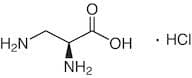
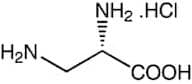
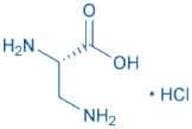
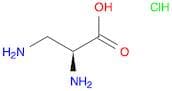
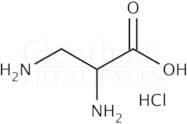
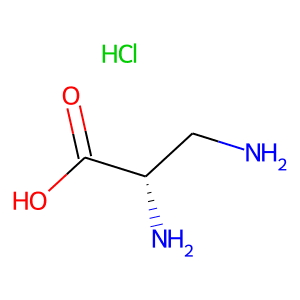
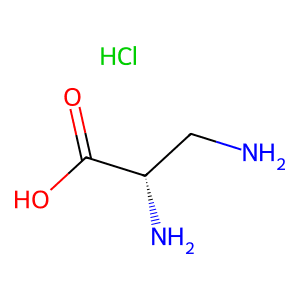
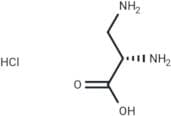
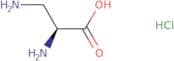
CAS 1482-97-9
:3-Amino-L-alanin-hydrochlorid
Beschreibung:
3-Amino-L-alanin-hydrochlorid, mit der CAS-Nummer 1482-97-9, ist ein Derivat der Aminosäure L-Alanin, das eine Aminogruppe an der Position 3 der Kohlenstoffkette aufweist. Diese Verbindung tritt typischerweise als weißes bis off-white kristallines Pulver auf und ist in Wasser löslich, was eine Eigenschaft vieler Aminosäuren und ihrer Derivate ist. Sie zeigt basische Eigenschaften aufgrund der Anwesenheit der Aminogruppe, die es ihr ermöglicht, an verschiedenen biochemischen Reaktionen teilzunehmen. Als Hydrochloridsalz wird sie durch die Anwesenheit von Salzsäure stabilisiert, was ihre Löslichkeit und Stabilität in wässrigen Lösungen erhöht. 3-Amino-L-Alanin ist von Interesse in der biochemischen Forschung und könnte potenzielle Anwendungen im Studium von Stoffwechselwegen, der Proteinsynthese und als Baustein in der Peptidsynthese haben. Ihre Rolle in biologischen Systemen und potenzielle therapeutische Anwendungen sind Bereiche laufender Untersuchungen, insbesondere in Bezug auf ihre strukturellen und funktionalen Eigenschaften in Proteinen und Enzymen.
Formel:C3H9ClN2O2
InChl:InChI=1/C3H8N2O2.ClH/c4-1-2(5)3(6)7;/h2H,1,4-5H2,(H,6,7);1H/t2-;/m0./s1
SMILES:C([C@@H](C(=O)O)N)N.Cl
Synonyme:- alpha,beta-Diaminopropionic acid HCL
- 3-Amino-L-alanine monohydrochloride
- L-3-Aminoalanine hydrochloride
- L(+)-2,3-Diaminopropionic acid HCL
- L(+)-2,3-Diaminopropionic acid hydrochloride
- L-2,3-Diaminopropionic acid monohydrochloride
- 3-Aminoalanine Hydrochloride (1:1)
- 3-amino-D-alanine hydrochloride
- (S)-(+)-2,3-Diaminopropionic Acid HCL
- H-Dap-OH.HCl
- H-Dap-OH・HCl
Sortieren nach
Reinheit (%)
0
100
|
0
|
50
|
90
|
95
|
100
10 Produkte.
(S)-(+)-2,3-Diaminopropionic Acid Hydrochloride
CAS:Formel:C3H8N2O2·HClReinheit:>98.0%(T)(N)Farbe und Form:White to Light yellow powder to crystalMolekulargewicht:140.57(S)-2,3-Diaminopropionic acid monohydrochloride, 95%
CAS:This Thermo Scientific Chemicals brand product was originally part of the Alfa Aesar product portfolio. Some documentation and label information may refer to the legacy brand. The original Alfa Aesar product / item code or SKU reference has not changed as a part of the brand transition to Thermo SciFormel:C3H9ClN2O2Reinheit:95%Molekulargewicht:140.57H-Dap-OH · HCl
CAS:Dap salts are used as growth inhibitors for microorganisms. Dap derivatives occur in plants. The Nβ-oxalyl derivative of Dap (β-ODAP, BOAA) which is found in the seeds of the grass pea (Lathyrus sativus), is a strong neurotoxin, whereas the α-isomer is far less toxic.Formel:C3H8N2O2·HClReinheit:> 99%Farbe und Form:White PowderMolekulargewicht:140.573-Amino-L-alanine, HCl
CAS:Formel:C3H9ClN2O2Reinheit:98%Farbe und Form:SolidMolekulargewicht:140.5688L-2,3-Diaminopropanoic acid hydrochloride
CAS:L-2,3-Diaminopropanoic acid hydrochlorideFormel:C3H8N2O2·ClHReinheit:98%Farbe und Form: white to off-white solidMolekulargewicht:140.57g/mol2,3-Diaminopropionic acid hydrochloride
CAS:2,3-Diaminopropionic acid hydrochlorideReinheit:≥98%Molekulargewicht:140.57g/mol2,3-Diaminopropionic acid hydrochloride
CAS:2,3-Diaminopropionic acid hydrochloride (3-Amino-L-alanine hydrochloride) is a competitive cystathionase(CTH) inhibitor.Formel:C3H9ClN2O2Reinheit:98.77% - 99.77%Farbe und Form:White Crystalline PowderMolekulargewicht:140.57(S)-2,3-Diaminopropanoic acid hydrochloride
CAS:Formel:C3H9ClN2O2Reinheit:97%Farbe und Form:SolidMolekulargewicht:140.57L(+)-2,3-Diaminopropionic acid HCl
CAS:L(+)-2,3-Diaminopropionic acid HCl is a chiral modifier that is used in the separation of organic compounds. It has been shown to selectively interact with borate, sulfate, and hydroxyapatite. This interaction changes the physical properties of these substances by modifying their surface charge or adsorption capacity. L(+)-2,3-Diaminopropionic acid HCl has also been shown to be useful in diastereoselective reactions. The technique of elution can be used to isolate specific compounds from mixtures using this compound as a modifier. Hydrogen bonding groups and moieties on the functional group are important factors in the specificity of this interaction.END>>Formel:C3H8N2O2·HClReinheit:Min. 95%Farbe und Form:White PowderMolekulargewicht:140.57 g/mol