CAS 1483-01-8
:L(+)-Homoarginin-Hydrochlorid
Beschreibung:
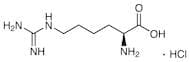
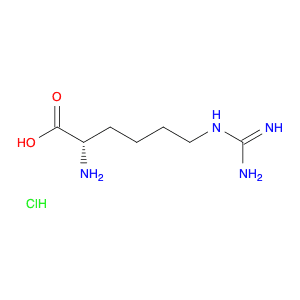
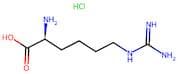
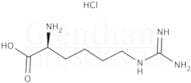
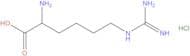
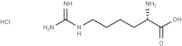
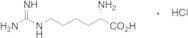
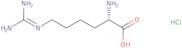
L(+)-Homoarginin-Hydrochlorid ist eine chemische Verbindung, die als Derivat der Aminosäure Arginin charakterisiert ist. Es handelt sich um ein weißes bis off-white kristallines Pulver, das in Wasser löslich ist, was es für verschiedene biochemische Anwendungen geeignet macht. Die Verbindung ist bekannt für ihre Rolle in biologischen Systemen, insbesondere bei der Synthese von Proteinen und als Vorläufer für die Produktion von Stickstoffmonoxid, das entscheidend für die Gefäßgesundheit ist. L(+)-Homoarginin wird häufig auf seine potenziellen Implikationen in der kardiovaskulären Forschung und seine Assoziation mit verschiedenen Gesundheitszuständen untersucht. Die Hydrochlorid-Form zeigt an, dass es mit Salzsäure kombiniert ist, was seine Löslichkeit und Stabilität in Lösung verbessert. Wie viele Aminosäuren und deren Derivate kann es aufgrund der Anwesenheit von Aminogruppen basische Eigenschaften aufweisen. Sicherheitsdatenblätter empfehlen Standardvorkehrungen beim Umgang mit der Substanz, wie bei jedem chemischen Stoff, um Risiken im Zusammenhang mit der Exposition zu mindern. Insgesamt dient L(+)-Homoarginin-Hydrochlorid als eine wichtige Verbindung sowohl in der Forschung als auch in potenziellen therapeutischen Anwendungen.
Formel:C7H17ClN4O2
InChl:InChI=1/C7H16N4O2.ClH/c8-5(6(12)13)3-1-2-4-11-7(9)10;/h5H,1-4,8H2,(H,12,13)(H4,9,10,11);1H
InChI Key:InChIKey=YMKBVNVCKUYUDM-JEDNCBNOSA-N
SMILES:C([C@@H](C(O)=O)N)CCCNC(=N)N.Cl
Synonyme:- (S)-2-Amino-6-Guanidinohexanoic Acid Hydrochloride
- <span class="text-smallcaps">L</span>-Homoarginine hydrochloride
- <span class="text-smallcaps">L</span>-Lysine, N<sup>6</sup>-(aminoiminomethyl)-, hydrochloride (1:1)
- <span class="text-smallcaps">L</span>-Lysine, N<sup>6</sup>-(aminoiminomethyl)-, monohydrochloride
- Fmoc-HoArg-OH・HCl
- L-Homoarginine Monohydrochloride
- L-homoarginine hcl
- Lysine, N<sup>6</sup>-amidino-, monohydrochloride, <span class="text-smallcaps">L</span>-
- NSC 145416
- N~6~-(diaminomethylidene)-L-lysine
- N~6~-(diaminomethylidene)-L-lysine hydrochloride
- N~6~-(diaminomethylidene)lysine
- N~6~-(diaminomethylidene)lysine hydrochloride
- L-Homoarginine Hydrochloride
- Lysine, N6-amidino-, monohydrochloride, L-
- L(+)-Homoarginine Hydrochloride
- L-Lysine, N6-(aminoiminomethyl)-, hydrochloride (1:1)
- L-Homoarginine hydrochloride
- L-Lysine, N6-(aminoiminomethyl)-, monohydrochloride
- L-Homoarginine hydrochloride, (S)-2-Amino-6-guanidinohexanoic acid hydrochloride
- H-HAR-OH HCL
- L-Homoarginine hydrochloride, 98+%
- 2-Amino-6-(diaminomethylideneamino)hexanoic acid hydrochloride
- 2-AMINO-6-GUANIDINOHEXANOIC ACID HYDROCHLORIDE
- HOMOARGININE HYDROCHLORIDE
- H-L-HArg-OH*HCl
- H-L-HOARG-OH HCL
- L-(S)-2-AMINO-6-GUANIDINOHEXANOIC ACID HYDROCHLORIDE
- 2-AMINO-6-GUANIDINO-HEXANOIC ACID, HCL
- L-HomoarginineHydrochloride>99%
- H-HOMOARG-OH HYDROCHLORIDE
- H-HOMOARG-OH HCL
- Weitere Synonyme anzeigen
Sortieren nach
Reinheit (%)
0
100
|
0
|
50
|
90
|
95
|
100
14 Produkte.
L-Homoarginine Hydrochloride
CAS:Formel:C7H16N4O2·HClReinheit:>97.0%(T)Farbe und Form:White to Almost white powder to crystalMolekulargewicht:224.69L-Homoarginine hydrochloride, 98%
CAS:An inhibitor of alkaline phosphatase isoenzymes. It is also an inhibitor of cellular transport of arginine by a sodium-independent high affinity y+ transporter. The substitution of homoarginine for arginine or lysine renders proteins resistant to proteolysis by trypsin. Arginine residues are often lFormel:C7H17ClN4O2Reinheit:98%Farbe und Form:Crystals or powder or crystalline powder or granules, WhiteMolekulargewicht:224.69(S)-2-Amino-6-Guanidinohexanoic Acid Hydrochloride
CAS:(S)-2-Amino-6-Guanidinohexanoic Acid HydrochlorideReinheit:98%Molekulargewicht:224.69g/molL-Homoarginine hydrochloride
CAS:Formel:C7H16N4O2·HClReinheit:(Titration) ≥ 97.5% (dry basis)Farbe und Form:White to off-white crystalline powderMolekulargewicht:224.69H-HomoArg-OH.HCl
CAS:H-HomoArg-OH.HCl (L-Homoarginine hydrochloride) is a specific inhibitor of liver-type alkaline phosphatase.Formel:C7H17ClN4O2Reinheit:98.88%Farbe und Form:White PowderMolekulargewicht:224.69L-Homoarginine Hydrochloride
CAS:Kontrolliertes ProduktStability Moisture Sensitive
Applications An inhibitor of alkaline phosphatase isoenzymes. An analog of Homoarginine (H585000).
References Muth, W., et al.: J. Biol. Chem., 249, 7463 (1974), Hanukoglu, I., et al.: Eur. J. Biochem., 180, 479 (1989), Khaw, L., et al.: J. Bacteriol. 180, 809 (1998), Gallagher, D., et al.: J. Mol. Biol., 342, 119 (2004),Formel:C7H16N4O2·ClHFarbe und Form:NeatMolekulargewicht:224.69H-HomoArg-OH HCl
CAS:M03208 - H-HomoArg-OH HCl
Formel:C7H17ClN4O2Reinheit:≥98%Farbe und Form:SolidMolekulargewicht:224.69L-Homoarginine HCl
CAS:L-Homoarginine is a non-essential amino acid that plays an important role in protein synthesis. L-Homoarginine is synthesized from lysine by the enzyme arginase, and can be converted to nitric oxide by nitric oxide synthase. It has been shown to ameliorate insulin resistance and improve glucose tolerance in animal models. L-Homoarginine also has anti-cancer effects, as it inhibits the phosphatase activity of cancer cells and prevents the production of basic proteins in tumor cells. The anti-cancer effects of L-homoarginine have been demonstrated using monoclonal antibody against human placental alkaline phosphatase (hPLA2) or tissue culture cells containing hPLA2 respectively. L-Homoarginine HCl is a salt form of L-homoarginine that maintains its stability at pH 7.0, and therefore can be used for experiments requiringReinheit:Min. 95%