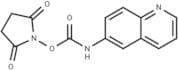
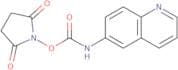
![2,5-Pyrrolidinedione, 1-[[(6-quinolinylamino)carbonyl]oxy]-](/_next/image/?url=https%3A%2Fstatic.cymitquimica.com%2Fcas-image%2Fthumb-webp%2F281215-6-aminoquinolyl-n-hydroxysuccinimidylcarbamate.webp&w=3840&q=75)
CAS 148757-94-2
:2,5-Pyrrolidindion, 1-[[(6-chinolinylamino)carbonyl]oxy]-
Beschreibung:
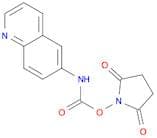
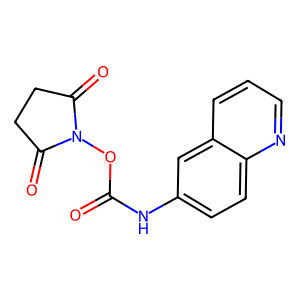
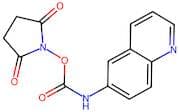
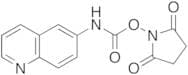
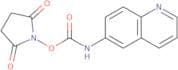
2,5-Pyrrolidindion, 1-[[(6-chinolinylamino)carbonyl]oxy]- ist eine chemische Verbindung, die durch ihre einzigartige Struktur gekennzeichnet ist, die einen Pyrrolidinring und eine Chinolinenheit umfasst. Das Vorhandensein der Pyrrolidinedionstruktur deutet darauf hin, dass sie Eigenschaften aufweisen könnte, die typisch für zyklische Imide sind, wie z.B. potenzielle Reaktivität in nucleophilen Additionsreaktionen. Die Chinolinenkomponente weist darauf hin, dass die Verbindung aromatische Eigenschaften besitzen könnte, die zu ihrer Stabilität und potenziellen biologischen Aktivität beitragen. Diese Verbindung könnte auch in organischen Lösungsmitteln löslich sein, was für ähnliche stickstoffhaltige Heterocyclen üblich ist. Ihre spezifischen funktionellen Gruppen, einschließlich der Carbonyl- und Aminogruppen, deuten auf ein Potenzial für Wasserstoffbrückenbindungen und Wechselwirkungen mit biologischen Zielen hin, was sie in der medizinischen Chemie von Interesse macht. Darüber hinaus ermöglicht die CAS-Nummer der Verbindung, 148757-94-2, eine präzise Identifizierung in chemischen Datenbanken, was die Forschung und Anwendung in verschiedenen Bereichen, einschließlich Pharmazie und Materialwissenschaften, erleichtert. Insgesamt implizieren die strukturellen Merkmale der Verbindung eine Vielzahl potenzieller Anwendungen, insbesondere in der Arzneimittelentwicklung und -synthese.
Formel:C14H11N3O4
InChl:InChI=1S/C14H11N3O4/c18-12-5-6-13(19)17(12)21-14(20)16-10-3-4-11-9(8-10)2-1-7-15-11/h1-4,7-8H,5-6H2,(H,16,20)
InChI Key:InChIKey=LINZYZMEBMKKIT-UHFFFAOYSA-N
SMILES:N(C(ON1C(=O)CCC1=O)=O)C2=CC3=C(C=C2)N=CC=C3
Synonyme:- 2,5-Dioxopyrrolidin-1-yl quinolin-6-ylcarbamate
- 6-Aminoquinolyl-N-hydroxysuccinimidyl carbamate
- AHC reagent
- AccQ.Fluor
- AccQ·Tag
- Carbamic acid, N-6-quinolinyl-, 2,5-dioxo-1-pyrrolidinyl ester
- 2,5-Pyrrolidinedione, 1-[[(6-quinolinylamino)carbonyl]oxy]-
- AQC
- Carbamic acid,N-6-quinolinyl-, 2,5-diox
- 6-AMinoquinolyl-N-hydroxysucciniMidyl CarbaMate 90%
- 6-Aminoquinoline-N-hydroxy-succinimidyl carbamate
- 2,5-DIOXOPYRROLIDIN-1-YL HYDROXYCARBAMATE COMPOUND WITH QUINOLIN-6-AMINE (1:1)
- 2,5-Dioxo-1-pyrrolidinyl 6-Quinolylcarbamate
- 6-Aminoquinoline N-succinimidyl ester
- Weitere Synonyme anzeigen
Sortieren nach
Reinheit (%)
0
100
|
0
|
50
|
90
|
95
|
100
11 Produkte.
Carbamic acid, N-6-quinolinyl-, 2,5-dioxo-1-pyrrolidinyl ester
CAS:Formel:C14H11N3O4Reinheit:95%Farbe und Form:SolidMolekulargewicht:285.25486-Aminoquinolyl-N-hydroxysuccinimidyl carbamate
CAS:6-Aminoquinolyl-N-hydroxysuccinimidyl carbamateFormel:C14H11N3O4Reinheit:95% (nmr) (Typical Value in Batch COA)Farbe und Form: yellow solidMolekulargewicht:285.25484g/molAQC
CAS:AQC: A reagent for HPLC-based fluorescence detection of amino acids and proteins at picomolar levels.Formel:C14H11N3O4Reinheit:99.57%Farbe und Form:SolidMolekulargewicht:285.256-Aminoquinoline N-succinimidyl ester
CAS:Formel:C14H11N3O4Reinheit:≥ 90%Farbe und Form:White to off-white or beige powderMolekulargewicht:285.256-Aminoquinolyl-N-hydroxysuccinimidyl Carbamate (90%)
CAS:Stability Moisture Sensitive
Applications 6-Aminoquinolyl-N-hydroxysuccinimidyl Carbamate is used as derivatization regent for detecting hydrogen cyanamide in fruit.
References Cohen, S., et al.: Anal. Biochem., 211, 279 (1993); Oreiro-Garcia, M., et al.: Biomed. Chromatogr., 19, 720 (2005); Pramanik, S., et al.: B. Environ. Contam. Tox., 82, 644 (2009);Formel:C14H11N3O4Reinheit:90%Farbe und Form:Light YellowMolekulargewicht:285.256-Aminoquinolyl-N-hydroxysuccinimidyl carbamate, particle size < 0.25 mm
CAS:6-Aminoquinolyl-N-hydroxysuccinimidylcarbamate reacts rapidly with amino acids to form stable urea derivatives. The use of fluorescence detection techniques allows quantification of amines at pmol levels. 6-Aminoquinolyl-N-hydroxysuccinimidylcarbamate was used in a study to derivatize glycated amino acids with the purpose of developing chromatographic assays for their quantification. Glycation of proteins initially gives rise to early glycation adducts, then progresses to advanced glycation end-products, which are markers for conditions such as diabetes, cataracts, uraemia and Alzheimer's disease. We also offer the product FA36291.Formel:C14H11N3O4Farbe und Form:PowderMolekulargewicht:285.25 g/mol6-Aminoquinolyl-N-hydroxysuccinimidylcarbamate
CAS:6-Aminoquinolyl-N-hydroxysuccinimidylcarbamate reacts rapidly with amino acids to form stable urea derivatives. The use of fluorescence detection techniques allows quantification of amines at pmol levels. 6-Aminoquinolyl-N-hydroxysuccinimidylcarbamate was used in a study to derivatize glycated amino acids with the purpose of developing chromatographic assays for their quantification. Glycation of proteins initially gives rise to early glycation adducts, then progresses to advanced glycation end-products, which are markers for conditions such as diabetes, cataracts, uraemia and Alzheimer's disease. We also offer the product FA172347 with a particle size < 0.25 mm.Formel:C14H11N3O4Reinheit:(Q-1H Nmr) Min 83%Farbe und Form:PowderMolekulargewicht:285.25 g/mol2,5-Dioxo-1-pyrrolidinyl 6-Quinolylcarbamate
CAS:Formel:C14H11N3O4Reinheit:≥95%Molekulargewicht:285.259