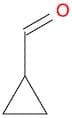
CAS 1489-69-6
:Cyclopropancarbaldehyd
Beschreibung:
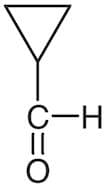
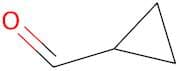
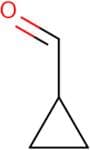
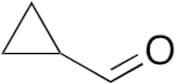
Cyclopropancarbaldehyd ist eine organische Verbindung, die durch ihre Cyclopropanringstruktur mit einer Carboxaldehydfunktion gekennzeichnet ist. Es ist eine farblose Flüssigkeit bei Raumtemperatur und hat einen ausgeprägten, stechenden Geruch. Die Verbindung ist bekannt für ihre Reaktivität aufgrund der Spannung im dreigliedrigen Cyclopropanring, die zu verschiedenen chemischen Transformationen führen kann. Cyclopropancarbaldehyd ist in organischen Lösungsmitteln löslich und hat eine begrenzte Löslichkeit in Wasser. Es wird hauptsächlich in der organischen Synthese verwendet und dient als Zwischenprodukt bei der Herstellung komplexerer Moleküle, einschließlich Arzneimitteln und Agrochemikalien. Die Anwesenheit der Aldehydgruppe macht es anfällig für Oxidations- und nucleophile Additionsreaktionen. Sicherheitsüberlegungen sind wichtig, wenn man mit dieser Verbindung umgeht, da sie die Haut und die Augen reizen kann, und es sollten geeignete Vorsichtsmaßnahmen getroffen werden, um Inhalation oder längere Exposition zu vermeiden. Insgesamt ist Cyclopropancarbaldehyd eine wertvolle Verbindung in der synthetischen organischen Chemie aufgrund seiner einzigartigen strukturellen Merkmale und Reaktivität.
Formel:C4H6O
InChl:InChI=1S/C4H6O/c5-3-4-1-2-4/h3-4H,1-2H2
InChI Key:InChIKey=JMYVMOUINOAAPA-UHFFFAOYSA-N
SMILES:C(=O)C1CC1
Synonyme:- 1-(Formyl)cyclopropane
- 2-Cyclopropanecarboxaldehyde
- Cyclopropane Carbaldehyde
- Cyclopropanecarbaldehyde
- Cyclopropylcarboxaldehyde
- Formylcyclopropane
- Cyclopropanecarboxaldehyde
Sortieren nach
Reinheit (%)
0
100
|
0
|
50
|
90
|
95
|
100
7 Produkte.
Cyclopropanecarboxaldehyde
CAS:Formel:C4H6OReinheit:>98.0%(GC)Farbe und Form:Colorless to Light orange to Yellow clear liquidMolekulargewicht:70.09Cyclopropanecarboxaldehyde, 98%
CAS:Cyclopropanecarboxaldehyde reacts with Grignard or organolithium reagents to give the expected secondary alcohols. These are susceptible to ring opening in the presence of HBr, providing stereoselective access to homoallylic bromides. It is also used in the synthesis of eta(2)-enonenickel complexesFormel:C4H6OReinheit:98%Farbe und Form:Clear colorless, LiquidMolekulargewicht:70.09Cyclopropanecarboxaldehyde
CAS:CyclopropanecarboxaldehydeFormel:C4H6OReinheit:97%Farbe und Form: clear. almost colourless liquidMolekulargewicht:70.08983g/molCyclopropanecarbaldehyde
CAS:Formel:C4H6OReinheit:95%Farbe und Form:Liquid, ClearMolekulargewicht:70.091Cyclopropanecarboxaldehyde
CAS:Cyclopropanecarboxaldehyde is a reactive organic compound that is used in the synthesis of other compounds. It has been shown to be a useful intermediate for the synthesis of heterocycles, such as indoles and quinolines. Cyclopropanecarboxaldehyde binds to nitrogen atoms through intermolecular hydrogen bond and has a coordination geometry of square-planar. The presence of two asymmetric carbon atoms allows for an enantioselective synthesis. Cyclopropanecarboxaldehyde has been shown to be effective against human immunodeficiency virus (HIV) infection by inhibiting the enzyme reverse transcriptase, which prevents HIV from replicating its genome. Cyclopropanecarboxaldehyde also inhibits malonic acid decarboxylase, which prevents production of malonic acid and thus glucose by inhibiting glycolysis, leading to diabetic neuropathy. This compound also can cause kinetic energy changes due to its electron withdrawing effects onFormel:C4H6OReinheit:Min. 95%Farbe und Form:Colorless Clear LiquidMolekulargewicht:70.09 g/molCyclopropanecarboxaldehyde
CAS:Kontrolliertes ProduktStability Volatile
Applications Cyclopropanecarboxaldehyde is a reagent in the preparation of N-alkylphenylalaninamides of pyridinylphenyl- and oxobipyridinylamines as human GPR 142 agonists for potential use as anti-diabetic agents and the cytochrome P 450 inhibition.
Not a dangerous good if item is equal to or less than 1g/ml and there is less than 100g/ml in the package
References Lizarzaburu, M., et al.: Bioorg. Med. Chem. Lett, 22, 5942 (2012)Formel:C4H6OFarbe und Form:NeatMolekulargewicht:70.09