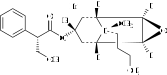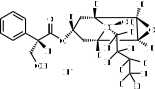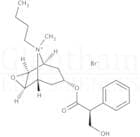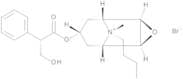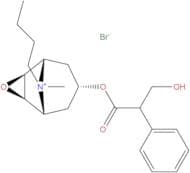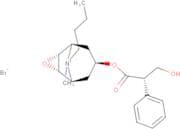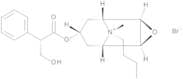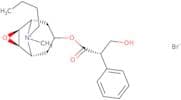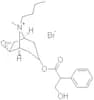
CAS 149-64-4
:Buscopan
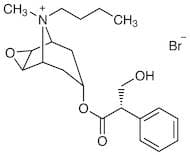
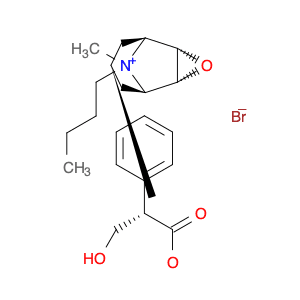
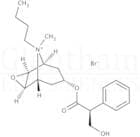
- (1S,2R,4S,5S)-9-butyl-7-[(3-hydroxy-2-phenylpropanoyl)oxy]-9-methyl-3-oxa-9-azoniatricyclo[3.3.1.0~2,4~]nonane bromide
- (1S,2R,4S,5S)-9-butyl-7-{[(2S)-3-hydroxy-2-phenylpropanoyl]oxy}-9-methyl-3-oxa-9-azoniatricyclo[3.3.1.0~2,4~]nonane bromide
- 1α<span class="text-smallcaps">H</smallcap>,5α<smallcap>H</span>-Tropanium, 8-butyl-6β,7β-epoxy-3α-hydroxy-, bromide, (-)-tropate
- 3-Oxa-9-azoniatricyclo[3.3.1.0<sup>2,4</sup>]nonane, 9-butyl-7-(3-hydroxy-1-oxo-2-phenylpropoxy)-9-methyl-, bromide, [7(S)-(1α,2β,4β,5α,7β)]-
- 3-Oxa-9-azoniatricyclo[3.3.1.0<sup>2,4</sup>]nonane, 9-butyl-7-[(2S)-3-hydroxy-1-oxo-2-phenylpropoxy]-9-methyl-, bromide (1:1), (1α,2β,4β,5α,7β)-
- 3-Oxa-9-azoniatricyclo[3.3.1.0<sup>2,4</sup>]nonane, 9-butyl-7-[(2S)-3-hydroxy-1-oxo-2-phenylpropoxy]-9-methyl-, bromide, (1α,2β,4β,5α,7β)-
- Amisepan
- Buscapine
- Buscol
- Buscolamin
- Buscolysin
- Buscolysine
- Buscopan
- Butylmin
- Butylscopolamine bromide
- Butylscopolammonium bromide
- Donopon
- Hyoscine Butylobromide
- Hyoscine butobromide
- Hyoscine butyl bromide
- Hyoscine butylbromide
- Hyoscine-N-Butyl Bromide
- Hyoscinen butylbromide
- Joscine
- Monospan
- N-Butylhyoscine bromide
- N-Butylscopolamine bromide
- N-Butylscopolaminium bromide
- N-Butylscopolammonium bromide
- N-butylhyoscinium bromide
- Scobro
- Scobron
- Scobutil
- Scobutyl
- Scopolamine Butylbromide
- Scopolamine bromobutylate
- Scopolamine butobromide
- Scopolamine butyl bromide
- Scopolan
- Sparicon
- Sporamin
- Sporamin (pharmaceutical)
- Stibron
- Tirantil
- Tropic acid, (-)-, ester with 8-butyl-6β,7β-epoxy-3α-hydroxy-1α<span class="text-smallcaps">H</smallcap>,5α<smallcap>H</span>-tropanium bromide
- 1αH,5αH-Tropanium, 8-butyl-6β,7β-epoxy-3α-hydroxy-, bromide, (-)-tropate
- 3-Oxa-9-azoniatricyclo[3.3.1.02,4]nonane, 9-butyl-7-[(2S)-3-hydroxy-1-oxo-2-phenylpropoxy]-9-methyl-, bromide (1:1), (1α,2β,4β,5α,7β)-
- 3-Oxa-9-azoniatricyclo[3.3.1.02,4]nonane, 9-butyl-7-[(2S)-3-hydroxy-1-oxo-2-phenylpropoxy]-9-methyl-, bromide, (1α,2β,4β,5α,7β)-
- Weitere Synonyme anzeigen
Buscopan
CAS:Formel:C21H30BrNO4Reinheit:>98.0%(T)(HPLC)Farbe und Form:White to Light yellow powder to crystalMolekulargewicht:440.38HYOSCINE BUTYLBROMIDE CRS
CAS:HYOSCINE BUTYLBROMIDE CRSFormel:C21H30BrNO4Farbe und Form:Crystalline Powder. White. Powder.Molekulargewicht:440.3712HYOSCINE BUTYLBROMIDE FOR SYSTEM SUITABILITY CRS
CAS:HYOSCINE BUTYLBROMIDE FOR SYSTEM SUITABILITY CRSHyoscine butylbromide
CAS:Hyoscine butylbromideFormel:C21H30BrNO4Reinheit:99.7%Farbe und Form:WhiteMolekulargewicht:439.13582Scopolamine Butylbromide
CAS:Formel:C21H30BrNO4Reinheit:98%Farbe und Form:SolidMolekulargewicht:440.3712Scopolamine butylbromide
CAS:Formel:C21H30BrNO4Reinheit:(Titration) 98.0 - 102.0 % (dried basis)Farbe und Form:White or almost white crystalline powderMolekulargewicht:440.37Hyoscine Butylbromide (N-Butyl Scopolamine Bromide, N-Butyl Hyoscine Bromide)
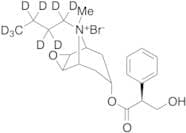
CAS:Formel:C21H30NO4·BrFarbe und Form:White To Off-White SolidMolekulargewicht:360.47 79.90Hyoscine Butylbromide-d9 (N-Butyl Scopolamine Bromide-d9, N-Butyl Hyoscine Bromide-d9)
CAS:Formel:C21H21D9NO4·BrFarbe und Form:White To Off-White SolidMolekulargewicht:369.53 79.90Scopolamine butylbromide, EP grade
CAS:Formel:C21H30BrNO4Reinheit:≤ 0.10% (HPLC)Farbe und Form:White or almost white crystalline powderMolekulargewicht:440.37Scopolamine butylbromide
CAS:Scopolamine butylbromide ((-)-Scopolamine butylbromide) is a competitive antagonist of mAChR (IC50: 55.3 ± 4.3 nM).Formel:C21H30NO4·BrReinheit:99.02% - 99.95%Farbe und Form:White PowderMolekulargewicht:440.37N-Butylscopolammonium Bromide-d9
CAS:Kontrolliertes ProduktStability Hygroscopic
Applications N-Butylscopolammonium Bromide (B693752) acts as an anticholinergic and antispasmodic. This is the labeled analog.
References Lee, J.R., et al.: Clin. Radiol., 33, 273 (1982), Bauer, et al.: Arzneim.-Forsch., 18, 1132 (1986), Steger, A.C., et al.: Am. J. Gastroenterol., 81, 615 (1986),Formel:C21H21D9NO4•BrFarbe und Form:Off-WhiteMolekulargewicht:369.52799(-)-Scopolamine N-butyl bromide
CAS:(-)-Scopolamine N-butyl bromide is an anti-cholinergic drug that is used for the diagnosis and treatment of bowel diseases. It has been shown to be effective in two different animal models of bowel disease, one of which was induced by dextran sulfate sodium. (-)-Scopolamine N-butyl bromide has been shown to decrease motility and increase tone in the colon, as well as reduce the severity of diarrhea in animals with experimental colitis. It also has a sedative effect on the gastrointestinal tract that may be due to its ability to bind to acetylcholine receptors.
Formel:C21H30NO4BrReinheit:Min. 98 Area-%Farbe und Form:White PowderMolekulargewicht:440.37 g/mol