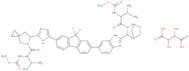
CAS 1499193-68-8
:Carbaminsäure, N-[(1S)-1-[[(6S)-6-[5-[9,9-difluoro-7-[2-[(1R,3S,4S)-2-[(2S)-2-[(methoxycarbonyl)amino]-3-methyl-1-oxobutyl]-2-azabicyclo[2.2.1]hept-3-yl]-1H-benzimidazol-6-yl]-9H-fluoren-2-yl]-1H-imidazol-2-yl]-5-azaspiro[2.4]hept-5-yl]carbonyl]-2-methylpropyl]-, methylester, (2S,3S)-2,3-dihydroxybutandioat (1:1)
Beschreibung:
Carbaminsäure, N-[(1S)-1-[[[6S)-6-[5-[9,9-Difluor-7-[2-[(1R,3S,4S)-2-[(2S)-2-[(Methoxycarbonyl)amino]-3-methyl-1-oxobutyl]-2-Azabicyclo[2.2.1]hept-3-yl]-1H-Benzimidazol-6-yl]-9H-Fluoren-2-yl]-1H-Imidazol-2-yl]-5-Azaspiro[2.4]hept-5-yl]carbonyl]-2-Methylpropyl]-, Methylester, (2S,3S)-2,3-Dihydroxybutandioat ist eine komplexe organische Verbindung, die durch ihre komplizierte molekulare Struktur gekennzeichnet ist, die mehrere funktionelle Gruppen wie Carbaminsäure, Ester und Hydroxylgruppen umfasst. Diese Verbindung weist ein chirales Zentrum auf, was auf potenzielles Stereoisomerismus hinweist, und enthält mehrere heterocyclische Ringe, die zu ihrer potenziellen biologischen Aktivität beitragen. Das Vorhandensein von Difluor- und Azabicyclischen Gruppen deutet darauf hin, dass sie einzigartige chemische Eigenschaften und Reaktivität aufweisen könnte. Ihr Molekulargewicht und ihre Löslichkeitseigenschaften würden von der spezifischen Anordnung ihrer Substituenten abhängen. Angesichts ihrer Komplexität könnte diese Verbindung von Interesse in der medizinischen Chemie sein, insbesondere bei der Entwicklung von Arzneimitteln, aufgrund ihrer potenziellen Wechselwirkungen mit biologischen Zielen. Weitere Studien wären erforderlich, um ihre spezifischen Eigenschaften und Anwendungen zu klären.
Formel:C49H54F2N8O6·C4H6O6
InChl:InChI=1S/C49H54F2N8O6.C4H6O6/c1-24(2)39(56-46(62)64-5)44(60)58-23-48(15-16-48)21-38(58)42-52-22-37(55-42)28-9-13-32-31-12-8-26(18-33(31)49(50,51)34(32)19-28)27-10-14-35-36(20-27)54-43(53-35)41-29-7-11-30(17-29)59(41)45(61)40(25(3)4)57-47(63)65-6;5-1(3(7)8)2(6)4(9)10/h8-10,12-14,18-20,22,24-25,29-30,38-41H,7,11,15-17,21,23H2,1-6H3,(H,52,55)(H,53,54)(H,56,62)(H,57,63);1-2,5-6H,(H,7,8)(H,9,10)/t29-,30+,38-,39-,40-,41-;1-,2-/m00/s1
InChI Key:InChIKey=ZQVLPYMRXLPMDX-KEAIDYLOSA-N
SMILES:C([C@@H](NC(OC)=O)[C@@H](C)C)(=O)N1CC2(C[C@H]1C=3NC(=CN3)C=4C=C5C(=CC4)C=6C(C5(F)F)=CC(=CC6)C=7C=C8C(=CC7)N=C(N8)[C@H]9N(C([C@@H](NC(OC)=O)C(C)C)=O)[C@]%10(C[C@@]9(CC%10)[H])[H])CC2.[C@H]([C@@H](C(O)=O)O)(C(O)=O)O
Synonyme:- Carbamic acid, N-[(1S)-1-[[(6S)-6-[5-[9,9-difluoro-7-[2-[(1R,3S,4S)-2-[(2S)-2-[(methoxycarbonyl)amino]-3-methyl-1-oxobutyl]-2-azabicyclo[2.2.1]hept-3-yl]-1H-benzimidazol-6-yl]-9H-fluoren-2-yl]-1H-imidazol-2-yl]-5-azaspiro[2.4]hept-5-yl]carbonyl]-2-methylpropyl]-, methyl ester, (2S,3S)-2,3-dihydroxybutanedioate (1:1)
Sortieren nach
Reinheit (%)
0
100
|
0
|
50
|
90
|
95
|
100
1 Produkte.
Ledipasvir D-tartrate
CAS:Ledipasvir D-tartrate is an antiviral compound, which is a direct-acting antiviral agent used in the treatment of hepatitis C virus (HCV) infection. It originates from synthetic sources designed to inhibit the replication of specific viral proteins. Ledipasvir functions by targeting the NS5A protein of the hepatitis C virus, a key component necessary for viral replication. By binding to this protein, Ledipasvir disrupts and inhibits the HCV replication complex, effectively suppressing the viral load in patients.
Formel:C53H60F2N8O12Reinheit:Min. 95%Molekulargewicht:1,039.1 g/mol