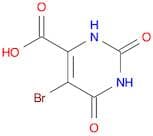
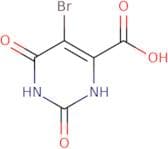
CAS 15018-62-9
:5-Brom-1,2,3,6-tetrahydro-2,6-dioxo-4-pyrimidincarbonsäure
Beschreibung:
5-Brom-1,2,3,6-tetrahydro-2,6-dioxo-4-pyrimidincarbonsäure ist eine heterocyclische organische Verbindung, die durch ihre Pyrimidinringstruktur gekennzeichnet ist, die mit einem Bromatom substituiert ist und zwei Carbonylgruppen (Oxo) enthält. Diese Verbindung zeigt typischerweise Eigenschaften, die sowohl mit sauren als auch mit basischen Funktionalitäten verbunden sind, aufgrund der Anwesenheit der Carbonsäuregruppe. Ihre molekulare Struktur deutet auf eine potenzielle Reaktivität hin, insbesondere bei nucleophilen Substitutionsreaktionen, aufgrund der elektrophilen Natur der Carbonylgruppen. Der Bromsubstituent kann die Reaktivität und Löslichkeit der Verbindung in verschiedenen Lösungsmitteln beeinflussen. Darüber hinaus kann die Anwesenheit mehrerer funktioneller Gruppen biologische Aktivität verleihen, was sie in der pharmazeutischen Chemie von Interesse macht. Die Stabilität und das Verhalten der Verbindung unter verschiedenen Bedingungen, wie pH und Temperatur, können variieren, was ihre Anwendungen in der Synthese und Forschung beeinflusst. Insgesamt ist 5-Brom-1,2,3,6-tetrahydro-2,6-dioxo-4-pyrimidincarbonsäure eine vielseitige Verbindung mit potenzieller Nützlichkeit in verschiedenen chemischen und biologischen Kontexten.
Formel:C5H3BrN2O4
InChl:InChI=1S/C5H3BrN2O4/c6-1-2(4(10)11)7-5(12)8-3(1)9/h(H,10,11)(H2,7,8,9,12)
InChI Key:InChIKey=YQYHIPBLZSIHDI-UHFFFAOYSA-N
SMILES:C(O)(=O)C1=C(Br)C(=O)NC(=O)N1
Synonyme:- 5-Bromo-1,2,3,6-tetrahydro-2,6-dioxo-4-pyrimidinecarboxylic acid
- 5-Bromouracil-6-carboxylic acid
- Orotic acid, 5-bromo-
- 5-Bromoorotic acid
- 4-Pyrimidinecarboxylic acid, 5-bromo-1,2,3,6-tetrahydro-2,6-dioxo-
Sortieren nach
Reinheit (%)
0
100
|
0
|
50
|
90
|
95
|
100
2 Produkte.
5-Bromo-2,6-dioxo-1,2,3,6-tetrahydropyrimidine-4-carboxylic acid
CAS:Formel:C5H3BrN2O4Molekulargewicht:234.99235-Bromoorotic acid
CAS:5-Bromoorotic acid is a chemical compound that contains one bromine atom. This compound has been shown to inhibit the growth of mammalian cells, which may be due to its ability to bind to DNA and interfere with protein synthesis. 5-Bromoorotic acid also has an inhibitory effect on radiation, which may be due to its ability to form stable complexes with electrons. 5-Bromoorotic acid has a helical structure, which may make it more stable than other compounds. It also inhibits the production of uridine by inhibiting uridine phosphorylase and nitro group production in g. lamblia, which is a parasitic protozoan that causes intestinal infections in humans.Formel:C5H3BrN2O4Reinheit:Min. 95%Farbe und Form:White PowderMolekulargewicht:234.99 g/mol