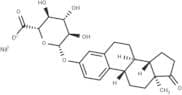
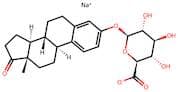
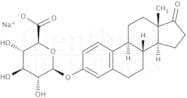
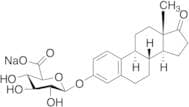
![1,3,5[10]-ESTRATRIEN-3-OL-17-ONE 3-GLUCURONIDE SODIUM SALT](/_next/image/?url=https%3A%2Fstatic.cymitquimica.com%2Fcas-image%2Fthumb-webp%2F328276-135-10-estratrien-3-ol-17-one-3-glucuronide-sodium-salt.webp&w=3840&q=75)
CAS 15087-01-1
:1,3,5[10]-ESTRATRIEN-3-OL-17-ON 3-GLUCURONID NATRIUMSALZ
Beschreibung:
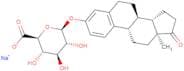
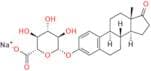
1,3,5[10]-ESTRATRIEN-3-OL-17-ON 3-GLUCURONID NATRIUMSALZ, mit der CAS-Nummer 15087-01-1, ist eine chemische Verbindung, die zur Klasse der Steroidhormone gehört, spezifisch ein Glucuronid-Konjugat von Estradiol. Diese Verbindung zeichnet sich durch ihre steroidale Struktur aus, die eine phenolische Hydroxylgruppe und eine Glucuronid-Gruppe umfasst, die ihre Löslichkeit erhöht und die Ausscheidung erleichtert. Die Natriumsalzform zeigt an, dass sie ionisiert ist, was ihre Bioverfügbarkeit und Pharmakokinetik beeinflussen kann. Typischerweise werden Glucuronide in der Leber durch den Prozess der Glucuronidierung gebildet, der einen wichtigen Weg für den Stoffwechsel verschiedener endogener und exogener Verbindungen darstellt. Diese Verbindung kann eine Rolle bei der Regulierung der östrogenen Aktivität im Körper spielen und wird häufig im Kontext von Hormontherapien und endokriner Funktion untersucht. Ihre Eigenschaften, wie Löslichkeit, Stabilität und biologische Aktivität, werden durch die Anwesenheit der Glucuronid-Gruppe und des Natriumions beeinflusst.
Formel:C24H29NaO8
InChl:InChI=1/C24H30O8.Na/c1-24-9-8-14-13-5-3-12(10-11(13)2-4-15(14)16(24)6-7-17(24)25)31-23-20(28)18(26)19(27)21(32-23)22(29)30;/h3,5,10,14-16,18-21,23,26-28H,2,4,6-9H2,1H3,(H,29,30);/q;+1/p-1/t14-,15-,16+,18+,19+,20-,21+,23-,24+;/m1./s1
SMILES:CC12CCC3c4ccc(cc4CCC3C1CCC2=O)OC1C(C(C(C(C(=O)O)O1)O)O)O.[Na]
Synonyme:- Estrone-3-(Beta-D-Glucuronide Sodium Salt)
- Estrone-3-Glucuronide Sodium Salt
- Estrone Beta-D-Glucuronide Sodium Salt
- Estrone Glucuronide, Sodium Salt
- 3-Hydroxy-1,3,5[10]-Estratrien-17-One 3-Glucuronide Sodium Salt
- 1,3,5(10)-Estratrien-3-Ol-17-One Glucosiduronate, Sodium Salt
- 1,3,5(10)-Estratrien-3-Ol-17-One 3(O->1Beta)-D-Glucopyranosiduronic Acid Sodium Salt
- sodium (2S,3S,4S,5R,6S)-3,4,5-trihydroxy-6-{[(8R,9S,13S,14S)-13-methyl-17-oxo-7,8,9,11,12,13,14,15,16,17-decahydro-6H-cyclopenta[a]phenanthren-3-yl]oxy}tetrahydro-2H-pyran-2-carboxylate (non-preferred name)
Sortieren nach
Reinheit (%)
0
100
|
0
|
50
|
90
|
95
|
100
6 Produkte.
Estrone-3-Glucuronide sodium
CAS:Estrone-3-Glucuronide sodium is a coupled metabolite of estrone, which is formed in the liver by UDP-glucuronyltransferase through glucuronide coupling.Formel:C24H29NaO8Reinheit:>99.99%Farbe und Form:SoildMolekulargewicht:468.47Estrone-3-Glucuronide sodium
CAS:Estrone-3-Glucuronide sodiumReinheit:≥98%Molekulargewicht:468.47g/molEstrone b-D-Glucuronide Sodium Salt (>97% by HPLC)
CAS:Kontrolliertes Produkt<p>Applications A metabolite of 17β -Estradiol (E888000).<br>References Cekan, S., et al.: J. Steroid Biochem., 27, 95 (1989), Martin, R., et al.: Clin. Chem., 46, 100 (2000), Blackwell, L., et al.: Steroids, 68, 465 (2003)<br></p>Formel:C24H29O8·NaReinheit:>97% by HPLCFarbe und Form:White To Light BrownMolekulargewicht:468.47Estrone b-D-glucuronide sodium salt
CAS:<p>Estrone b-D-glucuronide sodium salt (EBGG) is a steroid hormone that is synthesized in the ovaries. EBGG has been shown to be effective against bacterial vaginosis and polycystic ovarian syndrome. It is not active against other types of vaginal infections, such as yeast vaginitis or candida vulvovaginitis. EBGG has also been used to treat infertility in women, with promising results. The compound may work by increasing the metabolic rate and suppressing the production of progesterone and testosterone, which are important for fertility. EBGG binds to an estrogen receptor on cells in the uterus, stimulating the growth of uterine tissue and increasing blood flow to the uterus. EBGG binds to a specific site on the surface of cells called a monoclonal antibody, which can inhibit cell proliferation. This binding leads to an increase in progesterone receptor expression on uterine cells and inhibits the production of progesterone receptors on breast cancer</p>Formel:C24H29O8·NaReinheit:Min. 95%Farbe und Form:PowderMolekulargewicht:468.47 g/mol