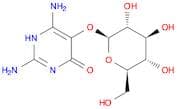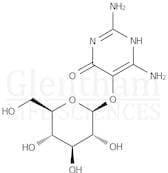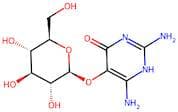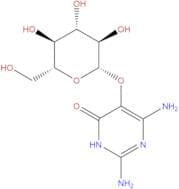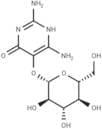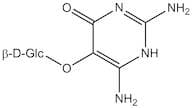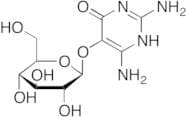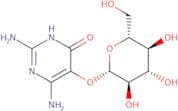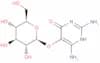
CAS 152-93-2
:Nachbar
Beschreibung:
Nachbar ist ein natürlich vorkommendes Alkaloid, das hauptsächlich in den Samen von Vicia faba, allgemein bekannt als Ackerbohnen, vorkommt. Es wird als Glykosid klassifiziert und ist bekannt für seine strukturelle Ähnlichkeit mit anderen Verbindungen wie conNachbar. Nachbar ist gekennzeichnet durch sein Potenzial, oxidativen Stress bei bestimmten Individuen zu verursachen, insbesondere bei denen mit einem Mangel an dem Enzym Glukose-6-phosphat-Dehydrogenase (G6PD), was zu hämolytischer Anämie führen kann. Die Verbindung hat eine chemische Formel, die ihre komplexe Struktur widerspiegelt, die mehrere funktionelle Gruppen umfasst. Nachbar ist in Wasser löslich und hat einen bitteren Geschmack. Seine Rolle in der Pflanzenphysiologie wird als mit Abwehrmechanismen gegen Herbivoren und Pathogene verbunden angesehen. Neben seiner biologischen Bedeutung wurde Nachbar auch auf seine potenziellen pharmakologischen Wirkungen untersucht, obwohl seine Sicherheit und Wirksamkeit in therapeutischen Anwendungen weiterer Untersuchungen bedarf. Insgesamt ist Nachbar eine wichtige Verbindung sowohl im ernährungsphysiologischen als auch im medizinischen Kontext, die eine sorgfältige Berücksichtigung bei der Ernährungsauswahl erfordert, insbesondere für Personen mit spezifischen Gesundheitszuständen.
Formel:C10H16N4O7
InChl:InChI=1S/C10H16N4O7/c11-7-6(8(19)14-10(12)13-7)21-9-5(18)4(17)3(16)2(1-15)20-9/h2-5,9,15-18H,1H2,(H5,11,12,13,14,19)/t2-,3-,4+,5-,9+/m1/s1
InChI Key:InChIKey=KGNGTSCIQCLKEH-SYCVNHKBSA-N
SMILES:O(C1=C(N)NC(N)=NC1=O)[C@@H]2O[C@H](CO)[C@@H](O)[C@H](O)[C@H]2O
Synonyme:- 2,6-Diamino-4-Oxo-1,4-Dihydropyrimidin-5-Yl Hexopyranoside
- 2,6-Diamino-5-(β-<span class="text-smallcaps">D</span>-glucopyranosyloxy)-4(1H)-pyrimidinone
- 2,6-diamino-4-oxo-1,4-dihydropyrimidin-5-yl beta-D-glucopyranoside
- 4(1H)-Pyrimidinone, 2,6-diamino-5-(β-<span class="text-smallcaps">D</span>-glucopyranosyloxy)-
- Divicine β-<span class="text-smallcaps">D</span>-glucopyranoside
- NSC 95092
- Vicine
- Vicioside
- 2,6-Diamino-5-(β-D-glucopyranosyloxy)-4(1H)-pyrimidinone
- Divicine β-D-glucopyranoside
- 4(1H)-Pyrimidinone, 2,6-diamino-5-(β-D-glucopyranosyloxy)-
Sortieren nach
Reinheit (%)
0
100
|
0
|
50
|
90
|
95
|
100
8 Produkte.
2,6-diamino-5-(β-D-glucopyranosyloxy)-(1H)-pyrimidin-4-one
CAS:Formel:C10H16N4O7Reinheit:99%Farbe und Form:SolidMolekulargewicht:304.2566Vicine
CAS:Vicine is important natural fungicide. "High levels" of vicine or convicine or both might have shortened the birds' survival time by enhancing the neurotoxicity induced by "lower levels" of beta-cyanoalanine.Formel:C10H16N4O7Reinheit:95%~99%Molekulargewicht:304.259Vicine
CAS:Vicine, an alkaloid found in fava beans, is toxic in individuals and may cause haemolytic anaemia.Formel:C10H16N4O7Reinheit:99.82% - >99.99%Farbe und Form:SolidMolekulargewicht:304.26Vicine
CAS:Natural alkaloidFormel:C10H16N4O7Reinheit:≥ 95.0 % (HPLC)Farbe und Form:PowderMolekulargewicht:304.26Vicine
CAS:Applications Vicine is a pyrimidine glycosides, a precursor of the aglycons divicine and isouramil which is main factors of favism. It is found in faba/fava bean. Also, it is derived from Ethyl Glyoxylate (E918550), which is used as a reagent in the synthesis of a new class of cinnamyl-triazole compounds which can be used as selective inhibitors of human aromatase (cytochrome P 450 19A1)
References Rizzello, C. G., et al.: Sci. Rep., 6, 32452 (2016); Pulkkinen, M., et al.: Food Chem., 212, 10-19 (2016); McNulty, J., et al.: Bioorg. Med. Chem. Lett., 24, 4586 (2014)Formel:C10H16N4O7Farbe und Form:White To Light BeigeMolekulargewicht:304.26Vicine
CAS:Vicine is a plant toxin that inhibits the activity of the enzyme hydroxylase, which is essential for the synthesis of the amino acid tyrosine. Vicine also inhibits proteins involved in the metabolism of carbohydrates, fatty acids, and proteins. Vicine is found in plants such as beans, peas, lentils, and soybeans. It has been shown to inhibit glomerular filtration rate and may be used to treat metabolic disorders such as hyperglycemia or fatty acid oxidation disorder.Formel:C10H16N4O7Reinheit:Min. 95%Molekulargewicht:304.26 g/mol