CAS 152120-54-2
:N,N'-bis-boc-1-guanylpyrazol
Beschreibung:
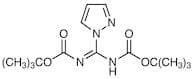
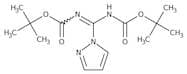
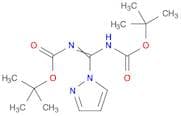
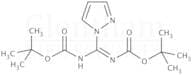
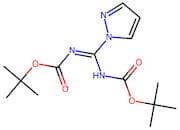
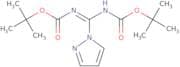
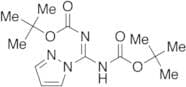
N,N'-bis-boc-1-guanylpyrazol ist eine chemische Verbindung, die durch ihre einzigartige Struktur gekennzeichnet ist, die einen Pyrazolring und zwei tert-butyloxycarbonyl (Boc) Schutzgruppen umfasst. Diese Verbindung wird typischerweise in der organischen Synthese und der medizinischen Chemie verwendet, insbesondere bei der Entwicklung von Arzneimitteln. Die Boc-Gruppen dienen dazu, die Aminfunktionen während der Reaktionen zu schützen, was selektive Modifikationen der Pyrazolgruppe ermöglicht. N,N'-bis-boc-1-guanylpyrazol ist bekannt für seine potenzielle biologische Aktivität und fungiert oft als Vorläufer in der Synthese von Guanidinderivaten, die verschiedene pharmakologische Eigenschaften aufweisen können. Die Verbindung ist unter Standardlaborbedingungen im Allgemeinen stabil, kann jedoch eine spezifische Handhabung und Lagerung erfordern, um ihre Integrität zu bewahren. Ihre Löslichkeit kann je nach verwendetem Lösungsmittel variieren, und es ist wichtig, ihre Reaktivität im Kontext des gewünschten synthetischen Weges zu berücksichtigen. Insgesamt ist N,N'-bis-boc-1-guanylpyrazol ein wertvolles Zwischenprodukt in der chemischen Forschung und Entwicklung.
Formel:C14H22N4O4
InChl:InChI=1/C14H22N4O4/c1-13(2,3)21-11(19)16-10(18-9-7-8-15-18)17-12(20)22-14(4,5)6/h7-9H,1-6H3,(H,16,17,19,20)
SMILES:CC(C)(C)OC(=O)N=C(N=C(O)OC(C)(C)C)n1cccn1
Synonyme:- N,N'-bis-(t-butyl-oxycarbonyl)-1-guanylpyrazole
- N,N'-bis-(tert-butyloxycarbonyl)-1-guanylpyrazole
- Pyrazole(Boc)2
- Pyrazol(Boc)2
- N,N'-bis-(tert-butoxycarbonyl)-1-guanylpyrazole
- N,N'-diboc-1h-pyrazole guanidine
- N,N-bis-(t-butyloxycarbonyl)-1-guanylpyrazole, N,N-di-boc-1h-pyrazole-1-carboxamidine
- N,N'-bis-boc-1-guanylpyrazol
- di-tert-butyl (1H-pyrazol-1-ylmethylylidene)biscarbamate
- N,N'-Di-Boc-1H-pyrazole-1-carboxamidine
Sortieren nach
Reinheit (%)
0
100
|
0
|
50
|
90
|
95
|
100
9 Produkte.
N,N'-Bis(tert-butoxycarbonyl)-1H-pyrazole-1-carboxamidine
CAS:Formel:C14H22N4O4Reinheit:>98.0%(T)(HPLC)Farbe und Form:White to Almost white powder to crystalMolekulargewicht:310.35N,N'-Di-Boc-1H-pyrazole-1-carboxamidine, 98+%
CAS:N,N'-Di-Boc-1H-pyrazole-1-carboxamidine is used in the stereoselective synthesis of the bicyclic guanidine alkaloid (+)-monanchorin. This Thermo Scientific Chemicals brand product was originally part of the Alfa Aesar product portfolio. Some documentation and label information may refer to the legacFormel:C14H22N4O4Reinheit:98+%Molekulargewicht:310.35N,N-Bis-Boc-1-Guanylpyrazole
CAS:Formel:C14H22N4O4Reinheit:95%Farbe und Form:SolidMolekulargewicht:310.3489Ref: IN-DA0035B1
1kgNachfragen1g21,00€5g27,00€10g31,00€25g56,00€50g83,00€100g124,00€250g198,00€500g355,00€N,N''-Di-Boc-1H-pyrazole-1-carboxamidine
CAS:Formel:C14H22N4O4Reinheit:≥ 98.0%Farbe und Form:White to almost white powderMolekulargewicht:310.351H-Pyrazole-1-carboxamidine, N,N'-Bis-BOC protected
CAS:1H-Pyrazole-1-carboxamidine, N,N'-Bis-BOC protectedFormel:C14H22N4O4Reinheit:98%Farbe und Form: white solidMolekulargewicht:310.35g/molBis-Boc-pyrazolocarboxamidine
CAS:Formel:C14H22N4O4Reinheit:95%Farbe und Form:Solid, Powder or Crystalline PowderMolekulargewicht:310.354N,N'-Bis-Boc-1-guanylpyrazol
CAS:N,N'-Bis-Boc-1-guanylpyrazol is a tetrapeptide that is used as a reagent in organic synthesis. It has been shown to have an inhibitory effect on the production and release of melanocortin and its related peptides, which are important for the regulation of body weight, appetite, and mood. N,N'-Bis-Boc-1-guanylpyrazol binds to sulfate groups on chondroitin sulfate proteoglycans. The inhibition of these sulfated proteoglycans leads to decreased levels of hyaluronic acid and a lack of water retention in the joints. This can cause symptoms such as pain and stiffness in joints, particularly those affected by osteoarthritis.Formel:C14H22N4O4Reinheit:Min. 95%Farbe und Form:White PowderMolekulargewicht:310.35 g/molN,N’-Bis-boc-1-guanylpyrazole
CAS:Kontrolliertes ProduktApplications N,N'-Bis-Boc-1-guanylpyrazole is used in the stereoselective synthesis of the bicyclic guanidine alkaloid (+)-monanchorin.
References Swift, M., et al.: Org. Biomol. Chem., 4, 3889 (2006), Reid, C., et al.: Bioorg. Med. Chem. Lett., 18, 5399 (2008),Formel:C14H22N4O4Farbe und Form:NeatMolekulargewicht:310.35