CAS 15291-75-5
:Ginkgolid A
Beschreibung:
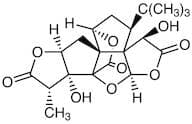
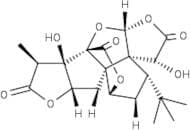
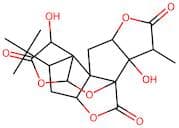
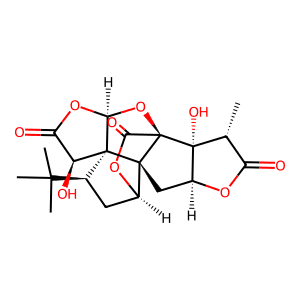
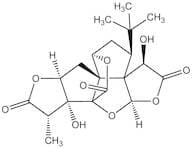
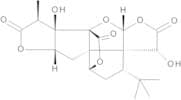
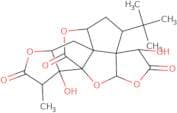
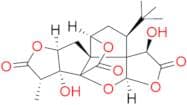
Ginkgolid A ist eine natürliche Verbindung, die aus den Blättern des Ginkgo biloba-Baums gewonnen wird und für ihre potenziellen gesundheitlichen Vorteile und medizinischen Eigenschaften bekannt ist. Sie gehört zu einer Klasse von Verbindungen, die Terpenoide genannt werden, speziell zu einer Art von Diterpenlacton. Ginkgolid A zeichnet sich durch seine einzigartige bicyclische Struktur aus, die zu seiner biologischen Aktivität beiträgt. Es zeigt verschiedene pharmakologische Wirkungen, einschließlich neuroprotektiver, entzündungshemmender und antioxidativer Eigenschaften, was es von Interesse für die Forschung zu neurodegenerativen Erkrankungen und kognitiver Verbesserung macht. Darüber hinaus wurde Ginkgolid A auf seine Fähigkeit untersucht, den plättchenaktivierenden Faktor (PAF) zu hemmen, der eine Rolle bei Entzündungen und Thrombosen spielt. Die Verbindung ist typischerweise in pflanzlichen Nahrungsergänzungsmitteln und Extrakten aus Ginkgo biloba zu finden, und ihr Sicherheitsprofil wurde in verschiedenen Studien bewertet. Wie viele pflanzliche Produkte kann es jedoch mit anderen Medikamenten interagieren, daher ist Vorsicht geboten, wenn es zusammen mit Antikoagulanzien oder Thrombozytenaggregationshemmern verwendet wird. Insgesamt stellt Ginkgolid A ein bedeutendes Forschungsfeld in der Phytochemie und Pharmakologie dar.
Formel:C20H24O9
InChl:InChI=1S/C20H24O9/c1-7-12(22)26-10-6-17-9-5-8(16(2,3)4)18(17)11(21)13(23)28-15(18)29-20(17,14(24)27-9)19(7,10)25/h7-11,15,21,25H,5-6H2,1-4H3/t7-,8+,9-,10+,11+,15+,17-,18?,19-,20?/m1/s1
InChI Key:InChIKey=FPUXKXIZEIDQKW-IKIFPUOBSA-N
SMILES:O[C@@]12C34[C@]5(C6([C@](O3)(OC(=O)[C@@H]6O)[H])[C@H](C(C)(C)C)C[C@]5(OC4=O)[H])C[C@@]1(OC(=O)[C@H]2C)[H]
Synonyme:- (1R,3S,3aS,4R,6aR,7aR,7bR,8S,10aS,11aS)-3-(1,1-Dimethylethyl)hexahydro-4,7b-dihydroxy-8-methyl-9H-1,7a-(epoxymethano)-1H,6aH-cyclopenta[c]furo[2,3-b]furo[3′,2′:3,4]cyclopenta[1,2-d]furan-5,9,12(4H)-trione
- (1R,3aR,4bR,5S,7aS,9R,11S)-11-tert-butyl-1,4b-dihydroxy-5-methyltetrahydro-4bH,9H-9,4a-(epoxymethano)cyclopenta[c]furo[2,3-b]furo[3',2':3,4]cyclopenta[1,2-d]furan-2,6,13(1H,5H)-trione
- (3aR,4aR,4bR,5S,7aS,9R,11S)-11-tert-butyl-1,4b-dihydroxy-5-methyltetrahydro-4bH,9H-9,4a-(epoxymethano)cyclopenta[c]furo[2,3-b]furo[3',2':3,4]cyclopenta[1,2-d]furan-2,6,13(1H,5H)-trione
- 9H-1,7a-(Epoxymethano)-1H,6aH-cyclopenta(c)furo(2,3-b)furo(3',2':3,4)cyclopenta(1,2-d)furan-5,9,12(4H)-trione, 3-(1,1-dimethylethyl)hexahydro-4,7b-dihydroxy-8-methyl-, (1R,3S,3aS,4R,6aR,7aR,7bR,8S,10aS,11aS)-
- 9H-1,7a-(Epoxymethano)-1H,6aH-cyclopenta(c)furo(2,3-b)furo(3',2':3,4)cyclopenta(1,2-d)furan-5,9,12(4H)-trione, 3-(1,1-dimethylethyl)hexahydro-4,7b-dihydroxy-8-methyl-, (1R-(1alpha,3beta,3aS*,4beta,6aalpha,7aalpha,7balpha,8alpha,10aalpha,11 aS*))-
- 9H-1,7a-(Epoxymethano)-1H,6aH-cyclopenta(c)furo(2,3-b)furo(3',2':3,4)cyclopenta(1,2-d)furan-5,9,12(4H)-trione, 3-tert-butylhexahydro-4,7b-dihydroxy-8-methyl-
- 9H-1,7a-(Epoxymethano)-1H,6aH-cyclopenta[c]furo[2,3-b]furo[3′,2′:3,4]cyclopenta[1,2-d]furan-5,9,12(4H)-trione, 3-(1,1-dimethylethyl)hexahydro-4,7b-dihydroxy-8-methyl-, (1R,3S,3aS,4R,6aR,7aR,7bR,8S,10aS,11aS)-
- 9H-1,7a-(Epoxymethano)-1H,6aH-cyclopenta[c]furo[2,3-b]furo[3′,2′:3,4]cyclopenta[1,2-d]furan-5,9,12(4H)-trione, 3-(1,1-dimethylethyl)hexahydro-4,7b-dihydroxy-8-methyl-, [1R-(1α,3β,3aS*,4β,6aα,7aα,7bα,8α,10aα,11aS*)]-
- 9H-1,7a-(Epoxymethano)-1H,6aH-cyclopenta[c]furo[2,3-b]furo[3′,2′:3,4]cyclopenta[1,2-d]furan-5,9,12(4H)-trione, 3-tert-butylhexahydro-4,7b-dihydroxy-8-methyl-
- Bilobalide A
- Bn 52020
- [1R-(1α,3β,3aS*,4β,6aα,7aα,7bα,8α,10aα,11aS*)]-3-(1,1-Dimethylethyl)hexahydro-4,7b-dihydroxy-8-methyl-9H-1,7a-(epoxymethano)-1H,6aH-cyclopenta[c]furo[2,3-b]furo[3′,2′:3,4]cyclopenta[1,2-d]furan-5,9,12(4H)-trione
- Weitere Synonyme anzeigen
Sortieren nach
Reinheit (%)
0
100
|
0
|
50
|
90
|
95
|
100
15 Produkte.
Ginkgolide A
CAS:Formel:C20H24O9Reinheit:>98.0%(HPLC)(qNMR)Farbe und Form:White to Light yellow powder to crystalMolekulargewicht:408.40Ginkgolide A
CAS:Ginkgolide A analytical standard provided with w/w absolute assay, to be used for quantitative titration.Formel:C20H24O9Reinheit:(HPLC) ≥98%Farbe und Form:PowderMolekulargewicht:408.41Ginkgolide A
CAS:Ginkgolide A is a platelet-activating factor antagonist, it can inhibit the neurotoxicity of prions or amyloid-beta1-42, may be relevant treatments for prion or Alzheimer's diseases.Ginkgolide A has neuroprotective, and anxiolytic-like effects, it is widely used for the treatment of cardiovascular diseases and diabetic vascular complications, which might be achieved through regulating the STAT3-mediated pathway.Formel:C20H24O9Reinheit:95%~99%Molekulargewicht:408.403Ginkgolide A
CAS:Formel:C20H24O9Reinheit:(HPLC) ≥ 98.0%Farbe und Form:Off-white powderMolekulargewicht:408.41Ginkgolide A
CAS:Ginkgolide A (BN-52020), from Ginkgo biloba leaves, is an active PAF antagonist with potential in treating inflammation and immune disorders.Formel:C20H24O9Reinheit:98.76% - 99.81%Farbe und Form:White PowderMolekulargewicht:408.40Ginkgolide a
CAS:LactoneFormel:C20H24O9Reinheit:≥ 95.0 % (HPLC)Farbe und Form:PowderMolekulargewicht:408.41Ginkgolide A
CAS:Kontrolliertes ProduktApplications Family of bioactive terpenes treating cardiovascular and cerebrovascular diseases. Specific platelet activating factor (PAF) antagonists.
References Korth, R., et al.: Eur. J. Pharmacol., 152, 101 (1988), Braquet, P., et al.: Med. Res. Rev., 11, 295 (1991), van Beek, T.A., et al.: Bioorg. Med. Chem., 13, 5001 (2005)Formel:C20H24O9Farbe und Form:NeatMolekulargewicht:408.4Ginkgolide A
CAS:Ginkgolide A is a terpenoid lactone, which is a diterpene known for its presence in the leaves of the Ginkgo biloba tree. As a bioactive compound, it is naturally sourced from this ancient plant, which has been utilized in traditional medicine for centuries. Ginkgolide A acts primarily as an antagonist of platelet-activating factor (PAF), thereby influencing a range of physiological processes. Its modulatory effects on neurotransmission and vascular function arise from its ability to inhibit PAF binding to its receptor, reducing platelet aggregation and improving microcirculatory flow.Formel:C20H24O9Reinheit:Min. 95%Farbe und Form:White PowderMolekulargewicht:408.4 g/mol