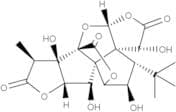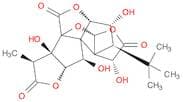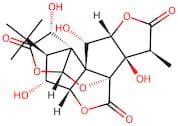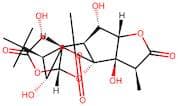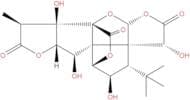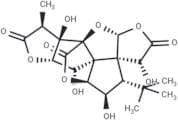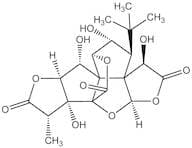
CAS 15291-76-6
:Ginkgolid C
Beschreibung:
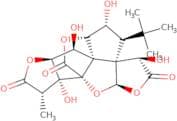
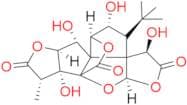
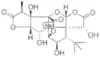
Ginkgolid C ist eine natürliche Verbindung, die als Diterpenlacton klassifiziert wird und hauptsächlich aus den Blättern des Ginkgo biloba-Baums gewonnen wird. Es ist eines von mehreren Ginkgoliden, die einzigartig für diese Art sind und zu ihren medizinischen Eigenschaften beitragen. Ginkgolid C ist bekannt für seine potenziellen neuroprotektiven Effekte und wird oft hinsichtlich seiner Rolle bei der Verbesserung der kognitiven Funktion und der Blutzirkulation untersucht. Die Verbindung zeigt antioxidative Eigenschaften, die helfen können, oxidativen Stress in Zellen zu mildern. Darüber hinaus wurde Ginkgolid C auf seine Fähigkeit untersucht, den Thrombozyten-aktivierenden Faktor (PAF) zu hemmen, was auf potenzielle therapeutische Anwendungen in der Herz-Kreislauf-Gesundheit hinweist. In Bezug auf die physikalischen Eigenschaften ist Ginkgolid C typischerweise ein blassgelbes bis weißes kristallines Feststoff und ist in organischen Lösungsmitteln löslich, hat jedoch eine begrenzte Löslichkeit in Wasser. Seine molekulare Struktur umfasst mehrere Ringe und funktionelle Gruppen, die zu seiner biologischen Aktivität beitragen. Insgesamt ist Ginkgolid C eine bedeutende Verbindung in der Kräutermedizin und Pharmakologie, mit laufender Forschung zu seinen verschiedenen gesundheitlichen Vorteilen.
Formel:C20H24O11
InChl:InChI=1/C20H24O11/c1-5-12(24)28-11-8(22)18-10-6(21)7(16(2,3)4)17(18)9(23)13(25)30-15(17)31-20(18,14(26)29-10)19(5,11)27/h5-11,15,21-23,27H,1-4H3/t5-,6-,7+,8?,9?,10-,11+,15+,17?,18?,19-,20+/m1/s1
InChI Key:InChIKey=AMOGMTLMADGEOQ-XQMLRWPUSA-N
SMILES:OC1[C@@]23[C@@]45[C@](O[C@]2([C@]6(O)[C@]1(OC(=O)[C@H]6C)[H])C(=O)O[C@@]3([C@H](O)[C@@H]4C(C)(C)C)[H])(OC(=O)[C@@H]5O)[H]
Synonyme:- (1S,2R,3S,3aS,4R,6aR,7aR,7bR,8S,10aS,11R,11aR)-3-(1,1-Dimethylethyl)hexahydro-2,4,7b,11-tetrahydroxy-8-methyl-9H-1,7a-(epoxymethano)-1H,6aH-cyclopenta[c]furo[2,3-b]furo[3',2':3,4]cyclopenta[1,2-d]furan-5,9,12(4H)-trione
- (1S,2R,3S,3aS,4R,6aR,7aR,7bR,8S,10aS,11R,11aR)-3-(1,1-Dimethylethyl)hexahydro-2,4,7b,11-tetrahydroxy-8-methyl-9H-1,7a-(epoxymethano)-1H,6aH-cyclopenta[c]furo[2,3-b]furo[3′,2′:3,4]cyclopenta[1,2-d]furan-5,9,12(4H)-trione
- (3aR,4aR,4bR,5S,7aS,9S,10R,11S)-11-tert-butyl-1,4b,8,10-tetrahydroxy-5-methyltetrahydro-4bH,9H-9,4a-(epoxymethano)cyclopenta[c]furo[2,3-b]furo[3',2':3,4]cyclopenta[1,2-d]furan-2,6,13(1H,5H)-trione
- 1,7-Dihydroxy-Ginkgolide A
- 11-tert-butyl-1,4b,8,10-tetrahydroxy-5-methyltetrahydro-4bH,9H-9,4a-(epoxymethano)cyclopenta[c]furo[2,3-b]furo[3',2':3,4]cyclopenta[1,2-d]furan-2,6,13(1H,5H)-trione
- 5H-Dicyclopenta[b,c]furan-3,5a(6H)-diacetic acid, 6-tert-butyl-3a-carboxyhexahydro-α<sup>5a</sup>,1,2,3,5,7,8-heptahydroxy-α<sup>3</sup>-methyl-, tri-γ-lactone
- 9H-1,7a-(Epoxymethano)-1H,6aH-cyclopenta[c]furo[2,3-b]furo[3′,2′:3,4]cyclopenta[1,2-d]furan-5,9,12(4H)-trione, 3-(1,1-dimethylethyl)hexahydro-2,4,7b,11-tetrahydroxy-8-methyl-, (1S,2R,3S,3aS,4R,6aR,7aR,7bR,8S,10aS,11R,11aR)-
- 9H-1,7a-(Epoxymethano)-1H,6aH-cyclopenta[c]furo[2,3-b]furo[3′,2′:3,4]cyclopenta[1,2-d]furan-5,9,12(4H)-trione, 3-(1,1-dimethylethyl)hexahydro-2,4,7b,11-tetrahydroxy-8-methyl-, [1R-(1α,2α,3β,3aS*,4β,6aα,7aα,7bα,8α,10aα,11α,11aR*)]-
- 9H-1,7a-(Epoxymethano)-1H,6aH-cyclopenta[c]furo[2,3-b]furo[3′,2′:3,4]cyclopenta[1,2-d]furan-5,9,12(4H)-trione, 3-tert-butylhexahydro-2,4,7b,11-tetrahydroxy-8-methyl-
- Bn 52022
- Bn52022
- Gingkolide C
- Ginkgolide A, 1,7-dihydroxy-, (1β,7β)-
- GinkgolideA,1,7-dihydroxy-, (1α,7β)-
- 5H-Dicyclopenta[b,c]furan-3,5a(6H)-diacetic acid, 6-tert-butyl-3a-carboxyhexahydro-α5a,1,2,3,5,7,8-heptahydroxy-α3-methyl-, tri-γ-lactone
- CGinkgolid
- Ginkgolide C,1,7-Dihydroxy-ginkgolide A
- Weitere Synonyme anzeigen
Sortieren nach
Reinheit (%)
0
100
|
0
|
50
|
90
|
95
|
100
12 Produkte.
Ginkgolide C
CAS:Ginkgolide C analytical standard provided with w/w absolute assay, to be used for quantitative titration.Formel:C20H24O11Reinheit:(HPLC) ≥98%Farbe und Form:PowderMolekulargewicht:440.41Ginkgolide C
CAS:Ginkgolide C is a potent inhibitor of collagen-stimulated platelet aggregation, it may increase intracellular cAMP and cGMP production and MMP-9 activity, inhibit intracellular Ca(2+) mobilization and TXA(2) production. Ginkgolide C has anti-adipogenic and ameliorating Alzheimer disease effects; it also can increase△LVP significantly,enhances the myocardial systolic and diastolic function of rats,but has no significant effect on HR while it shows inotropic activity.Formel:C20H24O11Reinheit:95%~99%Molekulargewicht:440.401Ginkgolide C
CAS:Ginkgolide C (BN-52022), a natural product, can enhance the cardiac function of rats in the body.Formel:C20H24O11Reinheit:99.71% - 99.98%Farbe und Form:White PowderMolekulargewicht:440.40Ginkgolide c
CAS:LactoneFormel:C20H24O11Reinheit:≥ 95.0 % (HPLC)Farbe und Form:PowderMolekulargewicht:440.4Ginkgolide C
CAS:Kontrolliertes ProduktApplications Family of bioactive terpenes treating cardiovascular and cerebrovascular diseases. Specific platelet activating factor (PAF) antagonists.
References Korth, R., et al.: Eur. J. Pharmacol., 152, 101 (1988), Braquet, P., et al.: Med. Res. Rev., 11, 295 (1991), van Beek, T.A., et al.: Bioorg. Med. Chem., 13, 5001 (2005)Formel:C20H24O11Reinheit:>90%Farbe und Form:NeatMolekulargewicht:440.4Ginkgolide C
CAS:Ginkgolide C is a terpenoid lactone, which is a natural compound isolated from the leaves of the Ginkgo biloba tree. Ginkgolide C is primarily known for its activity as a specific antagonist of platelet-activating factor (PAF), a potent phospholipid activator and mediator of many leukocyte functions, including platelet aggregation. Its mode of action involves the inhibition of PAF binding to its receptor, thereby reducing PAF-related inflammatory responses and platelet aggregation.Formel:C20H24O11Reinheit:Min. 95%Farbe und Form:PowderMolekulargewicht:440.4 g/mol