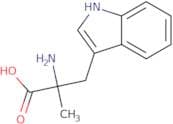
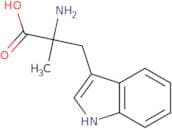
CAS 153-91-3
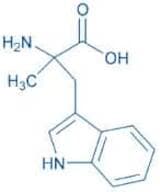
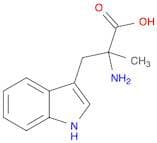
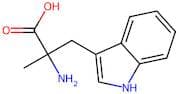
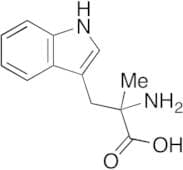
:A-methyl-dl-tryptophan
Beschreibung:
A-methyl-dl-tryptophan, mit der CAS-Nummer 153-91-3, ist ein Aminosäurederivat, das strukturell mit der essentiellen Aminosäure Tryptophan verwandt ist. Es weist eine Methylgruppe auf, die am Alpha-Kohlenstoff gebunden ist, was seine biochemischen Eigenschaften im Vergleich zu seiner Ausgangsverbindung verändert. Diese Verbindung wird häufig in der biochemischen Forschung verwendet, insbesondere in Studien zur Proteinsynthese und zum Stoffwechsel, da sie als Analogon von Tryptophan wirken kann. A-methyl-dl-tryptophan ist bekannt dafür, die Aktivität bestimmter Enzyme, die am Tryptophan-Stoffwechsel beteiligt sind, zu hemmen, was es zu einem wertvollen Werkzeug zur Untersuchung von Stoffwechselwegen macht. Es ist typischerweise ein weißes bis off-white kristallines Feststoff und in polaren Lösungsmitteln löslich. Die einzigartige Struktur der Verbindung ermöglicht es ihr, mit verschiedenen biologischen Systemen zu interagieren und Prozesse wie die Synthese von Neurotransmittern und das Falten von Proteinen zu beeinflussen. Wie bei vielen Aminosäurederivaten ist es wichtig, A-methyl-dl-tryptophan in Laborumgebungen mit Vorsicht zu behandeln und die Sicherheitsprotokolle einzuhalten, um potenzielle Gefahren zu mindern.
Formel:C12H14N2O2
Synonyme:- Alpha-Methyl-DL-Tryptophan
- H-.alpha.-Me-DL-Trp-OH
- A-Methyl-L-Tryptophan
Sortieren nach
Reinheit (%)
0
100
|
0
|
50
|
90
|
95
|
100
7 Produkte.
H-α-Me-DL-Trp-OH
CAS:Bachem ID: 4008387.
Formel:C12H14N2O2Reinheit:> 99%Farbe und Form:White PowderMolekulargewicht:218.26α-methyl-DL-tryptophan
CAS:Formel:C12H14N2O2Reinheit:95%Farbe und Form:SolidMolekulargewicht:218.2518α-Methyl-DL-tryptophan
CAS:Applications α-methyl-DL-tryptophan is used as a blocker of ATBo, an amino acid transporter whose expression is upregulated in cancer. It is also a substrate or non-transported inhibitor of the amino acid transporter PAT2 (slc36a2).
References Karunakaran, J., et al.: J. Biochem., 414, 343 (2008); Edwards, N., et al.: Biochimica et Biophysica Acta, Biomembranes, 1808, 260 (2011)Formel:C12H14N2O2Farbe und Form:Off White SolidMolekulargewicht:218.25DL-α-Methyltryptophan
CAS:DL-alpha-Methyltryptophan is a metabolite of the amino acid tryptophan. It is a monoamine neurotransmitter that has been implicated in brain function and inflammatory lesions. DL-alpha-Methyltryptophan can be used as a potential drug target for the treatment of Parkinson's disease, depression, and anxiety disorders. The hydroxyl group on the indole ring of DL-alpha-Methyltryptophan gives it an increased reactivity with oxygen, which allows it to be oxidized by monoamine oxidase B (MAO B) to 3-hydroxyanthranilic acid. This reaction can be inhibited by MAO A inhibitors such as clorgyline or selegiline. The oxidation of DL-alpha-Methyltryptophan leads to increased concentrations of serotonin in the brain and increased activity of aminotransferases.Formel:C12H14N2O2Reinheit:Min. 98 Area-%Farbe und Form:PowderMolekulargewicht:218.25 g/mol2-Amino-3-(1H-indol-3-yl)-2-methylpropanoic acid
CAS:Formel:C12H14N2O2Reinheit:98%Farbe und Form:SolidMolekulargewicht:218.256α-Methyl-DL-tryptophan
CAS:Alpha-methyl-DL-tryptophan is a useful building block that is used as a reaction component in the synthesis of other compounds. It is a versatile building block that can be used to synthesize complex compounds and as a necessary intermediate in the synthesis of other compounds. Alpha-methyl-DL-tryptophan is an important reagent for research purposes, and is also a speciality chemical. This compound has been shown to have beneficial effects on the central nervous system and may have potential therapeutic uses for neurological disorders (e.g., Parkinson's disease). Alpha-methyl-DL-tryptophan has been shown to be safe with minimal side effects when given at appropriate doses, but it should not be used by pregnant women or patients with epilepsy or depression.Formel:C12H14N2O2Reinheit:Min. 97.0 Area-%Molekulargewicht:218.26 g/mol