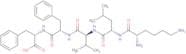
CAS 153247-40-6
:H-Lys-Leu-Val-Phe-Phe-OH
Beschreibung:
Die chemische Substanz "H-Lys-Leu-Val-Phe-Phe-OH," mit der CAS-Nummer 153247-40-6, ist ein synthetisches Peptid, das aus fünf Aminosäuren besteht: Lysin (Lys), Leucin (Leu), Valin (Val) und zwei Phenylalaninen (Phe). Dieses Peptid zeichnet sich durch seine spezifische Sequenz aus, die seine biologische Aktivität und Interaktionen beeinflusst. Die Anwesenheit der Aminosäure Lysin am N-Terminus deutet auf ein Potenzial für eine positive Ladung unter physiologischen Bedingungen hin, während die hydrophobe Natur von Leucin, Valin und Phenylalanin zu seiner strukturellen Stabilität und dem Potenzial zur Bildung sekundärer Strukturen wie Alpha-Helices oder Beta-Faltblätter beiträgt. Die C-terminale Phenylalanin mit einer Hydroxylgruppe zeigt an, dass es sich um eine Carbonsäureamid handelt, was die Löslichkeit und Stabilität verbessern kann. Peptide wie dieses werden oft hinsichtlich ihrer Rolle in biologischen Prozessen, einschließlich Signalwegen und als potenzielle therapeutische Wirkstoffe, untersucht. Ihre Eigenschaften können durch Faktoren wie pH, Temperatur und das Vorhandensein anderer Moleküle beeinflusst werden, was sie sowohl in der biochemischen Forschung als auch in pharmazeutischen Anwendungen wichtig macht.
Formel:C35H52N6O6
Synonyme:- Klvff
- Lys-Leu-Val-Phe-Phe
- Beta-Amyloid (16-20)
- Amyloid Beta-Protein (16-20)
- Amyloid-Beta Protein (16-20), Human, Mouse, Rat
Sortieren nach
Reinheit (%)
0
100
|
0
|
50
|
90
|
95
|
100
1 Produkte.
Amyloid beta-Protein (16-20) trifluoroacetate salt
CAS:Amyloid beta-protein (Aβ) is a peptide that is associated with the development of Alzheimer's disease. The Aβ(16-20) trifluoroacetate salt (ATF) has been used in the diagnosis of Alzheimer's disease by fluorescence microscopy. This compound binds to hyaluronic acid and has been used as a coating for optical fibers and other materials, such as coatings for mitochondria for use in live cell imaging. The ATF also interacts with mitochondria and alters mitochondrial membrane potential, which may be due to its ability to displace cardiolipin from the inner mitochondrial membrane. ATF binds to unsymmetrical dimethylarginine (DMA), an endogenous nitric oxide synthase inhibitor, and selectively inhibits only cancer cells that have elevated levels of DMA. ATFP also induces spontaneous apoptosis in human carcinoma cells when bound to these cells via a photoconjugation reaction with bioconjugate chemistry.Formel:C35H52N6O6Reinheit:Min. 95%Molekulargewicht:652.82 g/mol