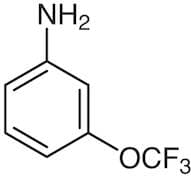
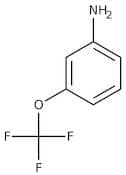
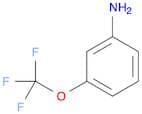
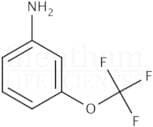
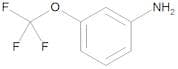
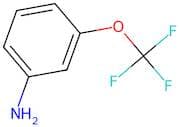
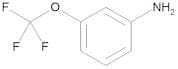
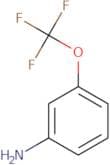
CAS 1535-73-5
:3-(Trifluormethoxy)anilin
- (3-(Trifluoromethoxy)phenyl)amine
- 1-Trifluoromethoxy-3-aminobenzene
- 3-(Trifluoromethoxy)benzenamine
- 3-Trifluoromethoxyaniline
- 3-[(Trifluoromethyl)oxy]aniline
- Benzenamine, 3-(trifluoromethoxy)-
- Zr Coxfff
- m-(Trifluoromethoxy)aniline
- m-Amiaotrifluoromethoxybenzene
- m-Aminophenyl trifluoromethyl ether
- m-Anisidine, α,α,α-trifluoro-
- Weitere Synonyme anzeigen
3-(Trifluoromethoxy)aniline
CAS:Formel:C7H6F3NOReinheit:>98.0%(GC)(T)Farbe und Form:Colorless to Yellow to Orange clear liquidMolekulargewicht:177.133-(Trifluoromethoxy)aniline, 98%
CAS:3-(Trifluoromethoxy)aniline may be used in chemical synthesis. This Thermo Scientific Chemicals brand product was originally part of the Alfa Aesar product portfolio. Some documentation and label information may refer to the legacy brand. The original Alfa Aesar product / item code or SKU referenceFormel:C7H6F3NOReinheit:98%Farbe und Form:Clear pale yellow to pale brown, LiquidMolekulargewicht:177.133-Trifluoromethoxyaniline
CAS:Formel:C7H6F3NOReinheit:98%Farbe und Form:LiquidMolekulargewicht:177.12383-(Trifluoromethoxy)aniline
CAS:3-(Trifluoromethoxy)anilineFormel:C7H6F3NOReinheit:98%Farbe und Form: clear. light brown liquidMolekulargewicht:177.12g/mol3-(Trifluoromethoxy)aniline
CAS:Formel:C7H6F3NOReinheit:97%Farbe und Form:Liquid, ClearMolekulargewicht:177.1263-(Trifluoromethoxy)aniline
CAS:Kontrolliertes ProduktApplications 3-(Trifluoromethoxy)aniline is reactant in the synthesis of pyrazolone-quinazolone hybrids as human hydroxyphenylpyruvate dioxygenase inhibitors which is a potential treatment for type I tyrosinemia.
References Xu, Y., et. al.: Bioorg. Med. Chem., 22, 5194 (2014)Formel:C7H6F3NOFarbe und Form:NeatMolekulargewicht:177.123-(trifluoromethoxy)aniline
CAS:3-(trifluoromethoxy)aniline is a compound that contains a trifluoromethoxy group. It has been shown to have antiproliferative effects in prostate cancer cells. 3-(trifluoromethoxy)aniline inhibits the activity of pim-1, which is important for cell proliferation and differentiation. The synthesis of 3-(trifluoromethoxy)aniline can be accomplished by one of two methods. In the first method, 3-chloroaniline is reacted with trifluoroacetic acid and bis(trimethylsilyl)acetamide in dichloromethane to form 3-hydroxy-4-chlorobenzenesulfonyl chloride (3HCBSCl). In the second method, the desired product is synthesized from 3-aminophenol and trifluoroacetic acid in acetonitrile. These two methods produce different isomers
Formel:C7H6F3NOReinheit:Min. 95%Farbe und Form:PowderMolekulargewicht:177.12 g/molRef: 3D-FT105000
Ausgelaufenes produkt