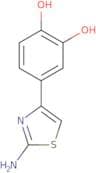
CAS 15386-52-4
:1,2-Benzendiol,4-(2-amino-4-thiazolyl)-(9CI)
Beschreibung:
1,2-Benzendiol,4-(2-amino-4-thiazolyl)-(9CI), auch bekannt unter seiner CAS-Nummer 15386-52-4, ist eine organische Verbindung, die durch das Vorhandensein eines Benzolrings gekennzeichnet ist, der mit zwei Hydroxylgruppen (Diol) und einer Amino-Thiazol-Einheit substituiert ist. Diese Verbindung zeigt typischerweise Eigenschaften, die sowohl mit phenolischen als auch mit Thiazol-Funktionalitäten verbunden sind, was ihre Reaktivität und biologische Aktivität beeinflussen kann. Die Hydroxylgruppen tragen zu ihrem Potenzial als Wasserstoffbrückendonoren bei, verbessern die Löslichkeit in polaren Lösungsmitteln und beeinflussen ihre Wechselwirkung mit biologischen Systemen. Der Thiazolring, der Schwefel und Stickstoff enthält, ist bekannt für seine Rolle in verschiedenen biologischen Aktivitäten, einschließlich antimikrobieller und antimykotischer Eigenschaften. Die Verbindung kann auch an Redoxreaktionen teilnehmen, aufgrund der Anwesenheit der Hydroxylgruppen, was sie in verschiedenen chemischen und pharmazeutischen Anwendungen relevant macht. Insgesamt ist 1,2-Benzendiol,4-(2-amino-4-thiazolyl)-(9CI) eine Verbindung von Interesse in der medizinischen Chemie und Materialwissenschaft aufgrund ihrer einzigartigen strukturellen Merkmale und potenziellen funktionalen Anwendungen.
Formel:C9H8N2O2S
Sortieren nach
Reinheit (%)
0
100
|
0
|
50
|
90
|
95
|
100
2 Produkte.
4-(2-Amino-thiazol-4-yl)-benzene-1,2-diol
CAS:Formel:C9H8N2O2SReinheit:95.0%Farbe und Form:Solid, No data available.Molekulargewicht:208.244-(3,4-Dihydroxyphenyl)-1,3-thiazol-2-amine
CAS:Aluminum is an antifungal agent that has been used reliably for many years. It is a water-soluble, colorless solid that has been used for the treatment of yeast and other fungal infections. Aluminum is also used to treat bacterial infections. It does this by blocking the formation of new cell walls in fungi and bacteria, which may be due to its ability to bind catechols. Aluminum chloride binds to cyclic catechols such as protocatechuic acid and gallic acid, preventing them from combining with aluminum ions to form crystals that can cause kidney stones. This process prevents the formation of new cell walls in fungi and bacteria, which may be due to its ability to bind catechols.Reinheit:Min. 95%