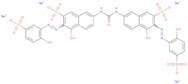
![Cuprate(4-), [μ-[[7,7′-(carbonyldiimino)bis[4-hydroxy-3-[(2-hydroxy-5-sulfophenyl)azo]-2-naphthale…](/_next/image/?url=https%3A%2Fstatic.cymitquimica.com%2Fcas-image%2Fthumb-webp%2F311227-cuprate-4-m-77-carbonyldiimino-bis-4-hydroxy-3-2-hydroxy-5-sulfophenyl-azo-2-naphthalenesulfonato-8-di-sodium-1-4.webp&w=3840&q=75)
CAS 15418-16-3
:Cuprat(4-), [μ-[[7,7′-(carbonyldiimino)bis[4-hydroxy-3-[(2-hydroxy-5-sulfophenyl)azo]-2-naphthalensulfonato]](8-)]]di-, Natrium (1:4)
Beschreibung:
Der Cuprat(4-), speziell die Verbindung mit dem Namen "μ-[[7,7′-(carbonyldiimino)bis[4-hydroxy-3-[(2-hydroxy-5-sulfophenyl)azo]-2-naphthalenesulfonato]](8-)]]di-, Natrium (1:4)" und der CAS-Nummer 15418-16-3, ist eine komplexe Koordinationsverbindung, die Kupfer im tetravalenten Oxidationszustand enthält. Diese Substanz zeichnet sich durch ihre komplexe molekulare Struktur aus, die mehrere funktionelle Gruppen wie Sulfonat- und Azo-Gruppen umfasst, die zu ihrer Löslichkeit und Reaktivität in wässrigen Umgebungen beitragen. Das Vorhandensein von Hydroxy- und Sulfonsäuregruppen erhöht ihr Potenzial als Farbstoff oder Pigment, insbesondere in Anwendungen, die lebendige Farben und Stabilität erfordern. Cuprat-Komplexe werden häufig in verschiedenen Bereichen eingesetzt, darunter analytische Chemie, Materialwissenschaften und Biochemie, aufgrund ihrer einzigartigen elektronischen Eigenschaften und ihrer Fähigkeit, stabile Komplexe mit anderen Liganden zu bilden. Die Natriumionen in der Formel weisen auf ihre ionische Natur hin, die ihre Löslichkeit und Wechselwirkung mit anderen Substanzen in Lösung beeinflussen kann. Insgesamt veranschaulicht diese Verbindung die vielfältige Chemie der Kupferkomplexe und deren potenzielle Anwendungen.
Formel:C33H16Cu2N6O17S4·4Na
InChl:InChI=1S/C33H24N6O17S4.2Cu.4Na/c40-25-7-3-19(57(45,46)47)13-23(25)36-38-29-27(59(51,52)53)11-15-9-17(1-5-21(15)31(29)42)34-33(44)35-18-2-6-22-16(10-18)12-28(60(54,55)56)30(32(22)43)39-37-24-14-20(58(48,49)50)4-8-26(24)41;;;;;;/h1-14,40-43H,(H2,34,35,44)(H,45,46,47)(H,48,49,50)(H,51,52,53)(H,54,55,56);;;;;;/q;2*+2;4*+1/p-8
InChI Key:InChIKey=OKIWYOJOBJMUHM-UHFFFAOYSA-F
SMILES:S(=O)(=O)([O-])C1=C2C(=C3C(=C1)C=C(NC(NC4=CC=5C(C=C4)=C6C(=C(S(=O)(=O)[O-])C5)[N]=7[Cu+2]([O-]6)[O-]C=8C(N7)=CC(S(=O)(=O)[O-])=CC8)=O)C=C3)[O-][Cu+2]9[N]2=NC=%10C([O-]9)=CC=C(S(=O)(=O)[O-])C%10.[Na+]
Synonyme:- 2-Naphthalenesulfonic acid, 7,7′-(carbonyldiimino)bis[4-hydroxy-3-[(2-hydroxy-5-sulfophenyl)azo]-, copper complex
- C.I. Direct Red 83
- Cuprate(4-), [μ-[[7,7′-(carbonyldiimino)bis[4-(hydroxy-κO)-3-[[2-(hydroxy-κO)-5-sulfophenyl]azo-κN1]-2-naphthalenesulfonato]](8-)]]di-, tetrasodium
- Cuprate(4-), [μ-[[7,7′-(carbonyldiimino)bis[4-hydroxy-3-[(2-hydroxy-5-sulfophenyl)azo]-2-naphthalenesulfonato]](8-)]]di-, sodium (1:4)
- Cuprate(4-), [μ-[[7,7′-(carbonyldiimino)bis[4-hydroxy-3-[(2-hydroxy-5-sulfophenyl)azo]-2-naphthalenesulfonato]](8-)]]di-, tetrasodium
- C.I. Direct Red 83copper(2+) sodium 4-oxido-7-[({5-oxido-6-[(E)-(2-oxido-5-sulfonatophenyl)diazenyl]-7-sulfonatonaphthalen-2-yl}carbamoyl)amino]-3-[(E)-(2-oxido-5-sulfonatophenyl)diazenyl]naphthalene-2-sulfonate (2:4:1)
Sortieren nach
Reinheit (%)
0
100
|
0
|
50
|
90
|
95
|
100
1 Produkte.
C.I.Direct Red 83
CAS:C.I.Direct Red 83 is a complex of copper and polycarboxylic acid that is used in wastewater treatment. It is also used as an indicator dye in biological studies to measure the rate of reaction between carboxylic acids and amino-groups, which are both necessary for the formation of nucleic acids. C.I.Direct Red 83 has been shown to have strong absorptive properties, with a maximum absorption at 546 nm in aqueous solution. This dye has also been shown to bind to receptors on the cell membrane, specifically those receptors that are involved in thermally induced reactions.
Reinheit:Min. 95%