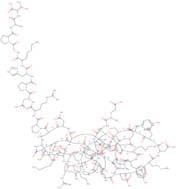
CAS 154303-05-6
:Echistatin
- M.W. 5417.05 C217H341N71O74S9 (Disulfide bonds between Cys2 and Cys11/Cys7 and Cys32/ Cys8 and Cys37/Cys20 and Cys39)
Echistatin
CAS:Echistatin is a 49-amino acid polypeptide from the venom of the saw-scaled viper, Echis carinatus. The peptide containing an RGD motif binds to the glycoprotein IIb/IIIa receptor on the platelet and is a potent competitive inhibitor of ADPstimulated platelet aggregation mediated by fibrinogen and other factors. Furthermore, echistatin effectively inhibits osteoclastic bone resorption in vitro and in vivo.Formel:C217H341N71O74S9Reinheit:> 90%Farbe und Form:Whitish PowderMolekulargewicht:5417.12Echistatin
CAS:Potent αVβ3 integrin blocker, stops osteoclast binding & bone loss, hinders platelet aggregation. Ki=0.27 nM, IC50s: 0.1 nM (bone), 30 nM (platelets).Formel:C217H341N71O74S9Reinheit:98%Farbe und Form:SolidMolekulargewicht:5417.1Echistatin
CAS:Echistatin is a natural product isolated from the venom of the snake Echis carinatus. It is an inhibitor of protein synthesis that binds to the integrin receptor and blocks the binding of extracellular matrix proteins, leading to cell death. Echistatin has been shown to inhibit the proliferation of human osteosarcoma cells in vitro and induce neuronal death in vivo. In addition, it has been shown to be effective against human breast cancer cells that express high levels of integrins. The disulfide bond in echistatin may represent a potential anticancer agent due to its ability to form covalent bonds with other molecules such as DNA, RNA, or proteins.
Formel:C217H341N71O74S9Reinheit:Min. 95%Molekulargewicht:5,417.14 g/molEchistatin α1 isoform
CAS:Antagonization of αVβ3 integrin. Inhibition of cell proliferation, migration, invasion, and adhesion of αVβ3 expressing cells.
Echistatin
CAS:Echistatin is a monoclonal antibody that binds to the Fc receptor on human cells, which blocks the interaction of fibrinogen with integrin receptors. It has shown potential as an anticancer agent in cell cultures and animal models. Echistatin may be used in combination with other drugs, such as cyclosporin A, to inhibit tumor growth. Echistatin also inhibits the proliferation of human osteosarcoma cells, suggesting that it may be useful for treating cancer of the bone.
Formel:C217H341N71O74S9Reinheit:Min. 95%Molekulargewicht:5,417.06 g/mol