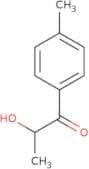
CAS 15482-26-5
:2-Hydroxy-1-(4-methylphenyl)-1-propanon
Beschreibung:
2-Hydroxy-1-(4-methylphenyl)-1-propanon, allgemein bekannt als Acetophenonderivat, ist eine organische Verbindung, die durch ihre Ketongruppe und eine Hydroxylgruppe gekennzeichnet ist. Sie weist ein Propanon-Rückgrat mit einer Hydroxylgruppe (-OH) am zweiten Kohlenstoff und einer Para-Methylphenylgruppe am ersten Kohlenstoff auf. Diese Verbindung ist typischerweise eine farblose bis blassgelbe Flüssigkeit mit einem süßen, angenehmen Geruch, was sie in verschiedenen Anwendungen nützlich macht, einschließlich als Aromastoff und in der Synthese anderer organischer Verbindungen. Sie ist in organischen Lösungsmitteln löslich, hat jedoch eine begrenzte Löslichkeit in Wasser aufgrund ihrer hydrophoben aromatischen Struktur. Das Vorhandensein sowohl der Hydroxyl- als auch der Ketongruppen ermöglicht eine potenzielle Reaktivität in verschiedenen chemischen Reaktionen, einschließlich Oxidation und Veresterung. Darüber hinaus ist es wichtig, diese Verbindung mit Vorsicht zu behandeln, da sie bei Exposition Gesundheitsrisiken darstellen kann, was angemessene Sicherheitsmaßnahmen in Labor- und Industrieumgebungen erforderlich macht.
Formel:C10H12O2
InChl:InChI=1S/C10H12O2/c1-7-3-5-9(6-4-7)10(12)8(2)11/h3-6,8,11H,1-2H3
InChI Key:InChIKey=ZUGZGQZJVSELKS-UHFFFAOYSA-N
SMILES:C(C(C)O)(=O)C1=CC=C(C)C=C1
Synonyme:- Propiophenone, 2-hydroxy-4′-methyl-
- 2-Hydroxy-1-(4-methylphenyl)-1-propanone
- 1-Propanone, 2-hydroxy-1-(4-methylphenyl)-
Sortieren nach
Reinheit (%)
0
100
|
0
|
50
|
90
|
95
|
100
1 Produkte.
2-Hydroxy-1-(4-methylphenyl)propan-1-one
CAS:2-Hydroxy-1-(4-methylphenyl)propan-1-one is a putrefactive compound that has been detected in the breath of pneumoniae and escherichia coli patients. It is also present in the urine of porcine, where it can be used as a biomarker for bacterial infection. The detection of 2-hydroxy-1-(4-methylphenyl)propan-1-one was found to be detectable by magnetic resonance spectroscopy and monitoring with magnetic resonance spectroscopy. The compound has been shown to inhibit bacterial growth in vitro.
Formel:C10H12O2Reinheit:Min. 95%Molekulargewicht:164.2 g/mol