CAS 15483-27-9
:L-Arginyl-L-arginin
Beschreibung:
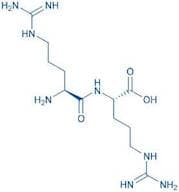
L-Arginyl-L-arginin, auch bekannt als Arg-Arg, ist ein Dipeptid, das aus zwei L-Arginin-Aminosäureresten besteht, die durch eine Peptidbindung verbunden sind. Es zeichnet sich durch seine basische Natur aus, die auf die Anwesenheit der Guanidiniumgruppe in der Seitenkette von Arginin zurückzuführen ist, was zu seiner positiven Ladung bei physiologischem pH-Wert beiträgt. Diese Verbindung ist in Wasser löslich und zeigt eine hohe Affinität zur Bindung an verschiedene biologische Rezeptoren, was sie in biochemischen und pharmakologischen Studien relevant macht. L-Arginyl-L-arginin spielt eine Rolle bei der Synthese von Stickstoffmonoxid, einem kritischen Signalmolekül, das an verschiedenen physiologischen Prozessen beteiligt ist, einschließlich Vasodilatation und Immunantwort. Seine potenziellen Anwendungen erstrecken sich auf Bereiche wie kardiovaskuläre Gesundheit, Wundheilung und Verbesserung der sportlichen Leistung. Darüber hinaus kann es als Substrat für die Produktion anderer bioaktiver Verbindungen dienen. Wie bei vielen Peptiden kann seine Stabilität und Bioverfügbarkeit durch Faktoren wie pH und das Vorhandensein von Enzymen beeinflusst werden. Insgesamt ist L-Arginyl-L-arginin eine bedeutende Verbindung sowohl in der Forschung als auch in therapeutischen Kontexten.
Formel:C12H26N8O3
InChl:InChI=1S/C12H26N8O3/c13-7(3-1-5-18-11(14)15)9(21)20-8(10(22)23)4-2-6-19-12(16)17/h7-8H,1-6,13H2,(H,20,21)(H,22,23)(H4,14,15,18)(H4,16,17,19)/t7-,8-/m0/s1
InChI Key:InChIKey=OMLWNBVRVJYMBQ-YUMQZZPRSA-N
SMILES:[C@H](NC([C@H](CCCNC(=N)N)N)=O)(CCCNC(=N)N)C(O)=O
Synonyme:- 108: PN: WO2021061872 SEQID: 108 claimed protein
- 162: PN: EP2161028 PAGE: 9 claimed protein
- 1688: PN: WO2007124090 PAGE: 83 claimed protein
- 204: PN: WO2010059829 SEQID: 221 unclaimed protein
- 43: PN: WO2010045512 SEQID: 41 unclaimed protein
- 43: PN: WO2020027640 SEQID: 106 claimed protein
- 83: PN: US20090175923 SEQID: 83 unclaimed protein
- 83: PN: US20110202000 SEQID: 83 unclaimed protein
- 83: PN: WO2011149461 SEQID: 83 unclaimed protein
- 85-86-Protein TIM-1 (human fragment)
- <span class="text-smallcaps">L</smallcap>-Arginine, <smallcap>L</span>-arginyl-
- <span class="text-smallcaps">L</smallcap>-Arginine, N<sup>2</sup>-<smallcap>L</span>-arginyl-
- <span class="text-smallcaps">L</smallcap>-Arginyl-<smallcap>L</span>-arginine
- Arg-arg
- Arginine, N<sup>2</sup>-<span class="text-smallcaps">L</smallcap>-arginyl-, <smallcap>L</span>-
- Arginyl-L-arginine
- Arginylarginine
- H-Arg-Arg-Oh Acetate Salt
- L-Arginine, N2-L-arginyl-
- N~5~-(diaminomethylidene)-L-ornithyl-N~5~-(diaminomethylidene)-L-ornithine
- N~5~-(diaminomethylidene)ornithyl-N~5~-(diaminomethylidene)ornithine
- Arginine, N2-L-arginyl-, L-
- L-Arginyl-L-arginine
- Weitere Synonyme anzeigen
Sortieren nach
Reinheit (%)
0
100
|
0
|
50
|
90
|
95
|
100
5 Produkte.
H-Arg-Arg-OH
CAS:Arginine-containing dipeptides as RR and RF are used by nitric oxide synthase as substrates in place of Arg.Formel:C12H26N8O3Reinheit:> 98%Farbe und Form:White PowderMolekulargewicht:330.39H-Arg-Arg-OH Acetate Salt
CAS:Kontrolliertes ProduktFormel:C12H26N8O3Farbe und Form:NeatMolekulargewicht:330.387H-Arg-Arg-OH acetate salt
CAS:H-Arg-Arg-OH acetate salt is a protease inhibitor. It has been shown to inhibit the activity of serine proteases, such as trypsin and chymotrypsin, in vitro. H-Arg-Arg-OH acetate salt binds to the active site of the enzyme and prevents substrate binding. The acidity of the environment where this inhibitor is active can be used to control its activity. At acidic pH, H-Arg-Arg-OH acetate salt is more potent than at neutral pH. When it comes into contact with a protein substrate, H-Arg-Arg-OH acetate salt will bind to a hydroxyl group on the protein molecule and prevent it from hydrolyzing its substrate. This process can be reversed by adding an alkaline buffer to increase the pH of the system or by adding an acid buffer to decrease it.br>br> H-Arg-Arg-OH acetate salt is found in cyanobFormel:C12H26N8O3Reinheit:Min. 95%Molekulargewicht:330.39 g/mol