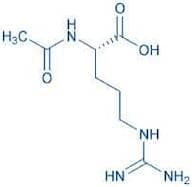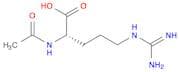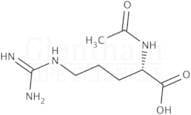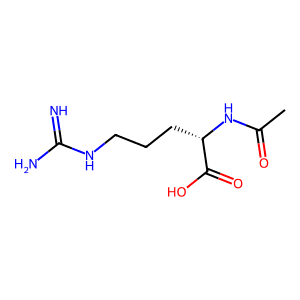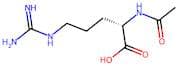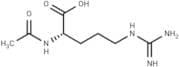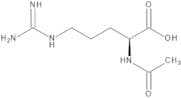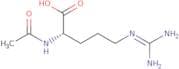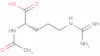
CAS 155-84-0
:N-Acetyl-L-Arginin
Beschreibung:
N-Acetyl-L-Arginin ist ein Derivat der Aminosäure L-Arginin, das durch die Addition einer Acetylgruppe an das Stickstoffatom der Guanidino-Seitenkette gekennzeichnet ist. Diese Modifikation verbessert seine Löslichkeit und Stabilität im Vergleich zu L-Arginin. Die Verbindung ist typischerweise ein weißes bis off-white kristallines Pulver und ist in Wasser und Alkohol löslich, was sie für verschiedene biochemische Anwendungen geeignet macht. N-Acetyl-L-Arginin spielt eine Rolle in biologischen Prozessen, einschließlich der Proteinsynthese und der Produktion von Stickstoffmonoxid, die entscheidend für die vaskuläre Gesundheit und die Immunfunktion sind. Es wird häufig in Forschungseinrichtungen verwendet, insbesondere in Studien, die sich mit Stoffwechsel und zellulärer Signalübertragung befassen. Darüber hinaus könnte es potenzielle therapeutische Anwendungen haben, einschließlich der Behandlung bestimmter kardiovaskulärer Erkrankungen und als Ergänzung zur Verbesserung der sportlichen Leistung. Wie bei vielen Aminosäurederivaten ist das Sicherheitsprofil im Allgemeinen günstig, aber es ist wichtig, die Dosierung und individuelle Gesundheitszustände zu berücksichtigen, wenn es als Ergänzung verwendet wird.
Formel:C8H16N4O3
InChl:InChI=1/C8H16N4O3/c1-5(13)12-6(7(14)15)3-2-4-11-8(9)10/h6H,2-4H2,1H3,(H,12,13)(H,14,15)(H4,9,10,11)/t6-/m1/s1
InChI Key:InChIKey=SNEIUMQYRCDYCH-LURJTMIESA-N
SMILES:[C@@H](CCCNC(=N)N)(NC(C)=O)C(O)=O
Synonyme:- (2S)-2-Acetamido-5-(diaminomethylideneamino)pentanoic acid
- <span class="text-smallcaps">L</span>-Arginine, N<sup>2</sup>-acetyl-
- Arginine, N<sup>2</sup>-acetyl-, <span class="text-smallcaps">L</span>-
- N-Acetyl-<span class="text-smallcaps">L</span>-arginine
- N-Acetyl-L-Arginine
- N-Alpha-Acetyl-L-Arginine
- N-α-Acetyl-L-arginine dihydrate
- N<sup>2</sup>-Acetyl-<span class="text-smallcaps">L</span>-arginine
- N<sup>α</sup>-Acetyl-<span class="text-smallcaps">L</span>-arginine
- N<sup>α</sup>-Acetylarginine
- α-N-Acetyl-<span class="text-smallcaps">L</span>-arginine
- N2-Acetyl-L-arginine
- α-N-Acetyl-L-arginine
- L-Arginine, N2-acetyl-
- Nα-Acetylarginine
- Arginine, N2-acetyl-, L-
- N-A-acetyl-L-arginine crystalline
- n2-acetyl-l-arginin
- Nα-Ac-L-Arg
- (S)-2-Acetylamino-5-guanidinopentanoic acid
- N5-Amidino-N2-acetyl-L-ornithine
- AC-ARGININE
- Ac-L-Arg-OH
- Weitere Synonyme anzeigen
Sortieren nach
Reinheit (%)
0
100
|
0
|
50
|
90
|
95
|
100
10 Produkte.
Ac-Arg-OH
CAS:Bachem ID: 4006130.
Formel:C8H16N4O3Reinheit:> 99%Farbe und Form:WhiteMolekulargewicht:216.24N-A-Acetyl-L-arginine
CAS:Formel:C8H16N4O3Reinheit:≥ 98.0%Farbe und Form:White to off-white powderMolekulargewicht:216.24N-Acetyl-L-arginine
CAS:N-Acetyl-L-arginine (Ac-Arg-OH) is a guanidino compound found in the serum of children with haemodialysis renal insufficiency.Formel:C8H16N4O3Reinheit:99.93%Farbe und Form:SolidMolekulargewicht:216.24(2S)-2-Acetamido-5-(diaminomethylideneamino)pentanoic Acid
CAS:Kontrolliertes ProduktApplications (2S)-2-acetamido-5-(diaminomethylideneamino)pentanoic Acid (cas# 155-84-0) is a useful research chemical.
Formel:C8H16N4O3Farbe und Form:NeatMolekulargewicht:216.2376Ac-Arg-OH
CAS:Ac-Arg-OH is a nucleotide that is involved in the synthesis of adenosine triphosphate (ATP). Ac-Arg-OH has been shown to have hemolytic activity and inhibit protein synthesis. Ac-Arg-OH binds to human serum albumin, which causes the release of hemoglobin. Ac-Arg-OH has also been shown to have an antimicrobial effect on both Gram positive and Gram negative bacteria. The copper complex of Ac-Arg-OH inhibits glutathione peroxidase (GSH-px) activities, causing oxidative stress. Ac-Arg-OH also induces alopecia areata in humans and rats.Formel:C8H16N4O3Reinheit:Min. 95%Molekulargewicht:216.24 g/mol