![2-Propenoic acid, 2-ethyl-2-[[(1-oxo-2-propenyl)oxy]methyl]-1,3-propanediyl ester](/_next/image/?url=https%3A%2Fstatic.cymitquimica.com%2Fcas-image%2Fthumb-webp%2F403763-trimethylolpropane-triacrylate.webp&w=3840&q=75)
CAS 15625-89-5
:2-Propenoinsäure, 2-ethyl-2-[[(1-oxo-2-propenyl)oxy]methyl]-1,3-propandiolester
Beschreibung:
2-Propenoinsäure, 2-ethyl-2-[[(1-oxo-2-propenyl)oxy]methyl]-1,3-propandiolester, allgemein bekannt als eine Art von Acrylatester, ist eine chemische Verbindung, die durch ihre Struktur gekennzeichnet ist, die sowohl ein Acrylat- als auch eine Esterfunktionalgruppe umfasst. Diese Verbindung erscheint typischerweise als farblose bis blassgelbe Flüssigkeit und ist bekannt für ihre Reaktivität, insbesondere in Polymerisationsprozessen. Sie hat eine relativ niedrige Viskosität und ist in organischen Lösungsmitteln löslich, was sie in verschiedenen Anwendungen nützlich macht, einschließlich Beschichtungen, Klebstoffen und Dichtstoffen. Das Vorhandensein der Acrylatgruppe ermöglicht eine schnelle Polymerisation unter UV-Licht oder Wärme, was in den Herstellungsprozessen von Vorteil ist. Darüber hinaus kann diese Verbindung eine moderate Toxizität aufweisen und sollte mit Vorsicht behandelt werden, wobei die entsprechenden Sicherheitsrichtlinien zu beachten sind. Ihre einzigartige Struktur trägt zu ihrer Nützlichkeit bei der Herstellung von Polymeren mit spezifischen Eigenschaften, wie Flexibilität und Haltbarkeit, bei, die in vielen industriellen Anwendungen unerlässlich sind.
Formel:C15H20O6
InChl:InChI=1/C15H20O9/c16-8-15(9-17,10-18)7-14(4-1-11(19)20,5-2-12(21)22)6-3-13(23)24/h1-6,16-18H,7-10H2,(H,19,20)(H,21,22)(H,23,24)/p-3/b4-1+,5-2+,6-3+
InChI Key:InChIKey=DAKWPKUUDNSNPN-UHFFFAOYSA-N
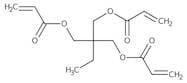
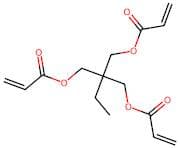
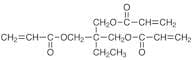
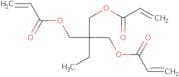
SMILES:C(COC(C=C)=O)(COC(C=C)=O)(COC(C=C)=O)CC
Synonyme:- 1,1,1-Tri(acryloyloxymethyl)propane
- 1,1,1-Trimethylolpropane triacrylate
- 1,3-Propanediol, 2-ethyl-2-(hydroxymethyl)-, triacrylate
- 2,2-Bis(prop-2-enoyloxymethyl)butyl prop-2-enoate
- 2,2-Bis[(acryloyloxy)methyl]butyl acrylate
- 2-Ethyl-2-(hydroxymethyl)-1,3-propanediol triacrylate
- 2-Ethyl-2-[[(1-Oxoallyl)Oxy]Methyl]-1,3-Propanediyl Diacrylate
- 2-Ethyl-2-[[(1-oxoallyl)oxy]methyl]-1,3-propandiyldiacrylat
- 2-Propenoic acid, 1,1'-[2-ethyl-2-[[(1-oxo-2-propen-1-yl)oxy]methyl]-1,3-propanediyl] ester
- A-Tmpt
- Acrylic acid, triester with 2-ethyl-2-(hydroxymethyl)-1,3-propanediol
- Ageflex TMPTA
- AgiSyn 2811
- Aronix M 308
- Aronix M 309
- Aronix M 709
- Blemmer ATT
- Clm 400
- Cognis 4006
- Diacrilato De 2-Etil-2-[[(1-Oxoalil)Oxi]Metil]-1,3-Propanodiilo
- Diacrylate De 2-Ethyl-2-[[(1-Oxoallyl)Oxy]Methyl]-1,3-Propanediyle
- Diacrylate de 2-ethyl-2-[[(1-oxoallyl)oxy]methyl]propane-1,3-diyle
- Ebecryl TMPTA
- Em 231
- Em 231Tf
- Em 232
- Etermer 231
- Etermer EM 231
- Genomer 1330
- Kayarad KS-TMPTA
- Kayarad M 309
- Kayarad TMPTA
- Ks-Tmpta
- Laromer PR 9119
- Laromer TMPTA
- Light Acrylate TMP-A
- Lm 353
- M 300
- M 308
- M 309
- M 380
- Miramer 300
- Miramer M 300
- Miramer M 3130
- Monocizer TD 1500A
- NK Ester A-TMPT
- Neomer TA 300
- Newfrontier TMPT
- Photomer 4006
- Photomer 4006F
- Pl 400
- Saret 351
- Saret SR 519HP
- Sartomer 351
- Sartomer 351HP
- Sartomer 357
- Sartomer SR 351
- Setalux UV 2241
- Sm 631
- Sr 305
- Sr 315S
- Sr 351
- Sr 351H
- Sr 351Hp
- Sr 351Lv
- Sr 351Ns
- Sr 351S
- Sr 354
- Sr 454D-Ns
- Sr 519Hp
- T 30
- Td 1500A
- Tmp 3A
- Tmp 3A3
- Tmp-A
- Tmpta
- Tmpta-N
- Triacrylate, Trimethylolpropane
- Trimethylol Propane Triacrylate
- Trimethylolpropane triacrylate
- Trimethylolpropane tripropenoate
- V 295
- Viscoat 295
- Viscoat PET-S
- Viscoat TMP 3A
- Viscoat V 295
- 2-Propenoic acid, 2-ethyl-2-[[(1-oxo-2-propenyl)oxy]methyl]-1,3-propanediyl ester
- HEXAGLYCERINE TRIACRYLATE
- setaluxuv2241
- 1,1,1-TRIMETHYLOL PROPANE TRIACRYLATE
- acrylicacid,triesterwith2-ethyl-2-(hydroxymethyl)-1,3-propanediol
- ogumontt200
- m309
- 2-propenoicacid,2-ethyl-2-(((1-oxo-2-propenyl)oxy)methyl)-1,3-propanediyle
- sartomersr351
- acrylicacid,1,1,1-(trihydroxymethyl)propanetriester
- nkesteratmpt
- sr351
- saret351
- 3-propanediol,2-ethyl-2-(hydroxymethyl)-triacrylate
- 1,1,1-(TRIHYDROXYMETHYL)PROPANE TRIACRYLATE
- Weitere Synonyme anzeigen
Sortieren nach
Reinheit (%)
0
100
|
0
|
50
|
90
|
95
|
100
5 Produkte.
Trimethylolpropane triacrylate, stabilized
CAS:This Thermo Scientific Chemicals brand product was originally part of the Alfa Aesar product portfolio. Some documentation and label information may refer to the legacy brand. The original Alfa Aesar product / item code or SKU reference has not changed as a part of the brand transition to Thermo Sci
Formel:(CH2CHCO2CH2)3CCH2CH3Farbe und Form:Liquid, Clear colorless to pale yellowMolekulargewicht:296.31Trimethylolpropane Triacrylate
CAS:Formel:C15H20O6Reinheit:90%Farbe und Form:LiquidMolekulargewicht:296.31571,1,1-Tris(Acryloyloxymethyl)Propane
CAS:1,1,1-Tris(Acryloyloxymethyl)PropaneReinheit:95%Molekulargewicht:296.32g/molTrimethylolpropane Triacrylate (stabilized with MEHQ)
CAS:Formel:C15H20O6Reinheit:>75.0%(GC)Farbe und Form:Colorless to Light yellow to Light orange clear liquidMolekulargewicht:296.32Trimethylolpropane triacrylate - stabilized with MEHQ
CAS:Trimethylolpropane triacrylate (TMPTA) is a glycol ester that reacts with acrylates and other monomers to form polymers. It has been used in coating materials as well as in the production of polymers for adhesives, paint, and varnishes. TMPTA has been shown to be carcinogenic in animal studies. In humans, exposure to TMPTA may lead to allergic skin reactions, but no long-term health effects have been observed. TMPTA is produced by reacting methyl ethyl alcohol with phosphorus pentoxide at temperatures above 140°C and then adding a catalyst such as MEHQ or MTOA. The reaction mechanism of this process is similar to that of an esterification reaction and the product is an acrylate. The reaction solution contains residual alcohols which can react with moisture in the air, forming water vapor and lower molecular weight molecules. This polymerization process is also known as "freeFormel:C15H20O6Reinheit:Min. 95%Molekulargewicht:296.32 g/mol