CAS 156251-01-3
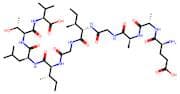
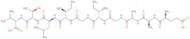
:H-GLU-ALA-ALA-GLY-ILE-GLY-ILE-LEU-THR-VAL-OH
Beschreibung:
Die chemische Substanz mit dem Namen "H-GLU-ALA-ALA-GLY-ILE-GLY-ILE-LEU-THR-VAL-OH" und der CAS-Nummer "156251-01-3" ist ein Peptid, das aus einer Sequenz von Aminosäuren besteht. Dieses Peptid weist eine Kombination aus hydrophilen und hydrophoben Resten auf, die seine Löslichkeit und Interaktion mit biologischen Membranen beeinflussen kann. Die Anwesenheit von Glutaminsäure (GLU) führt zu einer negativ geladenen Seitenkette, während die verzweigtkettigen Aminosäuren wie Isoleucin (ILE) und Leucin (LEU) zu seinem hydrophoben Charakter beitragen. Die terminale Hydroxylgruppe (OH) deutet darauf hin, dass es einige polare Eigenschaften haben könnte, die möglicherweise seine Löslichkeit in wässrigen Umgebungen erhöhen. Peptide wie dieses können eine bedeutende Rolle in biologischen Prozessen spielen, einschließlich Signalgebung, enzymatischer Aktivität und strukturellen Funktionen in Proteinen. Die spezifische Sequenz und Zusammensetzung können auch seine biologische Aktivität, Stabilität und potenzielle Anwendungen in der Pharmazie oder Biotechnologie beeinflussen. Das Verständnis der Eigenschaften solcher Peptide ist entscheidend für ihre Nutzung in Forschungs- und Therapiekontexten.
Formel:C42H74N10O14
Synonyme:- Glu-Ala-Ala-Gly-Ile-Gly-Ile-Leu-Thr-Val
- Eaagigiltv
- Antigen Sk29-Aa (26-35) (Human)
- Antigen Lb39-Aa (26-35) (Human)
- Mart 1 (26-35)
- Mart-1 (26-35) (Human)
- Melanoma Antigen Recognized By T-Cells 1 (26-35) (Human)
Sortieren nach
Reinheit (%)
0
100
|
0
|
50
|
90
|
95
|
100
6 Produkte.
MART-1 (26-35) (human)
CAS:MART-1 (26-35) has been shown to be better recognized by a number of polyclonal and monoclonal populations of tumor-reactive HLA-A*0201-restricted cytotoxic T lymphocytes (CTL) than MART-1 (27-35) (human).Formel:C42H74N10O14Reinheit:96.7%Farbe und Form:WhiteMolekulargewicht:943.11MART-1 (26-35) (human)
CAS:MART-1 (26-35) (human) (MART-1 (26-35) human) is a peptide fragment of MART-1 protein.Formel:C42H74N10O14Reinheit:>99.99%Farbe und Form:SolidMolekulargewicht:943.1MART-1 (26-35)
CAS:Native Melan-A (26-35) decapeptide derives from the melanocyte lineage-specific protein Melan-A/MART-1, which is expressed in almost 75-100% of primary and metastatic melanomas. The region 26-35 of Melan-A protein acts as an antigenic peptide that is recognized by CD8+ tumor-reactive cytolytic T lymphocytes (CTLs) for designing antigen-specific cancer vaccines1. It has been shown that CD8+ Melan-A-specific CTLs isolated from melanoma patients efficiently lyse the Melan-A-expressing HLA-A*0201+ melanoma cell line. However, CTLs preferentially recognize the Melan-A (26-35) peptide as compared with the Melan-A (27-35) peptide. Moreover, the Melan-A (26-35) A27L analog (ELAGIGILTV) has a higher binding affinity to HLA-A*0201 than the native Melan-A (26-35) peptide (EAAGIGILTV), and consequently displays more potent antigenicity and immunogenicity. It has been reported that the concentration of Melan-A (26-35) A27L analog required to obtain 50% of maximal antigenic activity (EC50) is 0.01nM, whereas that of the native Melan-A (26-35) peptide is 0.25nM1. Therefore, the relative activity of Melan-A (26-35) A27L analog is 25 fold higher than that of the native Melan-A (26-35) peptide. Furthermore, functional competition assay has shown that the concentration of Melan-A (26-35) A27L analog required to achieve 50% inhibition (IC50) of tumor lysis is 2nM, which is 10 fold lower than that of the native Melan-A (26-35) peptide. Regarding peptide stability in human serum, the half-lifes (t1/2) of the native Melan-A (26-35) peptide and the A27L analog are quite similar (45 and 40min, respectively) as measured by HPLC-ESI-MS, but much higher than that of the Melan-A (27-35) nonapeptide (5min).Formel:C42H74N10O14Farbe und Form:PowderMolekulargewicht:943.1 g/molMART-1 (26-35) (human)
CAS:Native Melan-A (26-35) decapeptide derives from the melanocyte lineage-specific protein Melan-A/MART-1, which is expressed in almost 75-100% of primary and metastatic melanomas. The region 26-35 of Melan-A protein acts as an antigenic peptide that is recognized by CD8+ tumor-reactive cytolytic T lymphocytes (CTLs) for designing antigen-specific cancer vaccines1. It has been shown that CD8+ Melan-A-specific CTLs isolated from melanoma patients efficiently lyse the Melan-A-expressing HLA-A*0201+ melanoma cell line. However, CTLs preferentially recognize the Melan-A (26-35) peptide as compared with the Melan-A (27-35) peptide. Moreover, the Melan-A (26-35) A27L analog (ELAGIGILTV) has a higher binding affinity to HLA-A*0201 than the native Melan-A (26-35) peptide (EAAGIGILTV), and consequently displays more potent antigenicity and immunogenicity. It has been reported that the concentration of Melan-A (26-35) A27L analog required to obtain 50% of maximal antigenic activity (EC50) is 0.01nM, whereas that of the native Melan-A (26-35) peptide is 0.25nM1. Therefore, the relative activity of Melan-A (26-35) A27L analog is 25 fold higher than that of the native Melan-A (26-35) peptide. Furthermore, functional competition assay has shown that the concentration of Melan-A (26-35) A27L analog required to achieve 50% inhibition (IC50) of tumor lysis is 2nM, which is 10 fold lower than that of the native Melan-A (26-35) peptide. Regarding peptide stability in human serum, the half-lifes (t1/2) of the native Melan-A (26-35) peptide and the A27L analog are quite similar (45 and 40min, respectively) as measured by HPLC-ESI-MS, but much higher than that of the Melan-A (27-35) nonapeptide (5min).Formel:C42H74N10O14Molekulargewicht:943.11 g/molMART-1 (26-35) (human) trifluoroacetate salt
CAS:Native Melan-A (26-35) decapeptide derives from the melanocyte lineage-specific protein Melan-A/MART-1, which is expressed in almost 75-100% of primary and metastatic melanomas. The region 26-35 of Melan-A protein acts as an antigenic peptide that is recognized by CD8+ tumor-reactive cytolytic T lymphocytes (CTLs) for designing antigen-specific cancer vaccines1. It has been shown that CD8+ Melan-A-specific CTLs isolated from melanoma patients efficiently lyse the Melan-A-expressing HLA-A*0201+ melanoma cell line. However, CTLs preferentially recognize the Melan-A (26-35) peptide as compared with the Melan-A (27-35) peptide. Moreover, the Melan-A (26-35) A27L analog (ELAGIGILTV) has a higher binding affinity to HLA-A*0201 than the native Melan-A (26-35) peptide (EAAGIGILTV), and consequently displays more potent antigenicity and immunogenicity. It has been reported that the concentration of Melan-A (26-35) A27L analog required to obtain 50% of maximal antigenic activity (EC50) is 0.01nM, whereas that of the native Melan-A (26-35) peptide is 0.25nM1. Therefore, the relative activity of Melan-A (26-35) A27L analog is 25 fold higher than that of the native Melan-A (26-35) peptide. Furthermore, functional competition assay has shown that the concentration of Melan-A (26-35) A27L analog required to achieve 50% inhibition (IC50) of tumor lysis is 2nM, which is 10 fold lower than that of the native Melan-A (26-35) peptide. Regarding peptide stability in human serum, the half-lifes (t1/2) of the native Melan-A (26-35) peptide and the A27L analog are quite similar (45 and 40min, respectively) as measured by HPLC-ESI-MS, but much higher than that of the Melan-A (27-35) nonapeptide (5min).Formel:C42H74N10O14Reinheit:Min. 95%Molekulargewicht:943.1 g/mol