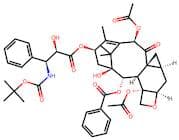
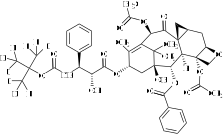
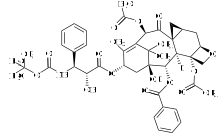
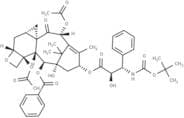
![Benzenepropanoic acid, β-[[(1,1-dimethylethoxy)carbonyl]amino]-α-hydroxy-, (1S,2S,4S,7R,8aR,9aS,10…](/_next/image/?url=https%3A%2Fstatic.cymitquimica.com%2Fcas-image%2Fthumb-webp%2F349111-benzenepropanoic-acid-b-11-dimethylethoxy-carbonyl-amino-a-hydroxy-1s-2s-4s-7r-8ar-9as-10ar-12as-12br-712a-bis-acetyloxy-1-benzoyloxy-1347899a-1010a-1212a-12b-dodecahydro-2-hydroxy-51313-trimethyl-8-oxo-26-methano-2h-cyclodeca-34-cyclopropa-45-.webp&w=3840&q=75)
CAS 156294-36-9
:Benzolpropansäure, β-[[(1,1-dimethylethoxy)carbonyl]amino]-α-hydroxy-, (1S,2S,4S,7R,8aR,9aS,10aR,12aS,12bR)-7,12a-bis(acetoxy)-1-(benzoyloxy)-1,3,4,7,8,9,9a,10,10a,12,12a,12b-dodecahydro-2-hydroxy-5,13,13-trimethyl-8-oxo-2,6-methano-2H-cyclodeca[3,4]cyclopropa[4,5]benz[1,2-b]oxet-4-yl ester, (αR,βS)-
Beschreibung:
Die Benzolpropansäure, β-[[(1,1-Dimethylethoxy)carbonyl]amino]-α-hydroxy- ist eine komplexe organische Verbindung, die durch ihre komplizierte molekulare Struktur gekennzeichnet ist, die mehrere funktionelle Gruppen wie Carbonsäuren, Ester und Hydroxylgruppen umfasst. Diese Verbindung weist ein bicyclisches Gerüst auf, das auf ihre potenzielle biologische Aktivität hinweist, und es ist wahrscheinlich, dass sie Eigenschaften aufweist, die typisch für aromatische und aliphatische Verbindungen sind. Das Vorhandensein mehrerer Stereozentren deutet darauf hin, dass sie in verschiedenen stereoisomeren Formen existieren kann, was ihr chemisches Verhalten und ihre Wechselwirkungen erheblich beeinflussen kann. Die Löslichkeit der Verbindung kann je nach Lösungsmittel variieren, wobei polare Lösungsmittel wahrscheinlich ihre Löslichkeit aufgrund der Anwesenheit von Hydroxyl- und Carbonsäuregruppen erhöhen. Darüber hinaus kann das Vorhandensein von Acetoxy- und Benzoyloxysubstituenten zu ihrer Reaktivität und potenziellen Anwendungen in der medizinischen Chemie oder als synthetischer Zwischenstoff beitragen. Insgesamt macht die strukturelle Komplexität und funktionale Vielfalt dieser Verbindung sie zu einem interessanten Thema in der chemischen Forschung und potenziellen pharmazeutischen Anwendungen.
Formel:C45H53NO14
InChl:InChI=1S/C45H53NO14/c1-23-29(57-39(52)33(49)32(26-15-11-9-12-16-26)46-40(53)60-41(4,5)6)21-45(54)37(58-38(51)27-17-13-10-14-18-27)35-43(36(50)34(56-24(2)47)31(23)42(45,7)8)20-28(43)19-30-44(35,22-55-30)59-25(3)48/h9-18,28-30,32-35,37,49,54H,19-22H2,1-8H3,(H,46,53)/t28-,29+,30-,32+,33-,34-,35+,37+,43-,44+,45-/m1/s1
InChI Key:InChIKey=DXOJIXGRFSHVKA-BZVZGCBYSA-N
SMILES:O=C1[C@@]23[C@@]([C@@]4(OC(C)=O)[C@@](C[C@@]2(C3)[H])(OC4)[H])([C@H](OC(=O)C5=CC=CC=C5)[C@@]6(O)C(C)(C)C([C@H]1OC(C)=O)=C(C)[C@@H](OC([C@@H]([C@@H](NC(OC(C)(C)C)=O)C7=CC=CC=C7)O)=O)C6)[H]
Synonyme:- PNU 100940
- Benzenepropanoic acid, β-[[(1,1-dimethylethoxy)carbonyl]amino]-α-hydroxy-, (1S,2S,4S,7R,8aR,9aS,10aR,12aS,12bR)-7,12a-bis(acetyloxy)-1-(benzoyloxy)-1,3,4,7,8,9,9a,10,10a,12,12a,12b-dodecahydro-2-hydroxy-5,13,13-trimethyl-8-oxo-2,6-methano-2H-cyclodeca[3,4]cyclopropa[4,5]benz[1,2-b]oxet-4-yl ester, (αR,βS)-
- Benzenepropanoic acid, β-[[(1,1-dimethylethoxy)carbonyl]amino]-α-hydroxy-, (1S,2S,4S,7R,8aR,9aS,10aR,12aS,12bR)-7,12a-bis(acetyloxy)-1-(benzoyloxy)-1,3,4,7,8,9,9a,10,10a,12,12a,12b-dodecahydro-2-hydroxy-5,13,13-trimethyl-8-oxo-2,6-methano-2H-cyclodeca[3,4]cyclopropa[4,5]benz[1,2-b]oxet-4-yl ester
- Larotaxel
- Benzenepropanoic acid, β-[[(1,1-dimethylethoxy)carbonyl]amino]-α-hydroxy-, 7,12a-bis(acetyloxy)-1-(benzoyloxy)-1,3,4,7,8,9,9a,10,10a,12,12a,12b-dodecahydro-2-hydroxy-5,13,13-trimethyl-8-oxo-2,6-methano-2H-cyclodeca[3,4]cyclopropa[4,5]benz[1,2-b]oxet-4-yl ester, [1S-[1α,2α,4α(αS*,βR*),7β,8aS*,9aα,10aα,12aα,12bα]]-
Sortieren nach
Reinheit (%)
0
100
|
0
|
50
|
90
|
95
|
100
6 Produkte.
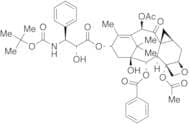
Larotaxel
CAS:Larotaxel (XRP9881), a taxane with anticancer properties, stabilizes microtubules, induces apoptosis, and is researched in breast and bladder cancer.Formel:C45H53NO14Reinheit:99.22%Farbe und Form:SolidMolekulargewicht:831.9Benzenepropanoic acid, β-[[(1,1-dimethylethoxy)carbonyl]amino]-α-hydroxy-, (1S,2S,4S,7R,8aR,9aS,10aR,12aS,12bR)-7,12a-bis(acetyloxy)-1-(benzoyloxy)-1,3,4,7,8,9,9a,10,10a,12,12a,12b-dodecahydro-2-hydroxy-5,13,13-trimethyl-8-oxo-2,6-methano-2H-cyclodeca[3,4]cyclopropa[4,5]benz[1,2-b]oxet-4-yl ester, (αR,βS)-
CAS:Formel:C45H53NO14Reinheit:98%Farbe und Form:SolidMolekulargewicht:831.9006Tolylfluanid 10 µg/mL in Cyclohexane
CAS:Kontrolliertes ProduktApplications Larotaxel (RPR 109881A) is a taxane analog with a broad spectrum of activity and different toxicity profile and with the possible advantages of surpassing some mechanisms of resistance and penetrating into the CNS.
References Kurata, T., et al.: J. Clin. Oncol., 18, 3164 (2000), Kemper, E., et al.: Eur. J. Cancer, 40, 1269 (2004), Nyman, D., et al.: J. Clin. Oncol., 23, 7785 (2005),Formel:C45H53NO14Farbe und Form:NeatMolekulargewicht:831.9

![Benzenepropanoic acid, β-[[(1,1-dimethylethoxy)carbonyl]amino]-α-hydroxy-, (1S,2S,4S,7R,8aR,9aS,10…](/_next/image/?url=https%3A%2Fstatic.cymitquimica.com%2Fproducts%2FIN%2Fthumb%2FDA001OMY.jpg&w=3840&q=75)