CAS 15785-26-9
:Amino-Cyclopropyl-Essigsäure
Beschreibung:
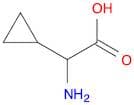
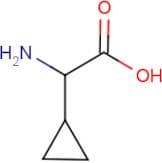
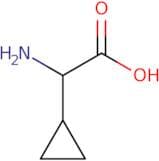
Amino-Cyclopropyl-Essigsäure, mit der CAS-Nummer 15785-26-9, ist eine organische Verbindung, die durch ihre einzigartige Cyclopropylstruktur in Kombination mit einer Amino- und einer Essigsäurefunktionalgruppe gekennzeichnet ist. Diese Verbindung zeigt typischerweise Eigenschaften, die sowohl mit Aminosäuren als auch mit zyklischen Verbindungen assoziiert sind, einschließlich potenzieller polarer Eigenschaften aufgrund der Anwesenheit der Aminogruppe, die an Wasserstoffbrückenbindungen teilnehmen kann. Der Cyclopropylring trägt zu ihrer Steifigkeit bei und kann ihre Reaktivität und Interaktion mit biologischen Systemen beeinflussen. Amino-Cyclopropyl-Essigsäure könnte in der pharmazeutischen Forschung von Interesse sein, da ihre strukturellen Merkmale natürliche Aminosäuren nachahmen oder als Baustein bei der Synthese komplexerer Moleküle dienen könnten. Ihre Löslichkeit in Wasser und organischen Lösungsmitteln kann variieren, abhängig von den spezifischen Bedingungen und der Anwesenheit von Substituenten. Insgesamt deutet die einzigartige Struktur dieser Verbindung und ihre funktionellen Gruppen auf potenzielle Anwendungen in der medizinischen Chemie und Materialwissenschaft hin, obwohl spezifische biologische Aktivitäten und Interaktionen weitere Untersuchungen erfordern würden.
Formel:C5H9NO2
InChl:InChI=1/C5H9NO2/c6-4(5(7)8)3-1-2-3/h3-4H,1-2,6H2,(H,7,8)
SMILES:C1CC1C(C(=O)O)N
Synonyme:- (2R)-amino(cyclopropyl)ethanoic acid
- 2-Cyclopropylglycine
Sortieren nach
Reinheit (%)
0
100
|
0
|
50
|
90
|
95
|
100
4 Produkte.
Cyclopropaneacetic acid, α-amino-
CAS:Formel:C5H9NO2Reinheit:97%Farbe und Form:SolidMolekulargewicht:115.13052-Cyclopropylglycine
CAS:<p>2-Cyclopropylglycine is a cyclic amino acid that is synthesized from threonine. It is an important intermediate in the biosynthesis of the aminoacyl-tRNA synthetases. The synthesis of 2-cyclopropylglycine begins with the conversion of threonine to homoserine by a series of reactions called the threonine deaminase pathway. Homoserine is converted to 3-hydroxy-2-methylvaleric acid by hydroxymethylglutaryl-CoA synthase and then to 2-cyclopropylglycine by cyclopropane carboxylic acid reductase, which reduces it to 2-cyclopropylmalonic acid, which is then converted to 2-cyclopropylglycine. This compound binds borohydride and forms an unstable complex with phenolic compounds. The affinity for these substrates depends on the pyrroline ring structure, with</p>Formel:C5H9NO2Reinheit:Min. 95%Molekulargewicht:115.13 g/mol