CAS 158563-45-2
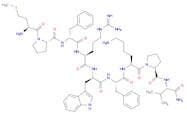
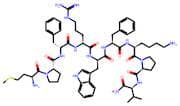
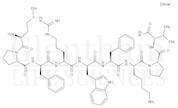
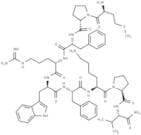
:Nonapeptid-1
Beschreibung:
Nonapeptid-1, auch bekannt unter seiner CAS-Nummer 158563-45-2, ist ein synthetisches Peptid, das aus neun Aminosäuren besteht. Es wird hauptsächlich für seine Rolle in Hautpflegeformulierungen anerkannt, insbesondere für seine potenziellen aufhellenden Effekte auf die Haut. Nonapeptid-1 wirkt, indem es die Aktivität der Tyrosinase hemmt, einem Enzym, das entscheidend für den Melaninproduktionsweg ist, und hilft so, die Hyperpigmentierung zu reduzieren und einen gleichmäßigeren Hautton zu fördern. Dieses Peptid wird häufig in kosmetischen Produkten verwendet, die darauf abzielen, Probleme wie Altersflecken und ungleichmäßige Hautpigmentierung zu behandeln. In Bezug auf die Stabilität ist Nonapeptid-1 unter normalen Lagerbedingungen im Allgemeinen stabil, sollte jedoch vor extremen Temperaturen und direkter Sonneneinstrahlung geschützt werden, um seine Wirksamkeit zu erhalten. Sein Sicherheitsprofil ist günstig, was es für topische Anwendungen geeignet macht, obwohl individuelle Empfindlichkeiten variieren können. Insgesamt stellt Nonapeptid-1 eine wertvolle Zutat in der Kosmetikindustrie dar, insbesondere in Formulierungen, die auf Hautverfärbungen abzielen und einen helleren Teint fördern.
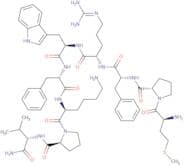
- Met-Pro-D-Phe-Arg-D-Trp-Phe-Lys-Pro-Val-NH2
- L-Methionyl-L-prolyl-D-phenylalanyl-L-arginyl-D-tryptophyl-L-phenylalanyl-L-lysyl-L-prolyl-L-valinamide
Sortieren nach
Reinheit (%)
0
100
|
0
|
50
|
90
|
95
|
100
7 Produkte.
(Met5,pro6,d-phe7,d-trp9,phe10)-α-msh (5-13)
CAS:Formel:C61H87N15O9SReinheit:98%Farbe und Form:SolidMolekulargewicht:1206.5036Nonapeptide-1
CAS:Nonapeptide-1 (Melanostatine™ 5) can inhibit the synthesis of melanin, which makes it of interest for treating certain skin conditions.Formel:C61H87N15O9SReinheit:100%Farbe und Form:SolidMolekulargewicht:1206.5Nonapeptide 1 acetate
CAS:Nonapeptide 1 acetate is an anticancer peptide that acts as a kinase inhibitor. It is a synthetic analog of a protein that is naturally found in human urine and has been used in Chinese medicinal practices for centuries. Nonapeptide 1 acetate has been shown to induce apoptosis in cancer cells by inhibiting the activity of kinases, which are enzymes involved in cell signaling pathways. This inhibition leads to the disruption of cellular processes necessary for tumor growth and survival. Nonapeptide 1 acetate is a promising candidate for cancer therapy due to its potent anticancer activity and low toxicity levels. Its efficacy as a cancer treatment has been demonstrated in preclinical studies, and it is currently being investigated further as a potential therapeutic option for various types of cancer.Formel:C61H87N15O9S•(C2H4O2)xReinheit:Min. 95%(Met5,Pro6,D-Phe7,D-Trp9,Phe10)-α-MSH (5-13)
CAS:(Met5,Pro6,D-Phe7,D-Trp9,Phe10)-a-MSH (5-13) is a fragment of alpha-MSH. It is produced by the coupling of 5 amino acids with a fatty acid at the C-terminus. This peptide has been found to have an anti aging effect on the skin due to its ability to stimulate the production of collagen and glycerin. It also has an active oxygen species that can activate tyrosinase and therefore increase melanin production. The enzyme tyrosinase is responsible for catalyzing the last step in the synthesis of melanin from dopaquinone. This compound may be used cosmetically or as a growth regulator in skincare products.Formel:C61H87N15O9SReinheit:Min. 95%Molekulargewicht:1,206.51 g/mol(Met⁵,Pro⁶,D-Phe⁷,D-Trp⁹,Phe¹⁰)-α-MSH (5-13)
CAS:Potent α-MSH antagonist (IC₅₀ = 11 ± 7 nM).
Formel:C61H87N15O9SReinheit:97.3%Farbe und Form:White PowderMolekulargewicht:1206.52