CAS 15878-00-9
:4-Chloropyrazol
Beschreibung:
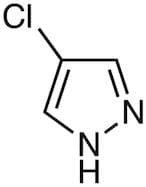
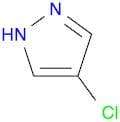
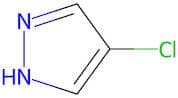
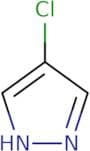
4-Chloropyrazol ist eine organische Verbindung, die durch ihre Pyrazolringstruktur gekennzeichnet ist, die einen fünfgliedrigen Ring mit zwei benachbarten Stickstoffatomen enthält. Das Vorhandensein eines Chloratoms an der Position 4 des Pyrazolrings unterscheidet sie von anderen Derivaten. Diese Verbindung erscheint typischerweise als weißes bis off-white kristallines Feststoff und ist bekannt für ihre moderate Löslichkeit in organischen Lösungsmitteln. 4-Chloropyrazol wird häufig in der Synthese verschiedener Arzneimittel und Agrochemikalien aufgrund ihrer biologischen Aktivität, einschließlich potenzieller antifungaler und herbizider Eigenschaften, verwendet. Ihre Reaktivität wird durch die elektronenanziehende Natur des Chlor-Substituenten beeinflusst, was ihre Wechselwirkung mit anderen chemischen Spezies beeinflussen kann. Sicherheitsdaten zeigen, dass, wie viele chlorierte Verbindungen, sie mit Vorsicht behandelt werden sollte, da sie Gesundheitsrisiken bei Exposition darstellen kann. Insgesamt dient 4-Chloropyrazol als wichtiger Baustein in der organischen Synthese und der medizinischen Chemie.
Formel:C3H3ClN2
InChl:InChI=1S/C3H3ClN2/c4-3-1-5-6-2-3/h1-2H,(H,5,6)
InChI Key:InChIKey=BADSZRMNXWLUKO-UHFFFAOYSA-N
SMILES:ClC=1C=NNC1
Synonyme:- 1H-Pyrazole, 4-chloro-
- 4-Chloro-1H-Pyrazol
- 4-Chloro-1H-Pyrazole
- 4-Chloro-Pyrazol
- Akos B001464
- Art-Chem-Bb B001464
- Pyrazole, 4-chloro-
- Vitas-Bb Tbb000653
- 4-Chloropyrazole
Sortieren nach
Reinheit (%)
0
100
|
0
|
50
|
90
|
95
|
100
5 Produkte.
4-Chloropyrazole
CAS:Formel:C3H3ClN2Reinheit:>98.0%(GC)Farbe und Form:White to Almost white powder to crystalMolekulargewicht:102.524-Chloro-1H-pyrazole
CAS:4-Chloro-1H-pyrazoleFormel:C3H3ClN2Reinheit:95%Farbe und Form: off-white powderMolekulargewicht:102.52g/mol4-Chloro pyrazole
CAS:4-Chloro pyrazole is a pyrazole derivative that has been shown to be effective as an inhibitor of aldehyde dehydrogenase. The structural formula for 4-chloro pyrazole is shown below. This compound binds to the active site of the enzyme, preventing it from catalyzing the conversion of acetaldehyde into acetic acid and thus preventing the accumulation of acetaldehyde in cells. The binding site is thought to involve a nucleophilic attack by the chlorine atom on the carbonyl group at C4 on the pyrazole ring, followed by coordination with two oxygens from water molecules. The chemical analyses indicate that 4-chloro pyrazole is not readily metabolized, which may be due to its inertness as a substrate for various enzymes or its low solubility in biological fluids. br>br> [[File:4-Chloro Pyrazole Structure.png|thumb|center|500px|StructFormel:C3H3ClN2Reinheit:Min. 95%Farbe und Form:Off-White PowderMolekulargewicht:102.52 g/mol4-Chloro-1H-pyrazole
CAS:Formel:C3H3ClN2Reinheit:95%Farbe und Form:Crystalline PowderMolekulargewicht:102.52