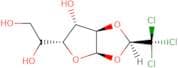
CAS 15879-93-3
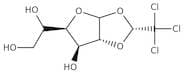
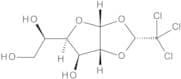
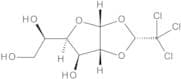
:Chloralose
- (R)-1,2-O-(2,2,2-trichloroethylidene)-alpha-D-glucofuranose
- 1,2-O-(2,2,2-Trichloroethylidene)-alpha-D-glucofuranose
- 1,2-O-(2,2,2-trichloroethylidene)hexofuranose
- 1,2-O-[(1R)-2,2,2-Trichloroethylidene]-α-<span class="text-smallcaps">D</span>-glucofuranose
- 1,2-O-[(1R)-2,2,2-trichloroethylidene]-alpha-D-glucofuranose
- 1,2-O-[(1S)-2,2,2-trichloroethylidene]-alpha-D-glucofuranose
- 1,2-O-[(1S)-2,2,2-trichloroethylidene]-beta-L-idofuranose
- AGC (carbohydrate)
- Alfa 4
- Alfamat
- Alpha 4
- Alpha-D-glucochloralose
- Alphakil
- Anhydroglucochloral
- Aphosal
- Chloralosane
- Chloralose
- Chloralose, α-
- Chloroalosane
- Dorcalm
- Dulcidor
- Furo[2,3-d]-1,3-dioxole, α-<span class="text-smallcaps">D</span>-glucofuranose deriv.
- Glucochloral
- Glucochloral C8H11O6Cl3
- Glucochloralose
- Glucofuranose, 1,2-o-(2,2,2-trichloroethylidene)-, (R)-
- Kalmettumsomniferum
- Murex
- Murex (carbohydrate)
- Somio
- α-<span class="text-smallcaps">D</span>-Chloralose
- α-<span class="text-smallcaps">D</span>-Glucofuranose, 1,2-O-(2,2,2-trichloroethylidene)-, (R)-
- α-<span class="text-smallcaps">D</span>-Glucofuranose, 1,2-O-[(1R)-2,2,2-trichloroethylidene]-
- α-Chloralose
- α-Glucochloralose
- α-Monotrichloroethylidene-<span class="text-smallcaps">D</span>-glucose
- α-D-Glucofuranose, 1,2-O-[(1R)-2,2,2-trichloroethylidene]-
- Furo[2,3-d]-1,3-dioxole, α-D-glucofuranose deriv.
- Weitere Synonyme anzeigen
α-Chloralose (contains β-isomer)
CAS:Formel:C8H11Cl3O6Reinheit:>85.0%(GC)Farbe und Form:White to Almost white powder to crystalMolekulargewicht:309.52α-Chloralose, 98+%, β anomer ca 20%
CAS:It has been employed widely as an animal anesthetic in the laboratory setting. alpha-chloralose is a true anesthetic or an immobilizing agent with sedative-hypnotic properties has important implications. Canada geese (Branta canadensis) and blue geese (Chen caerulescens) were caught with alpha-chlorFormel:C8H11Cl3O6Reinheit:98+%Farbe und Form:White to pale yellow, PowderMolekulargewicht:309.53α-Chloralose
CAS:Anesthetic used in laboratory animal studies; pesticideFormel:C8H11Cl3O6Reinheit:Min. 95%Farbe und Form:PowderMolekulargewicht:309.53 g/mola-Chloralose pure, 98%
CAS:Formel:C8H11O6Cl3Reinheit:min.98%Farbe und Form:White to off - white to pale brown, PowderMolekulargewicht:309.53α-Chloralose (max. 20% β-anomer)
CAS:Alpha-Chloralose (max. 20% beta-anomer) is a chemical compound primarily used as a sedative and for rodent control. It is synthesized through a chemical reaction involving glucose and chloral, creating a substance with unique physiological properties. Its mode of action primarily involves depressing the central nervous system, leading to reduced responsiveness and hypothermia in targeted organisms. Alpha-Chloralose induces symptoms that facilitate its application as a tranquilizer, particularly in small mammals and birds during scientific research. Additionally, due to its efficacy in lowering metabolic rates, it is utilized as a rodenticide. Within this context, it serves to humanely control rodent populations by inducing hypothermic conditions, leading to a humane death. Its dual functionality—both as a sedative and a rodenticide—makes it a versatile tool in scientific research and pest management. The specification of a maximum 20% beta-anomer content ensures a standardized formulation, enhancing its reliability and consistency for experimental and practical applications.
Formel:C8H11Cl3O6Molekulargewicht:309.53 g/mol