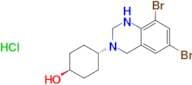
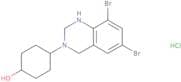
CAS 15942-08-2
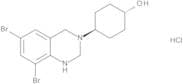
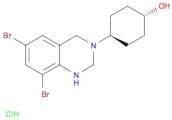
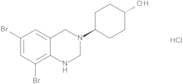
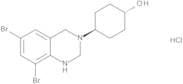
:trans-4-(6,8-dibrom-1,4-dihydrochinazolin-3(2H)yl) cyclohexanol
Beschreibung:
trans-4-(6,8-dibrom-1,4-dihydrochinazolin-3(2H)yl) cyclohexanol ist eine chemische Verbindung, die durch ihre einzigartige Struktur gekennzeichnet ist, die eine Cyclohexanol-Einheit und ein dibromiertes Chinazolin-Derivat umfasst. Die Anwesenheit von Bromatomen führt zu einer signifikanten Polarität und kann die Reaktivität der Verbindung erhöhen, was sie in verschiedenen chemischen Anwendungen von Interesse macht. Die trans-Konfiguration zeigt an, dass spezifische Substituenten auf gegenüberliegenden Seiten des Cyclohexanol-Rings positioniert sind, was die Stereochemie und die physikalischen Eigenschaften der Verbindung, wie Schmelz- und Siedepunkte, beeinflussen kann. Diese Verbindung kann aufgrund des Chinazolin-Kerns biologische Aktivität aufweisen, der für seine Präsenz in verschiedenen pharmakologisch aktiven Substanzen bekannt ist. Darüber hinaus trägt die Hydroxylgruppe im Cyclohexanol zu potenziellen Wasserstoffbrückenbindungen bei, die die Löslichkeit und Reaktivität beeinflussen. Insgesamt deutet die Kombination dieser strukturellen Merkmale darauf hin, dass trans-4-(6,8-dibrom-1,4-dihydrochinazolin-3(2H)yl) cyclohexanol in der medizinischen Chemie und Materialwissenschaft von Bedeutung sein könnte.
Sortieren nach
Reinheit (%)
0
100
|
0
|
50
|
90
|
95
|
100
7 Produkte.
trans-4-(6,8-Dibromo-1,4-dihydroquinazolin-3(2H)-yl)cyclohexanol Hydrochloride
CAS:Farbe und Form:NeatCyclohexanol, 4-(6,8-dibromo-1,4-dihydro-3(2H)-quinazolinyl)-, hydrochloride (1:1), trans-
CAS:Formel:C14H19Br2ClN2OReinheit:95%Farbe und Form:SolidMolekulargewicht:426.5745trans-4-(6,8-Dibromo-1,2-dihydroquinazolin-3(4H)-yl)cyclohexanol hydrochloride
CAS:trans-4-(6,8-Dibromo-1,2-dihydroquinazolin-3(4H)-yl)cyclohexanol hydrochlorideReinheit:95%trans-4-(6,8-Dibromo-1,4-dihydroquinazolin-3(2H)-yl)cyclohexanol Hydrochloride
CAS:Formel:C14H18Br2N2OClHFarbe und Form:NeatMolekulargewicht:426.57N,N'-Methylene Ambroxol Hydrochloride
CAS:Kontrolliertes ProduktImpurity Ambroxol EP Impurity B Hydrochloride
Stability Hygroscopic
Applications Ambroxol Cyclic Impurity is a metabolite as well as an impurity of the bronchosecretolytic drug, Ambroxol (A575900).
References Hammer, R. et al.: Arzneim.-Forsch., 28, 899 (1978); Nieder, M. et al.: HRC & CC, 9, 561 (1986); Huq, F. et al.: J. Pharmacol. Toxicol., 3, 147 (2008);Formel:C14H18Br2N2O·ClHFarbe und Form:White To Off-WhiteMolekulargewicht:426.57Trans-4-(6,8-dibromo-1,2-dihydroquinazolin-3(4H)-yl)cyclohexanol hydrochloride
CAS:Reinheit:95.0%Molekulargewicht:423.955265108Ambroxol hydrochloride impurity B
CAS:Ambroxol hydrochloride impurity B is a byproduct of the chemical synthesis of Ambroxol hydrochloride. It is an organic compound that is a colorless, crystalline solid with a melting point of 93°C and a vapor pressure of 0.0012 mmHg at 25°C. The biological relevance and chronic bronchitis detection time of Ambroxol hydrochloride impurity B are unknown. Chemical reactions involving this compound include hydrolysis, oxidation, esterification, and reduction. Ambroxol hydrochloride impurity B has been detected in human blood plasma as well as in the lungs, liver, spleen, brain and kidney tissues following intravenous administration. This substance can be found as a metabolite in urine and feces following oral ingestion or injection.Formel:C14H19Br2ClN2OReinheit:Min. 95%Farbe und Form:White PowderMolekulargewicht:426.57 g/mol