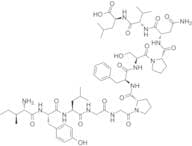
CAS 160369-86-8
:C-reaktives Proteinfragment 174-185
Beschreibung:
C-reaktives Proteinfragment 174-185 ist ein Peptid, das aus dem C-reaktiven Protein (CRP) abgeleitet ist, einem Akutphasenprotein, das von der Leber als Reaktion auf Entzündungen produziert wird. Dieses spezifische Fragment besteht aus den Aminosäuren 174 bis 185 des CRP-Moleküls und ist bekannt für seine Rolle bei der Modulation von Immunantworten. Es zeichnet sich durch seine Fähigkeit aus, an Phosphocholin zu binden, was die Opsonierung von Krankheitserregern erleichtert und deren Clearance durch Immunzellen verbessert. Das Fragment wird häufig auf seine potenziellen Implikationen bei entzündlichen Erkrankungen und kardiovaskulären Erkrankungen untersucht, da CRP-Spiegel häufig als Biomarker für Entzündungen verwendet werden. Die CAS-Nummer 160369-86-8 identifiziert dieses Peptid eindeutig in chemischen Datenbanken und ermöglicht eine präzise Referenz in Forschungs- und klinischen Kontexten. Seine Eigenschaften, wie Löslichkeit und Stabilität, können je nach Formulierung und Bedingungen, unter denen es untersucht wird, variieren. Insgesamt dient dieses Fragment als wertvolles Werkzeug zum Verständnis der biologischen Funktionen von CRP und seiner Rolle im Immunsystem.
Formel:C62H93N13O16
Synonyme:- C-Reactive Protein (CRP) (174-185)
- H-Ile-Tyr-Leu-Gly-Gly-Pro-Phe-Ser-Pro-Asn-Val-Leu-OH
- C-Reactive Protein (174-185)
Sortieren nach
Reinheit (%)
0
100
|
0
|
50
|
90
|
95
|
100
2 Produkte.
C-Reactive Protein (CRP) (174-185)
CAS:CRP protein and its fragment (174-185, RS-83277) boost human monocyte and macrophage cancer-killing effects in vitro.Formel:C62H93N13O16Reinheit:98%Farbe und Form:SolidMolekulargewicht:1276.48C-Reactive protein (crp) (174-185)
CAS:C-reactive Protein (CRP) is a protein that is made by the liver and other tissues in response to inflammation. CRP is an activator of the complement system and a ligand for the receptor C1q, which is involved in the inflammatory response. In addition, CRP binds to ion channels and has been shown to inhibit their opening. CRP also binds to antibody Fc receptors, which are found on macrophages and neutrophils. CRP can act as an inhibitor of protein interactions.
CRP has been used as a research tool to study cell biology, molecular biology, pharmacology, and life science. It is also used as an indicator of systemic inflammation or infection.Formel:C62H93N13O16Reinheit:Min. 95%Molekulargewicht:1,276.5 g/molRef: 3D-KGA36986
Ausgelaufenes produkt