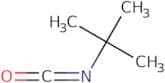
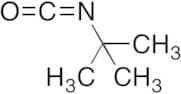
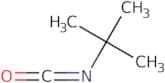
CAS 1609-86-5
:Propan, 2-isocyanato-2-methyl-
Beschreibung:
Propan, 2-isocyanato-2-methyl-, auch bekannt als Isocyanat-2-Methylpropan, ist eine organische Verbindung, die durch das Vorhandensein einer Isocyanat-Funktionalgruppe (-N=C=O) gekennzeichnet ist, die an eine verzweigte Propanstruktur gebunden ist. Diese Verbindung ist typischerweise eine farblose bis blassgelbe Flüssigkeit mit einem stechenden Geruch, der auf die Isocyanatgruppe hinweist. Sie ist bekannt für ihre Reaktivität, insbesondere bei der Bildung von Urethanelinks, wenn sie mit Alkoholen oder Aminen reagiert, was sie in der Produktion von Polyurethanen und anderen Polymeren wertvoll macht. Die Verbindung ist auch für ihre potenziellen Gesundheitsrisiken bekannt; sie kann ein Atemwegsreizmittel sein und wird als Hautsensibilisierer eingestuft. Ein ordnungsgemäßer Umgang und Sicherheitsvorkehrungen sind beim Arbeiten mit dieser Substanz unerlässlich, da eine Exposition zu nachteiligen gesundheitlichen Auswirkungen führen kann. Darüber hinaus ist es wichtig zu beachten, dass Isocyanate in Gegenwart von Feuchtigkeit hydrolysiert werden können, was zur Bildung entsprechender Amine und Kohlendioxid führt.
Formel:C5H9NO
InChl:InChI=1S/C5H9NO/c1-5(2,3)6-4-7/h1-3H3
InChI Key:InChIKey=MGOLNIXAPIAKFM-UHFFFAOYSA-N
SMILES:N(C(C)(C)C)=C=O
Synonyme:- 1,1-Dimethylethyl isocyanate
- 2-Isocyanato-2-methylpropane
- Isocianato De Terc-Butilo
- Isocyanate de tert-butyle
- Isocyanic acid, tert-butyl ester
- Tert-Butyl Isocyanate
- t-Butylisocyanate
- tert-Butylisocyanat
- 2-Methyl-2-isocyanopropane
- Butylisocyanate
- 1,1-dimethylethylisocyanate
- 2-isocyanato-2-methyl-propan
- left-Butyl isocyanate
- T-BUTYLISOCYANIDE
- 2-ISOCYANO-2-METHYL-PROPANE
- Propane, 2-isocyano-2-methyl-
- 2-isocyano-2-methyl-propan
- Propane, 2-isocyanato-2-methyl-
- tert-Butylisocyanate
- Weitere Synonyme anzeigen
Sortieren nach
Reinheit (%)
0
100
|
0
|
50
|
90
|
95
|
100
5 Produkte.
tert-Butylisocyanate
CAS:Tert-butylisocyanate is a reactive chemical that contains a carboxylate group. It is an ester hydrochloride that can be synthesized by reacting trifluoroacetic acid with molybdenum trioxide. This compound has been studied using X-ray crystal structures and the intramolecular hydrogen transfer reaction between two nitrogen atoms in the molecule. Tert-butylisocyanate is stable in solution because it does not react with water or alkalis, but does react with sodium carbonate, forming sodium cyanate and tetrabutylammonium hydroxide. Tert-butylisocyanate reacts with inorganic acids such as sulfuric acid to form its corresponding salts. The chelate ligand of tert-butylisocyanate prevents it from reacting with transition metals such as copper and iron, but will react with zinc metal.Formel:C5H9NOReinheit:Min. 98 Area-%Farbe und Form:Colorless Clear LiquidMolekulargewicht:99.13 g/moltert-Butylisocyanate
CAS:Please enquire for more information about tert-Butylisocyanate including the price, delivery time and more detailed product information at the technical inquiry form on this pageFormel:C5H9NOReinheit:Min. 98.5 Area-%Molekulargewicht:99.13 g/mol