CAS 16110-10-4
:Paracetamol-Glucuronid
Beschreibung:
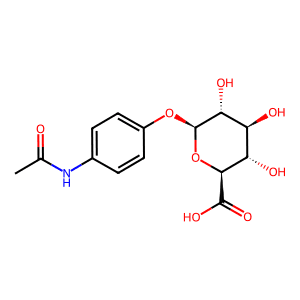
Paracetamol-Glucuronid, mit der CAS-Nummer 16110-10-4, ist ein Metabolit von Paracetamol (Acetaminophen), der durch den Prozess der Glucuronidierung gebildet wird, der eine Phase-II-Stoffwechselreaktion ist. Diese Verbindung zeichnet sich durch ihre Rolle bei der Entgiftung und Eliminierung von Paracetamol aus dem Körper aus. Es handelt sich um ein Konjugat, das entsteht, wenn Paracetamol mit Glucuronsäure verknüpft wird, wodurch seine Löslichkeit in Wasser erhöht und die Ausscheidung über den Urin erleichtert wird. Paracetamol-Glucuronid ist typischerweise nicht toxisch und gehört zu den Hauptmetaboliten, die im menschlichen Urin nach der Einnahme von Paracetamol gefunden werden. In Bezug auf die chemische Struktur enthält es eine phenolische Hydroxylgruppe und eine Glucuronsäureeinheit, die zu seinen polaren Eigenschaften beiträgt. Die Verbindung ist unter physiologischen Bedingungen im Allgemeinen stabil, kann jedoch von verschiedenen Faktoren beeinflusst werden, einschließlich der Leberfunktion und der Anwesenheit anderer Substanzen, die die Glucuronidierungswege beeinflussen können. Das Verständnis seiner Eigenschaften ist entscheidend für die Bewertung der Pharmakokinetik und der potenziellen Toxizität von Paracetamol, insbesondere im Falle einer Überdosierung.
Formel:C14H17NO8
InChl:InChI=1/C14H17NO8/c1-6(16)15-7-2-4-8(5-3-7)22-14-11(19)9(17)10(18)12(23-14)13(20)21/h2-5,9-12,14,17-19H,1H3,(H,15,16)(H,20,21)/t9-,10-,11+,12-,14+/m0/s1
InChI Key:InChIKey=IPROLSVTVHAQLE-BYNIDDHOSA-N
SMILES:O([C@@H]1O[C@H](C(O)=O)[C@@H](O)[C@H](O)[C@H]1O)C2=CC=C(NC(C)=O)C=C2
Synonyme:- 4-(Acetylamino)phenyl β-<span class="text-smallcaps">D</span>-glucopyranosiduronic acid
- 4-(acetylamino)phenyl beta-D-glucopyranosiduronic acid
- 4-Glucuronosidoacetanilide
- 4-Hydroxyacetanilide glucuronide
- Acetanilide glucuronide
- Deethylphenacetin glucuronide
- Glucopyranosiduronic acid, p-acetamidophenyl, β-<span class="text-smallcaps">D</span>-
- N-Acetyl-4-aminophenol glucuronide
- N-Acetyl-4-glucuronosidoaniline
- N-Acetyl-p-aminophenyl glucuronide
- Paracetamol O-glucuronide
- Paracetamol glucuronide
- Paracetamol β-glucuronide
- Pcm-G
- beta-D-Glucopyranosiduronic acid, 4-(acetylamino)phenyl
- p-Acetamidophenyl <span class="text-smallcaps">D</span>-glucosiduronic acid
- p-Acetamidophenyl glucosiduronic acid
- p-Acetamidophenyl glucuronide
- β-<span class="text-smallcaps">D</span>-Glucopyranosiduronic acid, 4-(acetylamino)phenyl
- β-<span class="text-smallcaps">D</span>-Glucopyranosiduronic acid, p-acetamidophenyl
- β-<span class="text-smallcaps">D</span>-Glucosiduronic acid, p-acetamidophenyl
- β-D-Glucopyranosiduronic acid, p-acetamidophenyl
- 4-(Acetylamino)phenyl β-D-glucopyranosiduronic acid
- β-D-Glucosiduronic acid, p-acetamidophenyl
- Acetaminophen glucuronide
- Glucopyranosiduronic acid, p-acetamidophenyl, β-D-
- β-D-Glucopyranosiduronic acid, 4-(acetylamino)phenyl
- Acetaminophen D-glucuronide
- Acetaminophen D-Glucuronide
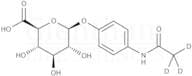
- 2H4]-Acetaminophen β-D-glucuronide
- Acetaminophen Impurity 33
- p-Acetamidophenyl β-D-glucuronide
- acetaminophen O-beta-D-glucosiduronic acid
- Acetaminophen β-D-glucuronide
- Acetaminophen beta-D-glucuronide, Min. 95%
- Acetaminophen O-β-D-glucuronide
- (4-Acetamidophenyl)-glucuronide
- Paracetamol β-D-glucuronide
- Acetaminophen beta-D-glucuronide
- See A158500
- Weitere Synonyme anzeigen
Sortieren nach
Reinheit (%)
0
100
|
0
|
50
|
90
|
95
|
100
6 Produkte.
Acetaminophen β-D-glucuronide
CAS:Acetaminophen β-D-glucuronideFormel:C14H17NO8Reinheit:>95%Farbe und Form: white crystalline solidMolekulargewicht:327.29g/molAcetaminophen D-glucuronide
CAS:Formel:C14H17NO8Reinheit:≥ 98.0%Farbe und Form:White to off-white powderMolekulargewicht:327.29Acetaminophen D-glucuronide
CAS:Acetaminophen D-glucuronide (APG) is a metabolite of acetaminophen. It is a major metabolite produced by the liver after acetaminophen is converted to APG by UDP-glucuronyltransferase. The biological properties of APG are similar to acetaminophen, but it has been shown that APG may have greater potency than acetaminophen in some tissues. For example, in vitro studies using hepatocyte-like cells have shown that APG has higher activity than acetaminophen on the induction of CYP2E1 and CYP3A4, two enzymes involved in drug metabolism. Acetaminophen D-glucuronide can be detected in blood samples for up to 48 hours after administration of an intravenous dose of acetaminophen, which provides a more precise measurement than other methods such as plasma concentrations or urinary excretion measurements.Formel:C14H17NO8Reinheit:Min. 95%Farbe und Form:White PowderMolekulargewicht:327.29 g/mol