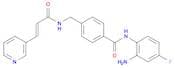
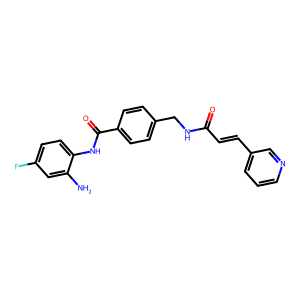
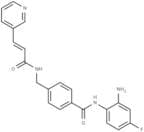
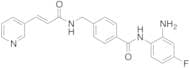
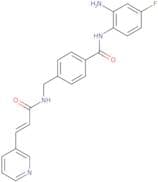
![N-(2-Amino-4-fluorophenyl)-4-[[[(2E)-1-oxo-3-(3-pyridinyl)-2-propen-1-yl]amino]methyl]benzamide](/_next/image/?url=https%3A%2Fstatic.cymitquimica.com%2Fcas-image%2Fthumb-webp%2F313962-n-2-amino-4-fluorophenyl-4-2e-1-oxo-3-3-pyridinyl-2-propen-1-yl-amino-methyl-benzamide.webp&w=3840&q=75)
CAS 1616493-44-7
:N-(2-Amino-4-fluorphenyl)-4-[[[(2E)-1-oxo-3-(3-pyridinyl)-2-propen-1-yl]amino]methyl]benzamid
Beschreibung:
N-(2-Amino-4-fluorphenyl)-4-[[[(2E)-1-oxo-3-(3-pyridinyl)-2-propen-1-yl]amino]methyl]benzamid, mit der CAS-Nummer 1616493-44-7, ist eine synthetische organische Verbindung, die durch ihre komplexe Struktur gekennzeichnet ist, die eine Amidfunktion, ein aromatisches System und ein Pyridinfragment umfasst. Diese Verbindung weist einen fluorierten Phenylring auf, der ihre biologische Aktivität und Lipophilie beeinflussen kann. Das Vorhandensein von Amino- und Carbonylgruppen deutet auf ein Potenzial für Wasserstoffbrückenbindungen hin, was ihre Löslichkeit in polaren Lösungsmitteln verbessern kann. Die Verbindung wird wahrscheinlich spezifische pharmakologische Eigenschaften aufweisen, was sie in der medizinischen Chemie von Interesse macht, insbesondere bei der Entwicklung therapeutischer Mittel. Ihre strukturellen Komponenten können mit biologischen Zielen interagieren, was potenziell zu Anwendungen bei der Behandlung verschiedener Krankheiten führen könnte. Wie bei vielen synthetischen Verbindungen hängen ihre Stabilität, Reaktivität und biologische Wirksamkeit von den spezifischen Bedingungen ab, unter denen sie untersucht wird, einschließlich pH-Wert, Temperatur und dem Vorhandensein anderer chemischer Spezies.
Formel:C22H19FN4O2
InChl:InChI=1S/C22H19FN4O2/c23-18-8-9-20(19(24)12-18)27-22(29)17-6-3-16(4-7-17)14-26-21(28)10-5-15-2-1-11-25-13-15/h1-13H,14,24H2,(H,26,28)(H,27,29)/b10-5+
InChI Key:InChIKey=SZMJVTADHFNAIS-BJMVGYQFSA-N
SMILES:C(NC1=C(N)C=C(F)C=C1)(=O)C2=CC=C(CNC(/C=C/C=3C=CC=NC3)=O)C=C2
Synonyme:- HBI 8000
- N-(2-Amino-4-fluorophenyl)-4-[[[(2E)-1-oxo-3-(3-pyridinyl)-2-propen-1-yl]amino]methyl]benzamide
- Tucidinostat
- Epidaza
- Benzamide, N-(2-amino-4-fluorophenyl)-4-[[[(2E)-1-oxo-3-(3-pyridinyl)-2-propen-1-yl]amino]methyl]-
Sortieren nach
Reinheit (%)
0
100
|
0
|
50
|
90
|
95
|
100
9 Produkte.
(E)-N-(2-Amino-4-Fluorophenyl)-4-((3-(Pyridin-3-Yl)Acrylamido)Methyl)Benzamide
CAS:(E)-N-(2-Amino-4-Fluorophenyl)-4-((3-(Pyridin-3-Yl)Acrylamido)Methyl)BenzamideReinheit:97%Molekulargewicht:390.41g/molTucidinostat
CAS:Tucidinostat is an oral HDAC1/2/3/10 inhibitor (IC50: 67-160 nM), weaker on HDAC8/11, inactive on HDAC4/5/6/7/9.Formel:C22H19FN4O2Reinheit:97.01% - 99.95%Farbe und Form:SolidMolekulargewicht:390.41Ref: TM-T4481
5mg60,00€10mg95,00€25mg159,00€50mg250,00€100mg399,00€200mg558,00€500mg832,00€1mL*10mM (DMSO)60,00€Chidamide
CAS:Kontrolliertes ProduktApplications Chidamide is a newly designed histone deacetylase inhibitor that induces an antitumor effect in various cancer by increasing the acetylation levels of histone H3 and decrease histone deacetylase (HDAC) activity, induces apoptosis. Also, it is a potential utility of Chidamide for the treatment of Myelodysplastic syndromes.
References Liu, Z., et al.: Biomed. Pharmacother., 83, 1032-1027 (2016)Formel:C22H19FN4O2Farbe und Form:NeatMolekulargewicht:390.41Tucidinostat
CAS:De-5-fluoro 4-Fluorochidamide is a potent inhibitor of histone deacetylases (HDACs) that was synthesized as a potential anti-cancer agent. The drug inhibits the HDAC enzyme and prevents the methylation of lysine residues on histones, which leads to changes in gene expression. De-5-fluoro 4-Fluorochidamide has been evaluated in clinical studies for its safety and efficacy in the treatment of cancer, but has not yet been approved for use in humans. De-5-fluoro 4-Fluorochidamide has shown thrombocytopenia and other toxicities in animal models at high doses, which can be attributed to its ability to inhibit HSP90.Formel:C22H19FN4O2Reinheit:Min. 95%Farbe und Form:PowderMolekulargewicht:390.41 g/mol