CAS 161797-99-5
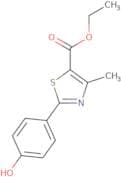
:Ethyl 2-(4-hydroxyphenyl)-4-methyl-5-thiazolcarboxylat
Beschreibung:
Ethyl 2-(4-hydroxyphenyl)-4-methyl-5-thiazolcarboxylat, mit der CAS-Nummer 161797-99-5, ist eine organische Verbindung, die durch ihre Thiazol- und phenolischen funktionellen Gruppen gekennzeichnet ist. Diese Verbindung erscheint typischerweise als feste oder kristalline Substanz und ist bekannt für ihre potenziellen Anwendungen in der Pharmazie und Agrochemie aufgrund ihrer biologischen Aktivität. Die Anwesenheit der Ethylestergruppe trägt zu ihrer Löslichkeit in organischen Lösungsmitteln bei, während die Hydroxylgruppe im phenolischen Ring ihre Reaktivität und Fähigkeit zur Bildung von Wasserstoffbrücken erhöhen kann. Der Thiazolring ist bekannt für seine Rolle in verschiedenen biologischen Prozessen, was diese Verbindung in der medizinischen Chemie von Interesse macht. Ihre molekulare Struktur deutet auf potenzielle Wechselwirkungen mit biologischen Zielen hin, die zu verschiedenen therapeutischen Effekten führen könnten. Darüber hinaus können die Stabilität und Reaktivität der Verbindung durch Umweltfaktoren wie pH und Temperatur beeinflusst werden, die wichtige Überlegungen bei ihrer Anwendung und Handhabung sind. Insgesamt veranschaulicht diese Verbindung die Komplexität und Nützlichkeit von heterocyclischen Verbindungen in der chemischen Forschung und Entwicklung.
Formel:C13H13NO3S
InChl:InChI=1S/C13H13NO3S/c1-3-17-13(16)11-8(2)14-12(18-11)9-4-6-10(15)7-5-9/h4-7,15H,3H2,1-2H3
InChI Key:InChIKey=LOCYSKNNFCGDTR-UHFFFAOYSA-N
SMILES:C(OCC)(=O)C=1SC(=NC1C)C2=CC=C(O)C=C2
Synonyme:- 2-(4-Hydroxyphenyl)-4-Methylthiazole-5-Carboxylate
- 2-(4-Hydroxyphenyl)-4-methylthiazole-5-carboxylic acid ethyl ester
- 2-(4-Hydroxyphenyl)-4-methylthiazole-5-carboxytic acid ethyl ester
- 5-Thiazolecarboxylic acid, 2-(4-hydroxyphenyl)-4-methyl-, ethyl ester
- Ethyl 2-(4-HydroxyPhenyl)-4-Methyl Thiazole-5-Carboxylate
- Ethyl 2-(4-hydroxyphenyl)-4-methyl-1,3-thiazole-5-carboxylate
- Ethyl-2-(4-Hydroxyphenyl)-4-Methyl-5-Thiazolecarboxylate
- Ethyl2-(4-hydroxy phenyl)-4-methylthiazole-5-carboxylate
- Febuxostat N-2
Sortieren nach
Reinheit (%)
0
100
|
0
|
50
|
90
|
95
|
100
7 Produkte.
5-Thiazolecarboxylic acid, 2-(4-hydroxyphenyl)-4-methyl-, ethyl ester
CAS:Formel:C13H13NO3SReinheit:96%Farbe und Form:SolidMolekulargewicht:263.3122Febuxostat Impurity 39
CAS:Formel:C13H13NO3SFarbe und Form:White To Off-White SolidMolekulargewicht:263.31Ethyl 2-(4-Hydroxyphenyl)-4-Methylthiazole-5-Carboxylate
CAS:Ethyl 2-(4-Hydroxyphenyl)-4-Methylthiazole-5-CarboxylateReinheit:98%Molekulargewicht:263.31g/molEthyl 2-(4-Hydroxyphenyl)-4-methylthiazole-5-carboxylate
CAS:Applications Ethyl 2-(4-Hydroxyphenyl)-4-methylthiazole-5-carboxylate is used in the synthesis of the major metabolites of Febuxostat (F229000), a xanthine oxidase/xanthine dehydrogenase inhibitor. Used for treatment of hyperuricemia and chronic gout. 40-120 mg/day febuxostat was proven effective in lowering serum urate levels when administered to manage hyperuricemia in patients with gout.
References Li, X., et. al.: Lett. Org. Chem., 12, 217 (2015); Vallu, V., et. al.: Anal. Chem. Indian J., 14, 339 (2014); Osada, Y., et al.: Eur. J. Pharmacol., 241, 183 (1993); Okamoto, K., et al.: J. Biol. Chem., 278, 1848 (2003); Mayer, M.D., et al.: Am. J. Therap., 12, 22 (2005); Tomlinson, B., et al.: Curr. Opin. Invest. Drugs, 6, 1168 (2005)Formel:C13H13NO3SFarbe und Form:NeatMolekulargewicht:263.312-(4-Hydroxyphenyl)-4-methyl-thiazole-5-carboxylic acid ethyl ester
CAS:Formel:C13H13NO3SReinheit:96%Farbe und Form:SolidMolekulargewicht:263.31Ethyl 2-(4-hydroxyphenyl)-4-methylthiazole-5-carboxylate
CAS:Ethyl 2-(4-hydroxyphenyl)-4-methylthiazole-5-carboxylate is an anticancer agent that belongs to the class of formamidines. It is synthesized by refluxing ethyl 4-hydroxyphenylacetic acid with hexamethylenetetramine and acetic acid in ethanol. After purification, it is converted to its active form by reacting with hydrochloric acid. Ethyl 2-(4-hydroxyphenyl)-4-methylthiazole-5-carboxylate prevents the growth of cancer cells in culture by preventing DNA synthesis, which prevents RNA and protein synthesis. This agent has also been found to suppress paclitaxel production in cultured human breast cancer cells.Formel:C13H13NO3SReinheit:Min. 95%Molekulargewicht:263.31 g/mol