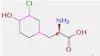
CAS 162599-96-4
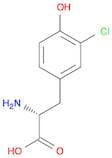
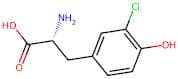
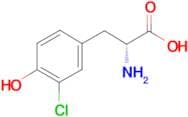
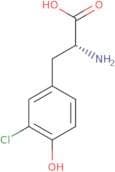
:H-D-Tyr(3-Cl)-OH
Beschreibung:
H-D-Tyr(3-Cl)-OH, auch bekannt als 3-Chlor-Tyrosin, ist ein Derivat der Aminosäure Tyrosin, das durch das Vorhandensein eines Chloratoms in der Meta-Position des phenolischen Rings gekennzeichnet ist. Diese Modifikation kann die biochemischen Eigenschaften des Verbindungsstoffs beeinflussen, wie z.B. seine Reaktivität und Interaktion mit Enzymen oder Rezeptoren. Das Vorhandensein der Hydroxylgruppe (-OH) trägt zu seiner polarer Natur bei und verbessert seine Löslichkeit in wässrigen Umgebungen. H-D-Tyr(3-Cl)-OH wird häufig in der biochemischen Forschung eingesetzt, insbesondere in Studien zur Proteinsynthese, Enzymaktivität und zur Untersuchung der Rolle von Tyrosin in der Produktion von Neurotransmittern. Seine strukturelle Ähnlichkeit mit natürlichem Tyrosin ermöglicht es ihm, an verschiedenen biologischen Prozessen teilzunehmen, während die Chlorersetzung einzigartige Eigenschaften verleihen kann, wie veränderte Bindungsaffinitäten oder Stabilität. Wie bei vielen Aminosäurederivaten ist es wichtig, diese Verbindung mit Vorsicht zu behandeln, da ihre potenzielle biologische Aktivität und die Auswirkungen ihrer Chlorersetzung in experimentellen Kontexten berücksichtigt werden müssen.
Formel:C9H10ClNO3
InChl:InChI=1S/C9H10ClNO3/c10-6-3-5(1-2-8(6)12)4-7(11)9(13)14/h1-3,7,12H,4,11H2,(H,13,14)/t7-/m0/s1
SMILES:c1cc(c(cc1C[C@@H](C(=O)O)N)Cl)O
Synonyme:- 3-Chloro-D-tyrosine
- m-Chloro-D-Tyr-OH
- D-Tyrosine, 3-chloro-
Sortieren nach
Reinheit (%)
0
100
|
0
|
50
|
90
|
95
|
100
4 Produkte.
Fmoc-D-Aph(D-Hor)-OH
CAS:<p>Fmoc-D-Aph(D-Hor)-OH is a prodrug that is metabolized to the active form, 3-chloro-l-tyrosine. It has been shown to interact with optical and natural products, such as oxone, to form novel compounds. Fmoc-D-Aph(D-Hor)-OH can be used as an antimitotic agent in cancer research. It has high cytotoxicity against a number of cell lines, including resistant cell lines. Fmoc-D-Aph(D-Hor)-OH inhibits microtubule formation by binding to tubulin monomers and preventing their polymerization into microtubules. This leads to accumulation of cells in the G2 phase of the cell cycle and ultimately apoptosis. Fmoc-D-Aph(D-Hor)-OH also inhibits fungal growth through interaction with ergosterol, which disrupts membrane integrity and causes leakage of intracellular contents</p>Formel:C29H26N4O7Reinheit:Min. 95%Farbe und Form:PowderMolekulargewicht:542.54 g/mol