CAS 1633-44-9
:3,4-Pyridindicarbonitril
Beschreibung:
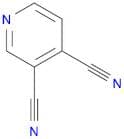
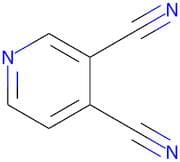
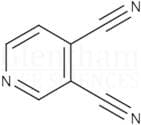
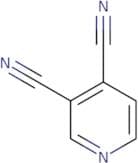
3,4-Pyridindicarbonitril, mit der CAS-Nummer 1633-44-9, ist eine organische Verbindung, die durch ihre Pyridinringstruktur gekennzeichnet ist, die an den Positionen 3 und 4 mit zwei Cyanogruppen substituiert ist. Diese Verbindung ist typischerweise ein Feststoff bei Raumtemperatur und weist ein kristallines Aussehen auf. Sie ist bekannt für ihre hohe Polarität aufgrund der Anwesenheit der Cyanogruppen, die an Wasserstoffbrückenbindungen und Dipol-Dipol-Interaktionen teilnehmen können. Die Cyanogruppen tragen auch zu ihrer Reaktivität bei, was sie zu einem nützlichen Zwischenprodukt in der organischen Synthese macht, insbesondere bei der Herstellung von Arzneimitteln und Agrochemikalien. Darüber hinaus kann 3,4-Pyridindicarbonitril biologische Aktivität aufweisen, die für potenzielle Anwendungen in der medizinischen Chemie untersucht werden kann. Ihre Löslichkeit in polaren Lösungsmitteln und die begrenzte Löslichkeit in unpolaren Lösungsmitteln sind typisch für Verbindungen, die Cyanogruppen enthalten. Sicherheitsdaten sollten konsultiert werden, da Verbindungen mit Cyanogruppen toxisch sein können und eine sorgfältige Handhabung erfordern.
Formel:C7H3N3
InChl:InChI=1/C7H3N3/c8-3-6-1-2-10-5-7(6)4-9/h1-2,5H
InChI Key:InChIKey=ALJUMASAQKRVRM-UHFFFAOYSA-N
SMILES:C(#N)C=1C(C#N)=CN=CC1
Synonyme:- 3,4-Dicyanopyridine
- Cinchomerononitrile
- Pyridine-3,4-Dicarbonitrile
- 3,4-Pyridinedicarbonitrile
- 3,4-pyridinedicarbonitrile
- CINCHOMERONIC DINITRILE
- 3 4-PYRIDINEDICARBONITRILE 96%
- Cinchomeronitrile
- Pyridine-3,4-dicarbonitrile, 98+%
- 3,4-Pyridinedicarbonitrile(7CI,8CI,9CI)
Sortieren nach
Reinheit (%)
0
100
|
0
|
50
|
90
|
95
|
100
5 Produkte.
3,4-Pyridinedicarbonitrile
CAS:Formel:C7H3N3Reinheit:95%Farbe und Form:SolidMolekulargewicht:129.11883,4-Pyridinedicarbonitrile
CAS:Formel:C7H3N3Reinheit:≥ 98.0%Farbe und Form:White to off-white powder to crystalsMolekulargewicht:129.12Pyridine-3,4-dicarbonitrile
CAS:Pyridine-3,4-dicarbonitrile (PDC) is a ligand that can be synthesized in the laboratory and is used to study the magnetic resonance spectroscopy of organic molecules. PDC binds to metal ions and forms coordination complexes. It has been shown that these complexes have synergistic effects with cancer drugs such as cisplatin and doxorubicin. This ligand also has been shown to bind to copper or iron ions and form stable coordination compounds. PDC can be used in organic solvents, which makes it an ideal candidate for use in organic synthesis.
Formel:C7H3N3Reinheit:Min. 95%Molekulargewicht:129.12 g/mol