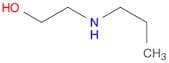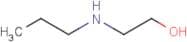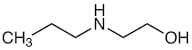
CAS 16369-21-4
:N-Propylethanolamin
- (2-Hydroxyethyl)propylamine
- 2-(Propylamino)ethan-1-ol
- 2-Propylaminoethanol
- Ethanol, 2-(propylamino)-
- Mono-n-propylaminoethanol
- N-Propyl-2-hydroxy-1-ethylamine
- N-Propyl-2-hydroxyethylamine
- N-Propylethanolamine
- Propyl(2-hydroxyethyl)amine
- 2-(Propylamino)ethanol
- 2-(Propylamino)ethanol
Ethanol, 2-(propylamino)-
CAS:Formel:C5H13NOReinheit:95%Farbe und Form:LiquidMolekulargewicht:103.16282-(Propylamino)ethanol
CAS:Formel:C5H13NOReinheit:>98.0%(GC)(T)Farbe und Form:Colorless to Almost colorless clear liquidMolekulargewicht:103.172-(Propylamino)ethanol
CAS:Formel:C5H13NOReinheit:96%;RGFarbe und Form:LiquidMolekulargewicht:103.1652-(Propylamino)ethanol
CAS:2-(Propylamino)ethanol (2-PAE) is a structural isomer of 2-aminoethanol. It has been shown to interact with polymer concentration and covid-19 pandemic. 2-PAE is an amine that can be used as a pharmaceutical solvent in the synthesis of polymers. This molecule also interacts with red blood cells and can be used in the study of these cells. Magnetic resonance spectroscopy (MRS) was used to measure the viscosity of 2-PAE, which was found to be lower than expected for this type of molecule. The decoupling effect between 2-PAE and water molecules was also studied using MRS, which showed that the interaction between 2-PAE and water molecules is stronger than that between water molecules themselves.
2-(Propylamino)ethanol has been shown to have a similar effect on chloride ion permeability as other alkanolamines, such as monoethanolReinheit:Min. 95%