CAS 1637-75-8
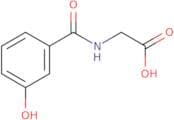
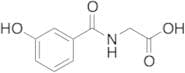
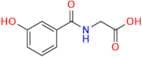
:3-Hydroxyhippursäure
Beschreibung:
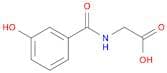
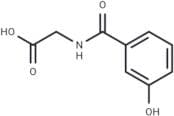
3-Hydroxyhippursäure ist eine aromatische Verbindung, die ein Derivat der Hippursäure ist und durch das Vorhandensein einer Hydroxylgruppe an der Position 3 des aromatischen Rings gekennzeichnet ist. Sie wird typischerweise im Körper als Metabolit bestimmter aromatischer Verbindungen gebildet, insbesondere solcher, die in Lebensmitteln und Umweltquellen vorkommen. Diese Verbindung ist in Wasser löslich und weist aufgrund der Carbonsäuregruppe schwache saure Eigenschaften auf. Ihre molekulare Struktur umfasst einen Benzolring, eine Carbonsäuregruppe und eine Aminogruppe, die zu ihrer biologischen Aktivität beitragen. 3-Hydroxyhippursäure wird häufig im Kontext der Umweltexposition gegenüber Schadstoffen untersucht, da sie als Biomarker für die Exposition gegenüber bestimmten aromatischen Verbindungen dienen kann. Darüber hinaus kann sie Implikationen in der Pharmakologie und Toxikologie haben, da ihre Werte metabolische Prozesse und potenzielle gesundheitliche Auswirkungen widerspiegeln können. Insgesamt ist 3-Hydroxyhippursäure sowohl in der biochemischen Forschung als auch in der Umweltgesundheitsforschung von Bedeutung.
Formel:C9H9NO4
InChl:InChI=1S/C9H9NO4/c11-7-3-1-2-6(4-7)9(14)10-5-8(12)13/h1-4,11H,5H2,(H,10,14)(H,12,13)
InChI Key:InChIKey=XDOFWFNMYJRHEW-UHFFFAOYSA-N
SMILES:C(NCC(O)=O)(=O)C1=CC(O)=CC=C1
Synonyme:- Glycine, N-(3-hydroxybenzoyl)-
- m-Hydroxyhippuric acid
- N-(3-Hydroxybenzoyl)glycine
- Hippuric acid, m-hydroxy-
- 3-Hydroxyhippuric acid
Sortieren nach
Reinheit (%)
0
100
|
0
|
50
|
90
|
95
|
100
9 Produkte.
Glycine,N-(3-hydroxybenzoyl)-
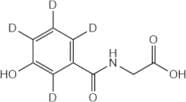
CAS:Formel:C9H9NO4Reinheit:98%Farbe und Form:SolidMolekulargewicht:195.17213-Hydroxyhippuric-d4 acid (3-hydroxybenzamido-2,4,5,6-d4)
CAS:Reinheit:98 atom % DMolekulargewicht:199.223-Hydroxyhippuric acid
CAS:3-Hydroxyhippuric acid is an acyl glycine, which are normally minor metabolites of fatty acids.Formel:C9H9NO4Farbe und Form:SolidMolekulargewicht:195.17m-Hydroxyhippuric Acid-13C2, 15N
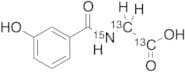
CAS:Applications m-Hydroxyhippuric Acid-13C2, 15N is labelled m-Hydroxyhippuric Acid (H943125) which is a metabolite of caffeic and chlorogenic acids in human.
References Booth, A., et al.: J. Biol. Chem., 229, 51 (1957); Gonthier, M., et al.: Biomed. Pharmacother., 60, 536 (2006)Formel:C713C2H915NO4Farbe und Form:White To Off-WhiteMolekulargewicht:198.153-Hydroxyhippuric acid
CAS:3-Hydroxyhippuric acid is an organic acid that is the main metabolite of benzoic acid. It is excreted in urine and can be used as a biomarker for the ingestion of benzoic acid. 3-Hydroxyhippuric acid has been detected in human urine samples after ingestion of caffeic acids, chlorogenic acids, or phenolic acids. 3-Hydroxyhippuric acid is also produced by microbial metabolism of p-hydroxybenzoate (pHBA) and may be used as a biomarker for pHBA consumption. The metabolic profile of 3-hydroxyhippuric acid varies with the type of substrate consumed: caffeic acids lead to the production of 3,4-dihydroxyphenylacetic acid (DOPAC), while chlorogenic acids produce 4-chlorophenol (4CP). Cholesterol estersase (CES) catalyzes the hydrolysis ofFormel:C9H9NO4Reinheit:Min. 95 Area-%Farbe und Form:White PowderMolekulargewicht:195.17 g/mol(3-HYDROXYBENZOYLAMINO)ACETIC ACID
CAS:Formel:C9H9NO4Reinheit:≥99%Farbe und Form:SolidMolekulargewicht:195.174m-Hydroxyhippuric Acid
CAS:Kontrolliertes ProduktFormel:C9H9NO4Farbe und Form:White To Off-WhiteMolekulargewicht:195.17