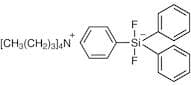
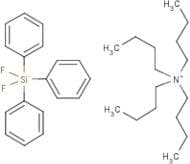
CAS 163931-61-1
:Tetrabutylammoniumtriphenyldifluorosilicat (TBAT)
- Tetrabutylammonium triphenyldifluorosilicate
- Tbat
- Tetrabutylammonium difluorotriphenylsilicate
- N,N,N-tributylbutan-1-aminium difluoro(triphenyl)silicate(1-)
- Tetrabutylamoniumdifluorotriphenylsilicate
Tetrabutylammonium Difluorotriphenylsilicate
CAS:Formel:C34H51F2NSiReinheit:>97.0%(T)(qNMR)Farbe und Form:White to Almost white powder to crystalMolekulargewicht:539.87Tetrabutylammonium difluorotriphenylsilicate
CAS:Tetrabutylammonium difluorotriphenylsilicateReinheit:98%Molekulargewicht:539.86g/molTetrabutylammonium Difluorotriphenylsilicate
CAS:Kontrolliertes ProduktStability Moisture Sensitive
Applications Tetrabutylammonium Difluorotriphenylsilicate is used as a reagent in the synthesis of (S)-N-(3-(3,6-dibromo-9H-carbazol-9-yl)-2-fluoropropyl)-6-methoxypyridin-2-amine ((-)-P7C3-S243); a neuroprotective chemical with improved druglike properties.
Not a dangerous good if item is equal to or less than 1g/ml and there is less than 100g/ml in the package
References Naidoo, J., et al.: J. Med. Chem., 57, 3754 (2014)Formel:C18H15F2Si·C16H36NFarbe und Form:NeatMolekulargewicht:539.858Tetrabutylammonium difluorotriphenylsilicate
CAS:Tetrabutylammonium difluorotriphenylsilicate is a model system for studying the mechanism of nucleophilic substitution at an unsymmetrical carbon center. It is used in analytical chemistry to prepare samples for analysis. Tetrabutylammonium difluorotriphenylsilicate has been shown to be an effective and selective reagent for the synthesis of picolinic acid, which can be used as a precursor for the synthesis of nicotinamide riboside, a vitamin B3 derivative. The reaction proceeds via an SN2 mechanism, where hydrogen fluoride (HF) acts as a nucleophile that attacks the electrophilic carbon center of allyl chloride (CH2=CH-CH2Cl) to form an intermediate with two alkyl groups on opposite sides. The reaction product is then hydrolyzed to release tetrabutylammonium chloride (tBuNH4Cl).
Formel:C34H51F2NSiReinheit:Min. 95%Farbe und Form:White PowderMolekulargewicht:539.86 g/mol