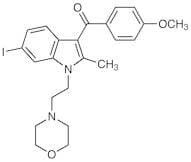
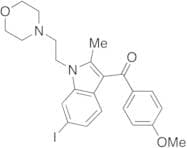
![[6-Iodo-2-methyl-1-[2-(4-morpholinyl)ethyl]-1H-indol-3-yl](4-methoxyphenyl)methanone](/_next/image/?url=https%3A%2Fstatic.cymitquimica.com%2Fcas-image%2Fthumb-webp%2F298996-6-iodo-2-methyl-1-2-4-morpholinyl-ethyl-1h-indol-3-yl-4-methoxyphenyl-methanone.webp&w=3840&q=75)
CAS 164178-33-0
:[6-Iod-2-methyl-1-[2-(4-morpholinyl)ethyl]-1H-indol-3-yl](4-methoxyphenyl)methanon
Beschreibung:
Die chemische Substanz, die als [6-Iod-2-methyl-1-[2-(4-morpholinyl)ethyl]-1H-indol-3-yl](4-methoxyphenyl)methanon bekannt ist, mit der CAS-Nummer 164178-33-0, ist eine synthetische Verbindung, die zur Klasse der Indolderivate gehört. Sie weist eine komplexe Struktur auf, die durch das Vorhandensein eines Indolrings gekennzeichnet ist, der eine bicyclische Struktur ist, die aus einem Benzolring besteht, der mit einem Pyrrolring verschmolzen ist. Die Verbindung enthält ein Iodatom an der Position 6 des Indols, was ihre Reaktivität und biologische Aktivität beeinflussen kann. Darüber hinaus hat sie eine Morpholin-Gruppe, die ein sechsgliedriger Ring ist, der Sauerstoff und Stickstoff enthält und zu ihren pharmakologischen Eigenschaften beiträgt. Die Methoxyphenylgruppe erhöht ihre Lipophilie, was möglicherweise ihre Löslichkeit und Permeabilität beeinflusst. Diese Verbindung kann verschiedene biologische Aktivitäten aufweisen, was sie in der medizinischen Chemie und der Arzneimittelentwicklung von Interesse macht. Spezifische biologische Wirkungen und Anwendungen würden jedoch weitere Untersuchungen durch empirische Studien erfordern.
Formel:C23H25IN2O3
InChl:InChI=1S/C23H25IN2O3/c1-16-22(23(27)17-3-6-19(28-2)7-4-17)20-8-5-18(24)15-21(20)26(16)10-9-25-11-13-29-14-12-25/h3-8,15H,9-14H2,1-2H3
InChI Key:InChIKey=JHOTYHDSLIUKCJ-UHFFFAOYSA-N
SMILES:C(=O)(C=1C=2C(N(CCN3CCOCC3)C1C)=CC(I)=CC2)C4=CC=C(OC)C=C4
Synonyme:- 6-Iodo-2-Methyl-1-[[2-(4-Morpholinyl)Ethyl]-1H-Indol-3-Yl](4-Methoxyphenyl)Methanone
- Am630
- Iodopravadoline
- Methanone, [6-iodo-2-methyl-1-[2-(4-morpholinyl)ethyl]-1H-indol-3-yl](4-methoxyphenyl)-
- [6-Iodo-2-methyl-1-(2-morpholin-4-ylethyl)indol-3-yl]-(4-methoxyphenyl)methanone
- [6-iodo-2-methyl-1-(2-morpholin-4-ylethyl)-1H-indol-3-yl](4-methoxyphenyl)methanone
- AM 630
Sortieren nach
Reinheit (%)
0
100
|
0
|
50
|
90
|
95
|
100
5 Produkte.
6-Iodopravadoline
CAS:6-Iodopravadoline (AM630) is an antagonist of CB2 (Ki: 31.2 nM). And it shows 165-fold selectivity more than CB1 receptors.Formel:C23H25IN2O3Reinheit:99.29%Farbe und Form:Off-White SolidMolekulargewicht:504.36Ref: TM-T14204
1mg38,00€2mg52,00€5mg70,00€10mg90,00€25mg198,00€50mg326,00€100mg520,00€1mL*10mM (DMSO)99,00€Methanone, [6-iodo-2-methyl-1-[2-(4-morpholinyl)ethyl]-1H-indol-3-yl](4-methoxyphenyl)-
CAS:Formel:C23H25IN2O3Reinheit:97%Farbe und Form:SolidMolekulargewicht:504.3607AM-630
CAS:Formel:C23H25IN2O3Reinheit:>98.0%(HPLC)Farbe und Form:White to Light yellow powder to crystalMolekulargewicht:504.37AM 630
CAS:Kontrolliertes ProduktApplications AM 630 acts as a potential CB2 receptor cannabinoid antagonist with application towards human lung cancer treatment and angiogenesis induction.Synthetic Cannabinoids
References Ramer, R. et al.: Mol. Canc. Ther., 12, 69 (2013); Huang, H. et al.: Hepatol., 56, 248 (2012);Formel:C23H25IN2O3Farbe und Form:NeatMolekulargewicht:504.36AM 630
CAS:Kontrolliertes ProduktAM630 is an aminoalkylindole synthetic cannabinoid which acts as a potent selective inverse agonist at the cannabinoid receptor CB2 (Ki = 32.1 nM) and a partial agonist at cannabinoid receptor CB1. However, it has also been reported to act as an antagonist at the CB1 receptor at higher concentrations2. In vitro, AM630 showed anti-tumorigenic properties by decreased viability in a prostate adenocarcinoma cell line and reducing pro-inflammatory cytokines in vitro as well as in vivo2,3. It also has been shown to activate TRPA1 channels in neural cultures as well as stimulate TRPA1-mediated antihyperalgesia in wild-type mice and rats4.Formel:C23H25IN2O3Reinheit:Min. 95%Farbe und Form:PowderMolekulargewicht:504.36 g/mol


![Methanone, [6-iodo-2-methyl-1-[2-(4-morpholinyl)ethyl]-1H-indol-3-yl](4-methoxyphenyl)-](/_next/image/?url=https%3A%2Fstatic.cymitquimica.com%2Fproducts%2FIN%2Fthumb%2FDA001UOM.jpg&w=3840&q=75)