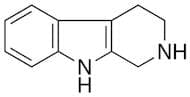
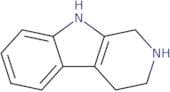
CAS 16502-01-5
:Tetrahydro-β-carbolin
Beschreibung:
Tetrahydro-β-carbolin (THBC) ist eine bicyclische Verbindung, die zur Klasse der β-Carboline gehört, die aus der Familie der Indolalkaloide abgeleitet sind. Sie ist durch eine verschmolzene Ringstruktur gekennzeichnet, die aus einem Benzolring und einem pyrrolähnlichen Ring besteht. THBC ist typischerweise eine farblose bis blassgelbe Flüssigkeit oder ein Feststoff, abhängig von seiner Form und Reinheit. Es ist bekannt für seine potenziellen biologischen Aktivitäten, einschließlich neuroprotektiver Effekte und der Fähigkeit, als Vorläufer in der Synthese verschiedener Alkaloide zu wirken. THBC kann an verschiedenen chemischen Reaktionen teilnehmen, einschließlich Oxidation und Kondensation, was es von Interesse in der organischen Synthese und der medizinischen Chemie macht. Darüber hinaus wurde es für seine Rolle bei der Modulation von Neurotransmittersystemen untersucht, insbesondere in Bezug auf Dopamin und Serotonin. Seine Löslichkeit in organischen Lösungsmitteln und die begrenzte Löslichkeit in Wasser sind bemerkenswerte Eigenschaften, die seine Anwendungen in der Forschung und potenziellen therapeutischen Anwendungen beeinflussen. Sicherheitsdaten sollten konsultiert werden, um Handhabungs- und Expositionsrichtlinien zu erhalten, wie bei jeder chemischen Substanz.
Formel:C11H12N2
InChl:InChI=1S/C11H12N2/c1-2-4-10-8(3-1)9-5-6-12-7-11(9)13-10/h1-4,12-13H,5-7H2
InChI Key:InChIKey=CFTOTSJVQRFXOF-UHFFFAOYSA-N
SMILES:C1=2C3=C(NC1=CC=CC2)CNCC3
Synonyme:- 1,2,3,4-Tetrahydro-9H-Pyrido[3,4-B]Indole
- 1,2,3,4-Tetrahydro-β-carboline
- 1H,2H,3H,4H,9H-Pyrido[3,4-b]indole
- 1H-Pyrido[3,4-b]indole, 2,3,4,9-tetrahydro-
- 2,3,4,9-Tetrahydro-1H-pyrido(3,4-b)indole
- 2,3,4,9-Tetrahydro-1H-pyrido[4,3-b]indole
- 2,3,4,9-Tetrahydro-1H-β-carboline
- 9H-1,2,3,4-Tetrahydropyrido(3,4-b)indole
- 9H-Pyrido(3,4-b)indole, 2,3,4,9-tetrahydro-
- Norharman, 1,2,3,4-tetrahydro-
- Tetrahydro-beta-carboline
- Tetrahydro-β-carboline
- Tetrahydronorharman
- Tetrahydronorharmane
- Triptoline
- Weitere Synonyme anzeigen
Sortieren nach
Reinheit (%)
0
100
|
0
|
50
|
90
|
95
|
100
7 Produkte gefunden.
1H-Pyrido[3,4-b]indole, 2,3,4,9-tetrahydro-
CAS:Formel:C11H12N2Reinheit:97%Farbe und Form:SolidMolekulargewicht:172.22641,2,3,4-Tetrahydro-9H-Pyrido[3,4-B]Indole
CAS:1,2,3,4-Tetrahydro-9H-Pyrido[3,4-B]IndoleReinheit:98%Molekulargewicht:172.23g/molTetrahydro-β-carboline
CAS:Tetrahydro-β-carboline ,with CAS No. 16502-01-5, is a fragment molecule that serves as an important scaffold for molecular linking, expansion, and modification. Tetrahydro-β-carboline provides a structural basis and research tool for the design and screening of novel drug candidates, and is commonly used in drug discovery, drug synthesis, and related research.Formel:C11H12N2Reinheit:96.31%Farbe und Form:Tan SolidMolekulargewicht:172.22642,3,4,9-Tetrahydro-1H-pyrido[3,4-b]indole
CAS:Reinheit:95.0%Farbe und Form:SolidMolekulargewicht:172.23100280761721,2,3,4-Tetrahydro-b-carboline
CAS:Kontrolliertes ProduktApplications A mitotic kinesin inhibitor as novel anti-cancer agent. Used in the study of neurodegenerative diseases.
References Brown, K., et al.: J. Cell Biol., 125, 1303 (1994), Sharp, D., et al.: Nature, 407, 41 (2000), Sueishi, M., et al.: J. Biol. Chem., 275, 28888 (2000), Lee, Y., et al.: Biochem. J., 360, 549 (2001),Formel:C11H12N2Farbe und Form:NeatMolekulargewicht:172.23Noreleagnine
CAS:Noreleagnine is a natural compound that is used to inhibit the replication of viruses. It has been shown to bind to dopamine receptors in the brain, which may be responsible for its cytotoxic effects on mouse tumor cells. Noreleagnine can also be used as a sample preparation agent because it can produce light emission and biological properties that are similar to those of dopamine. This drug is synthesized using an asymmetric synthesis and sodium carbonate. A number of methods have been developed for the synthesis of noreleagnine, including ester hydrochloride and electrochemical detector.Formel:C11H12N2Reinheit:Min. 98 Area-%Farbe und Form:PowderMolekulargewicht:172.23 g/mol
![1H-Pyrido[3,4-b]indole, 2,3,4,9-tetrahydro-](/_next/image/?url=https%3A%2Fstatic.cymitquimica.com%2Fproducts%2FIN%2Fthumb%2FDA001V86.jpg&w=3840&q=75)

![1,2,3,4-Tetrahydro-9H-Pyrido[3,4-B]Indole](/_next/image/?url=https%3A%2Fstatic.cymitquimica.com%2Fproducts%2F54%2Fthumb%2FOR1009061.jpg&w=3840&q=75)

![1,2,3,4-Tetrahydro-9H-pyrido[3,4-b]indole](/_next/image/?url=https%3A%2Fstatic.cymitquimica.com%2Fproducts%2F7W%2Fthumb%2FGK1961.jpg&w=3840&q=75)

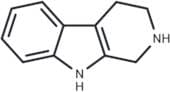

![2,3,4,9-Tetrahydro-1H-pyrido[3,4-b]indole](/_next/image/?url=https%3A%2Fstatic.cymitquimica.com%2Fproducts%2F10%2Fthumb%2FF216506.jpg&w=3840&q=75)