CAS 1660-19-1
:(4-Formyl-2-methoxyphenoxy)essigsäure
Beschreibung:
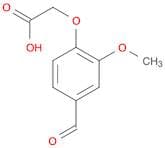
(4-Formyl-2-methoxyphenoxy)essigsäure, mit der CAS-Nummer 1660-19-1, ist eine organische Verbindung, die durch ihre funktionellen Gruppen gekennzeichnet ist, zu denen ein Aldehyd (Formyl) und eine Carbonsäure (Essigsäure) gehören, die an einen methoxy-substituierten Phenylring gebunden sind. Diese Verbindung erscheint typischerweise als feste oder kristalline Substanz und ist aufgrund der Anwesenheit der Carbonsäuregruppe in polaren Lösungsmitteln löslich. Ihre Struktur deutet auf potenzielle Anwendungen in der Pharmazie und Agrochemie hin, insbesondere als Zwischenprodukt in der Synthese komplexerer Moleküle. Die Anwesenheit der Methoxygruppe kann ihre Reaktivität und Löslichkeit beeinflussen, während die Aldehydfunktionalität an verschiedenen chemischen Reaktionen, wie Kondensation oder Oxidation, teilnehmen kann. Darüber hinaus kann die Verbindung biologische Aktivität zeigen, was sie für weitere Forschungen in der medizinischen Chemie von Interesse macht. Sicherheitsdaten sollten für den Umgang und die Lagerung konsultiert werden, wie bei jeder chemischen Substanz, um sicherzustellen, dass angemessene Vorsichtsmaßnahmen getroffen werden.
Formel:C10H9O5
InChl:InChI=1/C10H10O5/c1-14-9-4-7(5-11)2-3-8(9)15-6-10(12)13/h2-5H,6H2,1H3,(H,12,13)/p-1
SMILES:COc1cc(ccc1OCC(=O)[O-])C=O
Synonyme:- Acetic acid, 2-(4-formyl-2-methoxyphenoxy)-
- (4-Formyl-2-Methoxyphenoxy)Acetate
- (4-Formyl-2-methoxyphenoxy)acetic acid
Sortieren nach
Reinheit (%)
0
100
|
0
|
50
|
90
|
95
|
100
4 Produkte.
Acetic acid,2-(4-formyl-2-methoxyphenoxy)-
CAS:Formel:C10H10O5Reinheit:98%Farbe und Form:SolidMolekulargewicht:210.1834(4-Formyl-2-methoxyphenoxy)acetic acid
CAS:(4-Formyl-2-methoxyphenoxy)acetic acidReinheit:98%Molekulargewicht:210.1834g/mol(4-Formyl-2-methoxyphenoxy)acetic acid
CAS:Phenoxyacetic acid is a phenoxy compound that exhibits antibacterial and anthelmintic activity. It has been shown to be highly active against helminthes, such as tapeworms and roundworms. Phenoxyacetic acid interacts with the helminth's cell membrane, which causes the release of cytochrome c from mitochondria and inhibits mitochondrial function. This leads to cell death by inhibiting protein synthesis and DNA replication. The hydrophobic nature of phenoxyacetic acid allows it to penetrate the anthelmint's cuticle and enter the worm's body cavity where it inhibits mitochondrial function. Phenoxyacetic acid has also been shown to inhibit tuberculosis in mice in vivo, but not in vitro. In addition, phenoxyacetic acid binds to nuclei of cancer cells and prevents the production of RNA and protein synthesis. This results in cell death by apoptosis or necrosis.Formel:C10H10O5Reinheit:Min. 95%Farbe und Form:PowderMolekulargewicht:210.18 g/mol