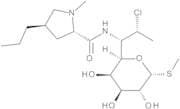
CAS 16684-06-3
:D-erythro-a-D-galacto-Octopyranosid, methyl 7-chlor-6,7,8-trideoxy-6-[[[(2S,4R)-1-methyl-4-propyl-2-pyrrolidinyl]carbonyl]amino]-1-thio-(9CI)
Beschreibung:
D-Erythro-a-D-Galacto-Octopyranosid, Methyl 7-Chloro-6,7,8-Trideoxy-6-[[[(2S,4R)-1-Methyl-4-Propyl-2-Pyrrolidinyl]carbonyl]amino]-1-Thio- (9CI), identifiziert durch die CAS-Nummer 16684-06-3, ist eine komplexe organische Verbindung, die durch ihre einzigartigen strukturellen Merkmale gekennzeichnet ist. Sie enthält eine Pyranosid-Gruppe, die eine sechsgliedrige zyklische Form eines Zuckers ist, was auf ihre potenzielle Rolle in biologischen Systemen hinweist, insbesondere in Glycosylierungsprozessen. Die Anwesenheit einer Thio-Gruppe deutet darauf hin, dass sie eine für Thiole typische Reaktivität aufweisen könnte und potenziell an nucleophilen Reaktionen teilnehmen kann. Die Verbindung weist auch ein chloriertes aromatisches System auf, das ihre biologische Aktivität und Löslichkeit beeinflussen kann. Darüber hinaus deutet das Vorhandensein eines Pyrrolidinrings darauf hin, dass sie mit biologischen Rezeptoren oder Enzymen interagieren könnte, was möglicherweise ihre pharmakologischen Eigenschaften beeinflusst. Insgesamt deutet die komplexe Struktur dieser Verbindung auf potenzielle Anwendungen in der medizinischen Chemie hin, insbesondere bei der Entwicklung von Therapeutika, die auf spezifische biologische Wege abzielen. Detaillierte Studien wären jedoch erforderlich, um ihre Eigenschaften und potenziellen Anwendungen vollständig zu klären.
Formel:C18H33ClN2O5S
Synonyme:- D-erythro-D-galacto-Octopyranoside,methyl7-chloro-6,7,8-trideoxy-6-(1-methyl-4-propyl-L-2-pyrrolidinecarboxamido)-1-thio-,trans- a- (8CI)
- D-erythro-a-D-galacto-Octopyranoside, methyl7-chloro-6,7,8-trideoxy-6-[[(1-methyl-4-propyl-2-pyrrolidinyl)carbonyl]amino]-1-thio-,(2S-trans)-
- 7-Epiclindamycin
- Antibiotic U 21251F
Sortieren nach
Reinheit (%)
0
100
|
0
|
50
|
90
|
95
|
100
6 Produkte.
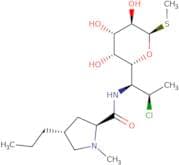
(2S,4R)-N-((1S,2R)-2-Chloro-1-((2R,3R,4S,5R,6R)-3,4,5-trihydroxy-6-(methylthio)tetrahydro-2H-pyran-2-yl)propyl)-1-methyl-4-propylpyrrolidine-2-carboxamide
CAS:Formel:C18H33ClN2O5SFarbe und Form:SolidMolekulargewicht:424.9830Clindamycin EP Impurity C (7-epi Clindamycin)
CAS:Formel:C18H33ClN2O5SFarbe und Form:Yellow SolidMolekulargewicht:424.98Clindamycin Phosphate Impurity 4
CAS:Formel:C18H33N2O8PSFarbe und Form:Yellow SolidMolekulargewicht:468.507-Epi Clindamycin
CAS:Kontrolliertes ProduktImpurity Clindamycin EP Impurity C
Applications 7-Epiclindamycin (Clindamycin EP Impurity C) is an epimer of Clindamycin (C580000), which is a semi-synthetic antibiotic prepared from Lincomycin, an antibacterial. In addition, 7-Epiclindamycin is an intermediate in synthesizing 7-Epiclindamycin 2-Phosphate (>90%) (E582505), which is an another impurity of Clindamycin.
References Birkenmeyer, R., et al.: J. Med. Chem., 13, 616 (1970), Platzer, D., et al.: J. Pharm. Biomed. Anal., 41, 84 (2006), Platzer, D., et al.: J. Pharm. Biomed. Anal., 41, 84 (2006); Oesterling, et al.: J. Pharm. Sci., 59, 63 (1970); Gray, J.E., et al.: Toxicol. Appl. Pharmacol., 21, 516 (1972); Brown, L.W., et al.: Anal. Profiles Drug Subs., 10, 75 (1981)Formel:C18H33ClN2O5SFarbe und Form:NeatMolekulargewicht:424.987-epi-Clindamycin
CAS:7-epi-Clindamycin is a clindamycin derivative, which is a semisynthetic antibiotic derived from the bacterium *Streptomyces lincolnensis*. Its mode of action involves binding to the 50S subunit of the bacterial ribosome, thereby inhibiting protein synthesis. This results in the suppression of bacterial growth, making it effective against certain Gram-positive bacteria and anaerobic species.Formel:C18H34Cl2N2O5SReinheit:Min. 95%Farbe und Form:White To Off-White SolidMolekulargewicht:461.44 g/mol