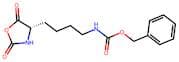
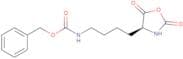
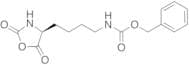
![Carbamic acid, [4-(2,5-dioxo-4-oxazolidinyl)butyl]-, phenylmethyl ester,(S)-](/_next/image/?url=https%3A%2Fstatic.cymitquimica.com%2Fcas-image%2Fthumb-webp%2F40544-n6-carbobenzoxy-l-lysine-n-carboxyanhydride.webp&w=3840&q=75)
CAS 1676-86-4
:Carbaminsäure, [4-(2,5-dioxo-4-oxazolidinyl)butyl]-, phenylmethylester,(S)-
Beschreibung:
Carbaminsäure, [4-(2,5-dioxo-4-oxazolidinyl)butyl]-, Phenylmethylester, mit der CAS-Nummer 1676-86-4, ist eine organische Verbindung, die durch ihre Carbamat-Funktionalität gekennzeichnet ist. Diese Substanz weist eine Phenylmethylester-Gruppe auf, die zu ihren potenziellen Anwendungen in der medizinischen Chemie und als synthetischer Zwischenstoff beiträgt. Das Vorhandensein des Oxazolidinonrings deutet darauf hin, dass sie interessante biologische Eigenschaften aufweisen könnte, möglicherweise in Bezug auf ihre strukturelle Ähnlichkeit mit bestimmten Arzneimitteln. Die Verbindung wird wahrscheinlich ein weißer bis schwach weißer Feststoff sein, der in organischen Lösungsmitteln löslich ist, und könnte unter Standardbedingungen eine moderate Stabilität aufweisen. Ihre Reaktivität kann durch die Ester- und Carbamat-Funktionalitäten beeinflusst werden, was sie zu einem Kandidaten für weitere chemische Transformationen macht. Sicherheitsdaten sollten für den Umgang und die Lagerung konsultiert werden, wie bei jeder chemischen Substanz, um sicherzustellen, dass die richtigen Vorsichtsmaßnahmen getroffen werden. Insgesamt stellt diese Verbindung eine einzigartige Struktur dar, die in verschiedenen Bereichen von Interesse sein könnte, einschließlich der Arzneimittelentwicklung und der organischen Synthese.
Formel:C15H18N2O5
Synonyme:- Carbamic acid, N-[(4S)-4-(2,5-dioxo-4-oxazolidinyl)butyl]-, phenylmethyl ester
- Lys(Z)-NCA
- N-[(4S)-4-(2,5-Dioxo-4-oxazolidinyl)butyl]carbaMic Acid PhenylMethyl Ester
- L-Lys(Cbz)-NCA
- CarbaMic acid, [4-(2,5-dioxo-4-oxazolidinyl)butyl]-, phenylMethyl ester,(S)-
- (S)-[4-(2,5-Dioxo-4-oxazolidinyl)butyl]carbaMic Acid Phen
- L-[4-(2,5-Dioxo-4-oxazolidinyl)butyl]carbaMic Acid Benzyl Ester
- N-benzyloxycarbonyl-L-lysine N-carboxyanhydride
- (S)-Benzyl (4-(2,5-dioxooxazolidin-4-yl)butyl)carbamate
- Lys(Cbz)-NCA
- K(Z)-NCA
- N6-Carbobenzoxy-L-lysine N-Carboxyanhydride
- Weitere Synonyme anzeigen
Sortieren nach
Reinheit (%)
0
100
|
0
|
50
|
90
|
95
|
100
5 Produkte.
N6-Benzyloxycarbonyl-L-lysine N-carboxyanhydride
CAS:Formel:C15H18N2O5Reinheit:96%Farbe und Form:SolidMolekulargewicht:306.3138(S)-Benzyl (4-(2,5-Dioxooxazolidin-4-Yl)Butyl)Carbamate
CAS:(S)-Benzyl (4-(2,5-Dioxooxazolidin-4-Yl)Butyl)CarbamateReinheit:97%Molekulargewicht:306.31g/molN6-Carbobenzoxy-L-lysine N-carboxyanhydride
CAS:N6-Carbobenzoxy-L-lysine N-carboxyanhydride is a protected form of amino acid L-lysine, where the side chain amine is Z-protected and the α-amine and carboxylic acid groups are linked via a carboxyl. N6-Carbobenzoxy-L-lysine N-carboxyanhydride can undergo a basic polycondensation reaction to afford polylysine, a polymer of α-linked lysine. Polylysine has a range of biological activities, such as, the inhibition of fungal infections (Trichophyton mentagrophytes, T. rubrum, and Candida albicans) in plants. Polylysine is used to coat tissue culture ware, where it enhances cell adherence.Formel:C15H18N2O5Reinheit:Min. 95%Farbe und Form:White Off-White PowderMolekulargewicht:306.31 g/mol(S)-Benzyl (4-(2,5-dioxooxazolidin-4-yl)butyl)carbamate
CAS:Formel:C15H18N2O5Reinheit:96%Molekulargewicht:306.318N6-Carbobenzoxy-L-lysine N-Carboxyanhydride
CAS:Kontrolliertes ProduktApplications A L-lysine derivative used in the preparation of Polylysine, a synthetic, basic poly-α-amino acid. Polylysine inhibited fungal penetration and polyphenol formation in susceptible sweet potatoes infected with C. fimbriata and caused some inhibition of fungal growth, a lessening of the penetration by the fungus, and more callus formation in resistant sweet potatoes. The compound inhibited the infection of tomato cuttings by F. lycopersici but was also toxic to the plants. Polyglutamic acid had no effect on the fungi in vitro.
References Buchanan-Davidson, D.J., et al.: Science, 132, 1664 (1960),Formel:C15H18N2O5Farbe und Form:NeatMolekulargewicht:306.31