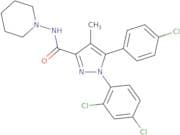
CAS 168273-06-1
:Rimonabant
Beschreibung:
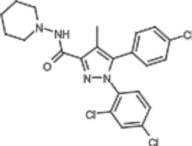
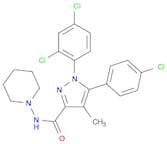
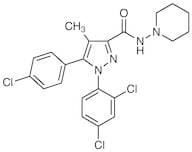
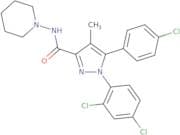
Rimonabant, mit der CAS-Nummer 168273-06-1, ist ein selektiver Antagonist der Cannabinoid-Rezeptoren, der hauptsächlich für seine Rolle im Gewichtsmanagement und in der Behandlung von Fettleibigkeit bekannt ist. Er wirkt, indem er die CB1-Rezeptoren im zentralen Nervensystem blockiert, die an der Regulierung des Appetits und dem Energiehaushalt beteiligt sind. Diese Verbindung ist durch ihre chemische Formel C22H21Cl3N2O gekennzeichnet und weist eine komplexe Struktur auf, die einen tricyclischen Kern umfasst. Rimonabant wurde ursprünglich als Anti-Adipositas-Medikament vermarktet, wurde jedoch aufgrund von Bedenken hinsichtlich psychiatrischer Nebenwirkungen, einschließlich Depressionen und Angstzuständen, vom Markt genommen. Sein pharmakologisches Profil deutet auch auf potenzielle Anwendungen bei Stoffwechselstörungen hin, aber die unerwünschten Wirkungen haben seine Verwendung eingeschränkt. Rimonabant wird typischerweise oral verabreicht und hat eine relativ lange Halbwertszeit, die eine einmal tägliche Dosierung ermöglicht. Trotz seines Rückzugs wird weiterhin Forschung zu seinen Mechanismen und potenziellen therapeutischen Anwendungen betrieben, insbesondere um die Rolle des Endocannabinoid-Systems in verschiedenen physiologischen Prozessen zu verstehen.
Formel:C22H21Cl3N4O
InChl:InChI=1S/C22H21Cl3N4O/c1-14-20(22(30)27-28-11-3-2-4-12-28)26-29(19-10-9-17(24)13-18(19)25)21(14)15-5-7-16(23)8-6-15/h5-10,13H,2-4,11-12H2,1H3,(H,27,30)
InChI Key:InChIKey=JZCPYUJPEARBJL-UHFFFAOYSA-N
SMILES:CC1=C(N(N=C1C(NN2CCCCC2)=O)C3=C(Cl)C=C(Cl)C=C3)C4=CC=C(Cl)C=C4
Synonyme:- 1-(2,4-Dichlorophenyl)-5-(4-chlorophenyl)-4-methyl-N-(piperidin-1-yl)-1H-pyrazole-3-carboxamide
- 1H-Pyrazole-3-carboxamide, 5-(4-chlorophenyl)-1-(2,4-dichlorophenyl)-4-methyl-N-1-piperidinyl-
- 5-(4-Chlorophenyl)-1-(2,4-dichlorophenyl)-4-methyl-1H-pyrazole-3-carboxylic acid N-(piperidin-1-yl)amide
- 5-(4-Chlorophenyl)-1-(2,4-dichlorophenyl)-4-methyl-N-1-piperidinyl-1H-pyrazole-3-carboxamide
- 5-(4-Chlorophenyl)-1-(2,4-dichlorophenyl)-4-methyl-N-piperidinopyrazole-3-carboxamide
- 5-(4-chlorophenyl)-1-(2,4-dichlorophenyl)-4-methyl-N-(piperidin-1-yl)-1H-pyrazole-3-carboxamide
- 5-(4-chlorophenyl)-1-(2,4-dichlorophenyl)-4-methyl-N-(piperidin-1-yl)-1H-pyrazole-3-carboxamide hydrochloride (1:1)
- A 281
- Acomplia
- Enp 9
- N-Piperidino-5-(4-chlorophenyl)-1-(2,4-dichlorophenyl)-4-methylpyrazole-3-carboxamide
- Rimonabant(Acomplia,Sr141716)
- Sr 141617
- Sr 141716
- Zimulti
- Weitere Synonyme anzeigen
Sortieren nach
Reinheit (%)
0
100
|
0
|
50
|
90
|
95
|
100
6 Produkte.
Rimonabant
CAS:Rimonabant (SR141716) is an inverse agonist for the cannabinoid receptor CB1.Formel:C22H21Cl3N4OReinheit:98% - 99.91%Farbe und Form:White Or Almost White Crystalline PowderMolekulargewicht:463.795-(4-Chlorophenyl)-1-(2,4-dichlorophenyl)-4-methyl-N-piperidinopyrazole-3-carboxamide
CAS:Formel:C22H21Cl3N4OReinheit:98%Farbe und Form:SolidMolekulargewicht:463.7873Rimonabant base
CAS:Formel:C22H21Cl3N4OReinheit:≥ 98%Farbe und Form:White to off-white powder or crystalsMolekulargewicht:463.79Rimonabant
CAS:Formel:C22H21Cl3N4OReinheit:>98.0%(HPLC)Farbe und Form:White to Almost white powder to crystalMolekulargewicht:463.79Rimonabant
CAS:Kontrolliertes ProduktCannabinoid receptor 1 (CB1) antagonist. Lowers consumption of food, via central and peripheral mechanisms. Reduces triglyceride and low-density lipoprotein levels (LDLs). Reduces nicotine dependence, potentially by modulating dopaminergic signalling. Serious adverse effects associated with Rimonabant include psychiatric disorders such as anxiety and depression.
Formel:C22H21Cl3N4OFarbe und Form:PowderMolekulargewicht:463.79 g/molRimonabant - Bio-X ™
CAS:Kontrolliertes ProduktRimonabant is cannabinoid receptor type 1 (CB1) inverse agonist drug. Rimonabant is used to treat obesity by reducing appetite and calorie intake. It lowers the consumption of food, via central and peripheral mechanisms. It also reduces triglyceride and low-density lipoprotein levels (LDLs). This drug has shown to reduce nicotine dependence, potentially by modulating dopaminergic signalling. >Formel:C22H21Cl3N4OReinheit:Min. 99.0%Farbe und Form:PowderMolekulargewicht:463.79 g/mol