CAS 1692-25-7
:Pyridin-3-borsäure
Beschreibung:
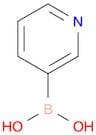
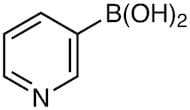
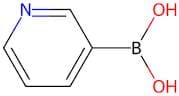
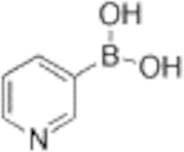
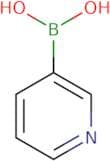
Pyridin-3-borsäure, mit der CAS-Nummer 1692-25-7, ist eine Organoborverbindung, die durch das Vorhandensein einer boronsäurefunktionellen Gruppe gekennzeichnet ist, die an einem Pyridinring in der Position 3 angebracht ist. Diese Verbindung erscheint typischerweise als weißer bis off-white fester Stoff und ist in polaren Lösungsmitteln wie Wasser und Alkoholen löslich, was auf die Anwesenheit der boronsäuregruppe zurückzuführen ist. Pyridin-3-borsäure ist bekannt für seine Nützlichkeit in der organischen Synthese, insbesondere in Suzuki-Miyaura-Kreuzkupplungsreaktionen, wo es als vielseitiger Baustein für die Bildung von Kohlenstoff-Kohlenstoff-Bindungen dient. Die boronsäuregruppe kann auch an verschiedenen Reaktionen teilnehmen, einschließlich der Bildung von Boronatestern und der Koordination mit Diolen, was sie in der medizinischen Chemie und Materialwissenschaft wertvoll macht. Darüber hinaus hat ihre Fähigkeit, Komplexe mit Biomolekülen zu bilden, Auswirkungen auf biologische Anwendungen. Insgesamt ist Pyridin-3-borsäure eine bedeutende Verbindung sowohl in der synthetischen als auch in der angewandten Chemie aufgrund ihrer Reaktivität und funktionalen Vielseitigkeit.
Formel:C5H6BNO2
InChl:InChI=1/C5H6BNO2/c8-6(9)5-2-1-3-7-4-5/h1-4,8-9H
InChI Key:InChIKey=ABMYEXAYWZJVOV-UHFFFAOYSA-N
SMILES:B(O)(O)C=1C=CC=NC1
Synonyme:- (3-Pyridinyl)boronic acid
- (Pyridin-3-Yl)Boronic Acid
- 3-Pyridineboronic acid
- 3-Pyridinylboronic acid
- 3-Pyridylboronic acid
- B-3-Pyridinylboronic acid
- Boronic acid, 3-pyridinyl-
- Boronic acid, B-3-pyridinyl-
- Dihydroxy(3-pyridyl)borane
- Pyridin-3-Boronic Acid
- Pyridin-3-Ylboronic Acid
- Pyridin-3-Ylboronicacid
- Pyridine-3-boronic acidl
- Pyridine-3-boronicacid
- IFLAB-BB F1957-0039
- 3-Pridylboronic acid
- 3-PYRIDINEBORNIC ACID
- PYRIDINE-3-BORONIC ACID
- PYRIDYL-3-BORONIC ACID
- AKOS BRN-0272
- 3-Pyridylboronic Acid (contains varying amounts of Anhydride)
- 3-pyridineboric acid
- RARECHEM AH PB 0251
- Pyridine-3-boronic acid ,98%
- PYRIDIN-3-YL-3-BORONIC ACID
- Weitere Synonyme anzeigen
Sortieren nach
Reinheit (%)
0
100
|
0
|
50
|
90
|
95
|
100
9 Produkte.
Boronic acid, B-3-pyridinyl-
CAS:Formel:C5H6BNO2Reinheit:95%Farbe und Form:SolidMolekulargewicht:122.91763-Pyridylboronic Acid (contains varying amounts of Anhydride)
CAS:Formel:C5H6BNO2Reinheit:97.0 to 117.0 %Farbe und Form:White to Light yellow powder to crystalMolekulargewicht:122.92Pyridine-3-boronic acid
CAS:Pyridine-3-boronic acidFormel:C5H6BNO2Reinheit:95%Farbe und Form: white powderMolekulargewicht:122.92g/molPyridine-3-boronic acid
CAS:Formel:C5H6BNO2Reinheit:95%Farbe und Form:CrystallineMolekulargewicht:122.923-Pyridineboronic Acid
CAS:Kontrolliertes ProduktApplications Boronic acid derivatives and their binding affinities with diols.
References Yang, W., et al.: Bioorg. Med. Chem. Lett., 12, 2175 (2002), Yang, W., et al.: Med. Res. Rev., 23, 346 (2003),Formel:C5H6BNO2Farbe und Form:NeatMolekulargewicht:122.923-Pyridineboronic Acid extrapure, 98%
CAS:Formel:C5H6BNO2Reinheit:min. 98.0%Farbe und Form:White to off-white, Powder, ClearMolekulargewicht:122.923-Pyridineboronic acid
CAS:3-Pyridineboronic acid is an antimicrobial agent that is used to treat bacterial and fungal infections. 3-Pyridineboronic acid is a prodrug that is metabolized to its active form, pyridinium boronate. This drug has been shown to be effective in the treatment of hypoxic tumors in mice, which are resistant to other anticancer drugs. 3-Pyridineboronic acid also has acidic properties and can be used as an antiseptic for the treatment of skin and eye infections. It can also be used as a hydrogen bonding partner when combined with halides, such as chloride or bromide ions. The drug binds to human serum proteins and forms an acidic complex that prevents bacterial growth by inhibiting protein synthesis. 3-Pyridineboronic acid also inhibits prostate cancer cells by competitively inhibiting the enzyme 4-pyridinylboronic acid reductase (4PBAR).Formel:C5H6BNO2Reinheit:Min. 95%Molekulargewicht:122.92 g/mol