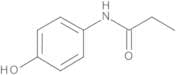
CAS 1693-37-4
:parapropamol
Beschreibung:
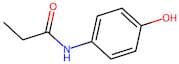
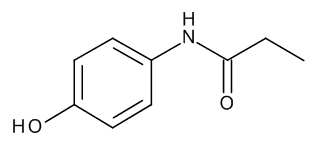
parapropamol, auch bekannt als 1-(3-Hydroxypropyl)-2-methyl-2-phenylpropan-1-on, ist eine chemische Verbindung, die hauptsächlich für ihre schmerzlindernden und fiebersenkenden Eigenschaften anerkannt ist. Sie wird als nicht-opioides Analgetikum klassifiziert und wird häufig zur Behandlung von leichten bis mäßigen Schmerzen und Fieber eingesetzt. Die Substanz zeigt eine moderate Löslichkeit in Wasser und ist in organischen Lösungsmitteln besser löslich, was für viele organische Verbindungen typisch ist. parapropamol wirkt, indem es die Synthese von Prostaglandinen im zentralen Nervensystem hemmt und somit die Schmerzempfindung reduziert. Ihre Pharmakokinetik umfasst die orale Absorption, wobei der Stoffwechsel hauptsächlich in der Leber erfolgt. Obwohl sie im Allgemeinen als sicher gilt, wenn sie wie vorgeschrieben verwendet wird, kann sie Nebenwirkungen haben, einschließlich gastrointestinaler Störungen und allergischer Reaktionen bei einigen Personen. Aufgrund ihrer chemischen Struktur kann parapropamol auch mit anderen Medikamenten interagieren, was Vorsicht in Situationen der Polypharmazie erfordert. Insgesamt ist es wichtig, parapropamol unter medizinischer Aufsicht zu verwenden, um Sicherheit und Wirksamkeit zu gewährleisten.
Formel:C9H11NO2
InChl:InChI=1S/C9H11NO2/c1-2-9(12)10-7-3-5-8(11)6-4-7/h3-6,11H,2H2,1H3,(H,10,12)
InChI Key:InChIKey=SSMYTAQHMUHRSK-UHFFFAOYSA-N
SMILES:N(C(CC)=O)C1=CC=C(O)C=C1
Synonyme:- 4'-Hydroxypropionanilid
- 4-(Propionylamino)phenol
- 4-Propionamidophenol
- 4′-Hydroxypropionanilide
- N-(4-Hydroxyphenyl)propionamide
- N-(4-hydroxyphenyl)propanamide
- N-(p-Hydroxyphenyl)propionamide
- Parapropamol [INN:DCF]
- Parapropamolo
- Parapropamolo [DCIT]
- Parapropamolum
- Parapropamolum [INN-Latin]
- Parapropanol
- Propanamide, N-(4-hydroxyphenyl)-
- Propionanilide, 4′-hydroxy-
- Solvodol
- Unii-I729P6N0P7
- p-Hydroxypropionanilide
- p-Propionamidophenol
- Parapropamol
- Weitere Synonyme anzeigen
Sortieren nach
Reinheit (%)
0
100
|
0
|
50
|
90
|
95
|
100
11 Produkte.
Acetaminophen Related Compound B (N-(4-hydroxyphenyl)propanamide)
CAS:Aromatic cyclic amides (including cyclic carbamates) and their derivatives; salts thereofFormel:C9H11NO2Farbe und Form:White Brown PowderMolekulargewicht:165.07898N-(4-Hydroxyphenyl);propionamide
CAS:Formel:C9H11NO2Reinheit:98%Farbe und Form:SolidMolekulargewicht:165.1891Paracetamol (Acetaminophen) EP Impurity B (Acetaminophen USP Related Compound B)
CAS:Formel:C9H11NO2Farbe und Form:White To Off-White SolidMolekulargewicht:165.19N-(4-Hydroxyphenyl)propanamide (N-Propionyl-4-aminophenol)
CAS:Formel:C9H11NO2Farbe und Form:NeatMolekulargewicht:165.194-Propionamidophenol
CAS:4-Propionamidophenol is a kind of analog of p-acetamidophenol.Formel:C9H11NO2Reinheit:99.64%Farbe und Form:Pale Purple SolidMolekulargewicht:165.194-Propionamidophenol (Acetaminophen Impurity B)
CAS:Impurity Paracetamol EP Impurity B, Acetaminophen Related Compound B (USP)
Applications 4-Propionamidophenol (Acetaminophen Impurity B) is an impurity of Acetaminophen (A161220) (1). Acetaminophen is an analgesic and antipyretic agent and used as a pain reliever to treat headache, muscle aches, and arthritis (2,3).
References (1) Hajduk, P., et al.: Science, 278, 497 (2) McGill, M. R. and Jaeschke, H. Pharm Res. 30, 2174 (2013)(3) Fairbrother, J.E., et al.: Anal. Profiles Drug Subs., 3, 1 (1974)Formel:C9H11NO2Farbe und Form:WhiteMolekulargewicht:165.19N-(4-Hydroxyphenyl)propanamide
CAS:The N-(4-hydroxyphenyl)propionamide (HPPA) is a synthetic drug that binds to the human liver. It has been shown to be effective in preventing implantation of fertilized eggs, and can be used as a diagnostic agent for determining the presence of HPPA in human liver tissue. HPPA is also used as a diluent for other drugs. The HPPA binds to chromatographic components and can be detected using electrochemical detection, which allows it to be used as a targetable probe for cancer research. HPPA is also used to study iontophoretic transport of ions across reconstituted membranes in vitro.Formel:C9H11NO2Reinheit:(%) Min. 97%Molekulargewicht:165.19 g/mol