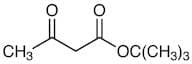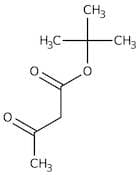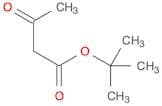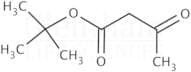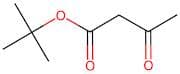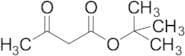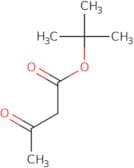
CAS 1694-31-1
:tert-Butylacetoacetat
- 1,1-Dimethylethyl 3-oxobutanoate
- 1,1-Dimethylethyl acetoacetate
- 3-Oxobutanoate de 1,1-dimethylethyle
- 3-Oxobutanoic acid 1,1-dimethylethyl ester
- 3-Oxobutyric acid tert-butyl ester
- Acetessigsaure-tert-butylester
- Acetoacetate, Tert-Butyl
- Acetoacetic acid tert-butyl ester
- Acide butanoique, oxo-3-, ester de dimethylethyle-1,1
- Butanoic acid, 3-oxo-, 1,1-dimethylester
- Butansaure, 3-oxo-, 1,1-dimethylethylester
- Lonza TBAA
- Nsc 42869
- Tert-Butyl Acetoacetate
- t-Butyl acetoacetate
- tert-Butyl 3-oxobutanoate
- tert-Butyl 3-oxobutyrate
- tert-Butyl acetylacetate
- tert-Butyl acetylacetonate
- Weitere Synonyme anzeigen
tert-Butyl Acetoacetate
CAS:Formel:C8H14O3Reinheit:>95.0%(GC)Farbe und Form:Colorless to Almost colorless clear liquidMolekulargewicht:158.20tert-Butyl acetoacetate, 97%
CAS:tert-Butyl acetoacetate is used as intermediate for the syntheses of different organic chemicals. Raw material in pharmaceutical Industry, In agrochemical industry. Reagent for Acyloin synthesis and ?, - unsaturated ketones synthesis. This Thermo Scientific Chemicals brand product was originally parFormel:C8H14O3Reinheit:97%Farbe und Form:Clear colorless to yellow, LiquidMolekulargewicht:158.20tert-Butyl 3-oxobutanoate
CAS:Formel:C8H14O3Reinheit:95%Farbe und Form:LiquidMolekulargewicht:158.197tert-Butyl Oxobutyrate
CAS:Kontrolliertes ProduktApplications tert-Butyl Oxobutyrate is a chemical reagent used in the preparation of a potent Bcl-2/Bcl-xL inhibitor used in tumor inhibition. Also used in the synthesis of potent small molecule-peptide conjugates in HIV-1 inhibition.
References Aguilar, A. et al.: J. Med. CHem., 56, 3048 (2013); Wang, C. et al.: J. Med. Chem., 56, 2527Formel:C8H14O3Farbe und Form:NeatMolekulargewicht:158.19tert-Butyl acetoacetate
CAS:tert-Butyl acetoacetate is an organic molecule that contains nitrogen atoms. The structure of tert-butyl acetoacetate can be described as a planar molecule with two hydrogen atoms and two carbon atoms. One of the hydrogen atoms is bonded to the carbon atom in the middle, and the other hydrogen atom is bonded to one of the carbons on the outside. The compound has a coordination geometry with a sodium ion in its center, and it can also exist as an anion or as a cation. Tert-butyl acetoacetate was synthesized by reacting sodium carbonate with tert-butyl alcohol. This reaction is exothermic and produces tert-butyl acetoacetate along with water and sodium hydroxide. In addition, tert-butyl acetoacetate is toxicologically studied, which has shown that it does not have any carcinogenic effects or adverse effects on reproduction in rats at doses up to 2000 mg/kg/day
Formel:C8H14O3Reinheit:Min. 95%Molekulargewicht:158.19 g/mol